

If you see a snapper on land, it’s likely a mom on a ‘dangerous journey’; experts discuss formidable turtles, including the ‘celebrity’ in Potter Lake
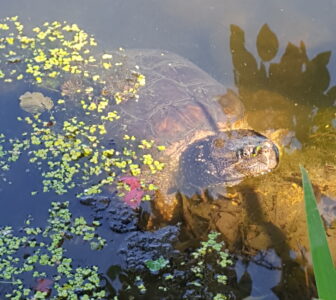
photo by: Dan Coleman
A common snapping turtle that some have dubbed "Mossynoggin" is something of a wildlife celebrity at Potter Lake on the University of Kansas campus. This photo was taken two summers ago, in June 2020.
Swallows dart to and fro after a recent afternoon rain at Potter Lake, and a squirrel tiptoes along a dripping branch, but a rustling among the water lilies reveals something less serene approaching shore, and its cold eye and craggy beak soon break the surface like a shark fin.
Is there a prehistoric creature living in Potter Lake? The short answer is yes. The long answer may have you thinking differently about a much maligned local critter: the common snapping turtle, known in scientific circles as Chelydra serpentina.
“They are formidable,” says Travis Taggart, director of the Center for North American Herpetology, and co-author with Joseph Collins of “Amphibians, Reptiles and Turtles in Kansas,” noting that the largest official specimen in state history weighed in at 45 pounds, with a shell 16 inches long. “If you spend much time in the water, you’ve probably been next to them hundreds of times without incident. Especially in the eastern half of the state, almost every semipermanent body of water has one in it.”
The large snapper living in Potter Lake, which some admirers have nicknamed “Mossynoggin” after the hairpiece of green algae adorning its head, is estimated to be in the 10- to 12-inch range, marking it as an adult who is probably queen or king of the pond, since a snapper of that size would have no natural predators, Taggart says.
Its offspring may have a harder time, however. Rich Glor, a professor of ecology and evolutionary biology, and reptile curator at the Biodiversity Institute at the University of Kansas, says 70% to 80% of snapping turtle hatchlings — a delicacy for hungry herons, snakes, fish or small mammals like skunks and raccoons — die soon after they are born. If they survive “childhood,” they can live for 30 or 40 years in the wild.
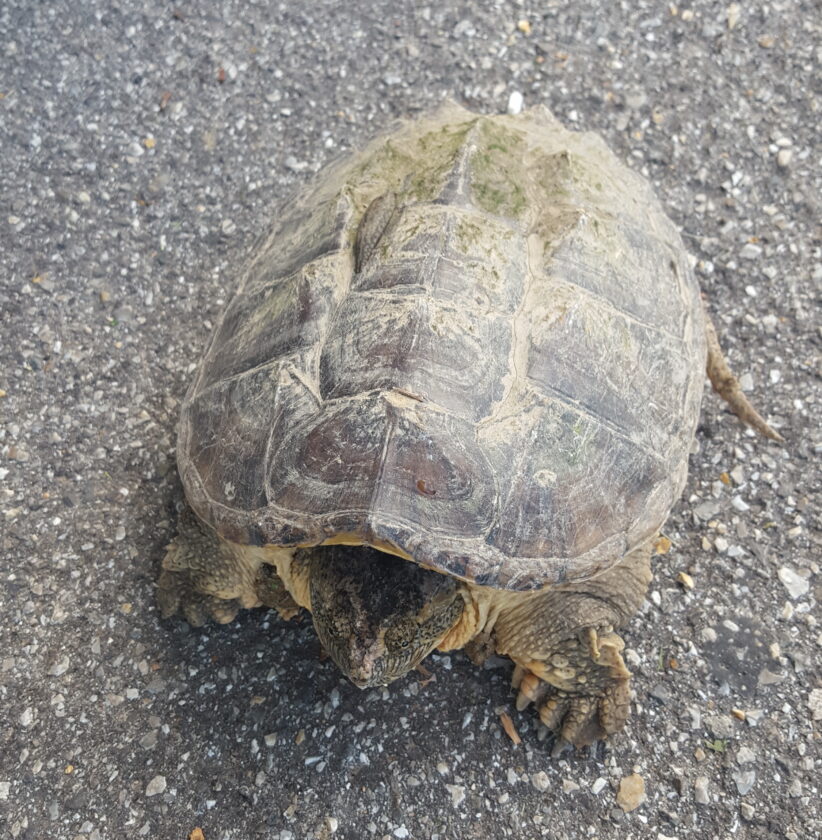
photo by: Dan Coleman
A common snapping turtle makes its way across a road near the Kansas River.
“Early summer is prime egg-laying time,” says Glor, explaining that most of the snappers people encounter on land this time of year are females looking for a place to lay their eggs. Once they find a suitably dry upland location, they dig a hole and lay a clutch of around 30 eggs, which will hatch in August, September or October, depending on temperatures, which will also determine the sex of the babies. Females develop at both the cool and warm ends of the range, males in the middle.
Snapping turtles can be aggressive on land, but Glor attributes this behavior to their vulnerability during a dangerous journey. “These animals spend most of their lives underwater. If you look at the underside of a snapping turtle, it’s pathetic. It’s not like a box turtle’s, which covers everything so it can pull its arms and legs completely in. A snapping turtle’s hardly covers half. So when they see a large mammal like a human approaching, they go right into defensive mode and start snapping. In the water, they usually just swim away.”
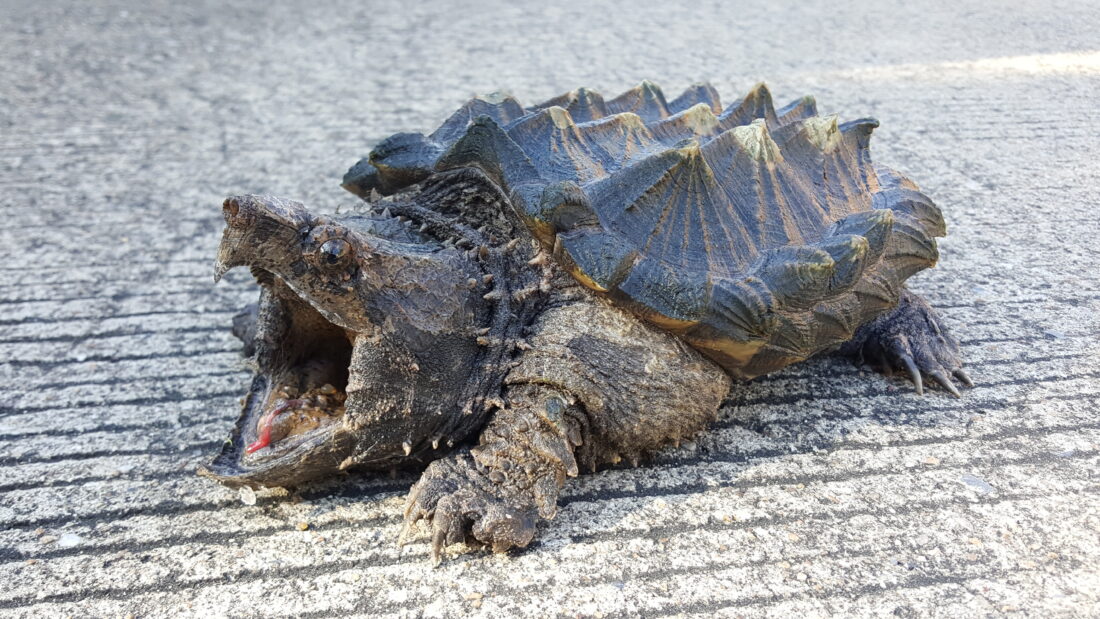
photo by: Shutterstock
An alligator snapping turtle — the larger, fiercer cousin of the common snapping turtle.
Accounts exist of people losing fingers to the species’ larger cousin, the alligator snapping turtle (Macrochelys temminckii), but these are extremely rare in Kansas, and Glor has never known anyone who was injured by a common snapping turtle. They do, however, pose an obvious threat to small fish and other aquatic animals swimming near — or right into — their open mouths.
So are they holdouts from the dinosaur age?
“Until recently, because turtles are so different from everything else, their bodies are so weird, we really didn’t have a good idea where they fit in the tree of life,” Glor says. “Now we know they are closer to crocodiles and birds than they are to lizards and snakes. And we have a well-documented fossil record linking today’s birds to feathered dinosaurs.”
As to the “danger” of a living fossil like Mossynoggin reigning over Potter Lake, Taggart is philosophical. “We got rid of the bears, and most of the mountain lions. Snapping turtles are one of the few things left that make going out into the wild still feel wild.”
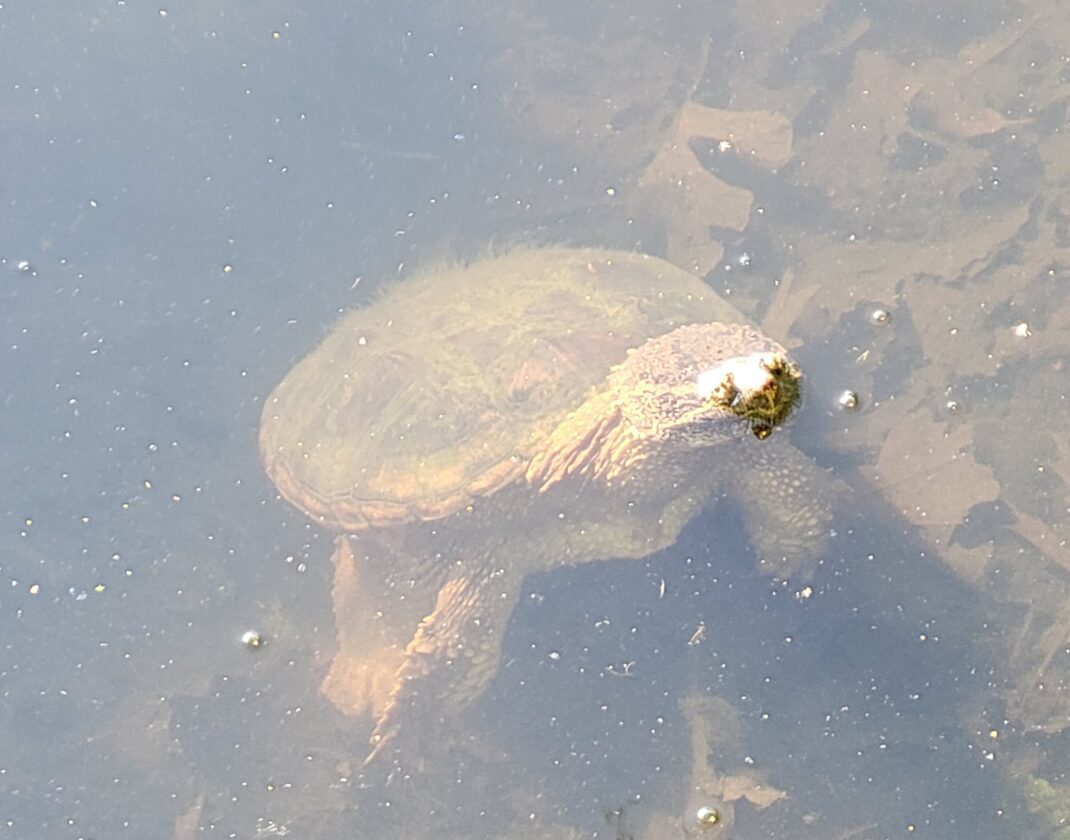
photo by: Dan Coleman
“Mossynoggin” is pictured at KU’s Potter Lake in June 2022.
Other News

Nine Lawrence-area high school seniors named semifinalists in national scholarship program

Manufacturer opens new production facility, adds 30 jobs in Lawrence industrial park

Douglas County commissioners to hear plan for updating zoning, subdivision codes in rural areas
Lawrence school board members approve budget for 2026-2027

Supreme Court stops Trump’s effort to restrict mail ballots ahead of midterm elections
