Tick-borne illness season is ramping up in Kansas; KU researchers hope project could help people identify the pests
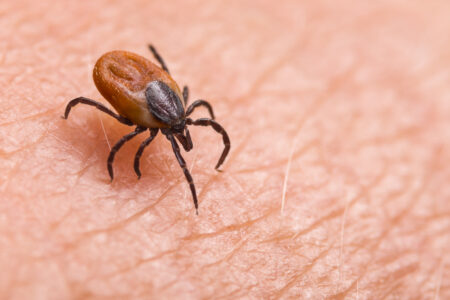
photo by: Shutterstock
Tick-borne illnesses can cause severe complications that can result in hospitalization.
The risk of tick-borne illness should be on the public’s radar as the weather continues to warm, a physician with LMH Health told the Journal-World Friday.
Infectious disease physician Dr. Christopher C. Penn said Douglas County is actually already in its typical tick season.
“It feels like a surprise every year, but generally in early spring, I have to step back and remember that we are entering tick season,” Penn told the Journal-World Friday.
Penn said that many people may not even be aware they’ve been bitten by a tick; one could have been carried inside a family’s home by an outdoor pet, for example. But tick-borne illnesses can cause severe complications and can even send patients to the hospital. Penn said some of the most common tick-borne illnesses seen in the Lawrence area are Rocky Mountain spotted fever, ehrlichiosis and tularemia, all of which are bacterial infections.
If you don’t know you’ve been bitten, Penn said, it could be difficult to spot these illnesses, because the symptoms can be innocuous at first.
“A fair number of people do not remember a tick bite,” Penn said. “… When people come in, generally it’s very nonspecific symptoms; they just don’t feel well. They’re fatigued, they usually have a fever, they may have a headache. These are nonspecific, flu-like symptoms, really.”
Rocky Mountain spotted fever is a bit easier to spot given that it also causes a rash that appears in conspicuous locations like the palms, Penn said. But by and large, diseases like the ones Penn mentioned can be indistinguishable outside of symptoms like a rash.
Testing is also “far from perfect,” Penn said. None of the tests LMH Health offers for these illnesses is currently processed on-site, he said, but he’s optimistic that the hospital may soon have the capacity for bringing that in-house. For now, tests are sent out to reference labs and filter back in. Tests may also appear as false negatives if they’re administered too early, which Penn said is another challenge. That means antibiotic treatment usually starts before test results return to LMH Health.
“When things are not adding up, meaning we don’t have a clear cause for those kind of nonspecific symptoms, I would say the rule is generally that we’re going to go ahead and cover people with doxycycline (an antibiotic used to treat infections),” Penn said. “We want to take care of what’s in front of us, get them better.”
For those who have concerns about possible early tick-borne disease symptoms, Penn said he’d recommend starting with a visit to a primary care physician, rather than the emergency room, unless they’re exhibiting something like an exceedingly high fever.
As for preventing tick bites in the first place, Penn said there are a number of strategies. Tick checks, for one, are important in catching the parasites before they can bite you in the first place, and he said recognizing that there are different sizes of ticks can be important on that front. Larger ticks, which he called “dog ticks,” tend to be tracked inside by animals, but tiny, harder-to-spot variants like the lone star tick are also common in this part of Kansas.
Other prevention strategies could include bathing right after spending time in an area where tracking in a tick on one’s clothing might be more likely; using a spray repellent; or drying clothing on high heat to kill any remaining ticks that are still hanging around.
• • •
When it comes to prevention efforts, University of Kansas researchers are involved in an ongoing study on tick-borne illness that might provide more tools for recognizing harmful ticks in the wild.
A. Townsend Peterson, a KU distinguished professor of ecology and evolutionary biology, is leading a team including fellow ecology and evolutionary biology professor Folashade Agusto and about seven or eight KU graduate students. It’s not just a KU project, though; it’s a collaboration with researchers at other institutions, including Oklahoma State professor Susan Little, remote sensing specialist and University of Oklahoma professor Xiangming Xiao, and tick-borne disease researchers at Pittsburg State University and the University of Central Oklahoma.
The four-year project is funded by a grant through the National Science Foundation’s EPSCoR program, which is designed to boost scientific research funding in states that traditionally haven’t had as much support on that front. The team has been collecting ticks from 13 sites across Kansas and Oklahoma. For the past two years, Townsend Peterson said four or five of those sites have been sampled every two weeks, and the rest have been visited four times per year.
All those ticks are sent to Oklahoma State for identification, where they’re also tested for bacterial pathogens. The University of Oklahoma has simultaneously been developing detailed mapping products across both states, and Townsend Peterson said his lab has been contributing by mapping when and where ticks have been appearing.
“We’re turning the when and where we find a tick into maps across the two states,” Townsend Peterson said. “So essentially, you’re taking into account the geography … the soil, the vegetation and the weather conditions, and you build up models that can predict when and where each tick species is likely to be present across Kansas and Oklahoma.”
Researchers are also working to develop automated routines for identifying ticks, Townsend Peterson said. The hope is that those routines, which are being executed by artificial intelligence, will improve in efficacy as they’re trained by tick identification professionals. So far, Townsend Peterson said that identification is most successful with higher-quality images, and they’re next hoping to increase the efficacy of pictures taken on cell phones.
Townsend Peterson said generally when people think of tick-borne diseases across the country, the focus is often on Lyme disease, a bacterial infection that causes a rash in an often bullseye-like pattern and flu-like symptoms. But the idea that Lyme disease is the only tick-borne disease isn’t accurate, he said, nor is the common perception that tick-borne disease is more commonly spread in areas like New England and the northern part of the Midwest.
In fact, the whole U.S. sees some level of tick-borne disease incidence, Townsend Peterson said. Kansas has what he described as a “rich fauna” of tick species which host various microbes, some of which are pathogens that can get people sick.
“We’re kind of the Wild West out here, where we have this incredible diversity of ticks and pathogens and we’re fairly understudied,” Townsend Peterson said. “K-State has done some work over the years, Oklahoma State has a very active lab, but as far as really understanding the risk of these different pathogens, there’s not enough information.”
Though the grant funding for the project will end about a year from now, Townsend Peterson said that doesn’t mean the work will be done. The research team is already considering what might come next.
“What we’ll have is very detailed knowledge of where and when each species of tick occurs in the central Great Plains, and where and when each species of pathogen occurs in the central Great Plains,” Townsend Peterson said. “We’ll be able to turn those into risk maps, and we’ll potentially have this automated identification so the general public can make use of this knowledge that we’re gaining.”
Townsend Peterson said the AI tick identification system is one example. The team is hoping to have a proof of concept developed for that particular idea by the end of the project. He said the hope is that down the line, identifying a tick on one’s arm will be simple as taking a picture of it with an app and within minutes getting information about what type of tick it is and what pathogens it might carry.
Other next steps, Townsend Peterson said, could end up including population modeling — in the same vein as during the COVID-19 pandemic, but for ticks and the pathogens that they carry. Linked into that could be possible mediation measures, like what might happen to tick populations if their habitat is subjected to periodic burns or sprayed with chemicals. He said another follow-up proposal could be studying all the ticks they’ve collected to further examine lesser-known viruses.
“Obviously, when you have a big grant for a project like this tick work, there’s a lot of activity,” Townsend Peterson said. “But it’s not like in August of 2023 (you say) ‘OK, done with ticks; now let’s go on to something else.’ It doesn’t work that way. You really need to follow up on things you’ve learned in the first few years.”
Other News

RJ Mitte, ‘Breaking Bad’ actor and disability rights champion, dies at 34

Clinton State Park and other state parks will increase overnight camping, vehicle permit fees starting next month
‘No day is like the other here’: Students from Lawrence’s German sister city discover football, new foods and new friends on exchange

GCSAA celebrates 100 years with new plaza and statue honoring its founder and first president

Go, See, Do: Library book sale, candidate forum and more