Douglas County leaders end COVID-19 disaster declaration, praise county’s emergency management team
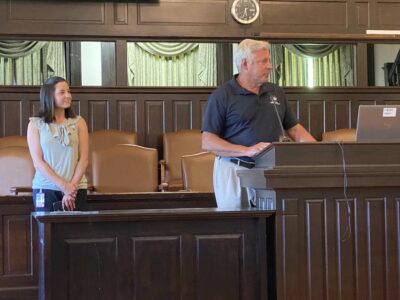
photo by: Austin Hornbostel/Journal-World
Douglas County Emergency Management Director Robert Bieniecki and Deputy Director Jillian Rodrigue were on hand at Wednesday's Douglas County Commission meeting to thank commissioners for their support as the county's COVID-19 disaster declaration was terminated after more than two years.
Douglas County leaders approved a recommendation to end the county’s COVID-19 disaster declaration, which had been in effect since March 17, 2020, at their meeting Wednesday night.
That approval comes about a week after the county’s Unified Command team, which was formed to respond to the pandemic, elected to demobilize.
County Emergency Management Director Robert Bieniecki and Deputy Director Jillian Rodrigue were on hand to thank the commission for their support. Commissioners, for their part, praised Bieniecki, Rodrigue and the rest of the Unified Command team who helped guide the county’s response to the pandemic.
“It’s quite a feat that our community stood up and responded to, and I’m really proud of all of it — I would say mostly how well we rolled with the punches, quite literally,” Commissioner Shannon Reid said. “Every time we thought we were headed in one direction and things changed course and we realized that we weren’t in control, Unified Command was really wonderful at steering the ship and helping us recalculate and keep mitigating in the ways that we needed to.”
Reid joined the meeting via Zoom and said that she was currently in quarantine. She had missed the previous week’s meeting.
In other business, the commission:
• Heard presentations about the county’s truancy process and programs, the Housing Stabilization Collaborative and the Lawrence-Douglas County Housing Authority’s engagement with local landlords to support community housing needs.
• Voted to repeal and replace a chapter of construction codes for unincorporated areas of the county, which will be updated to align with the 2018 International Code Council series of construction codes effective Jan. 1, 2023.
The changes will include a new permit fee methodology for assigning valuations for new residential, commercial and accessory building construction, and the adoption of appendices allowing light straw-clay construction, straw-bale construction and tiny-house construction.
County Administrator Sarah Plinsky told commissioners the door could be left open for possible amendments to catch any mistakes or to make additions prior to when the new codes take effect at the beginning of next year. The process of putting together the new codes has been “rushed,” Plinsky said, because the county’s director of building and codes, Tina Rakes, is retiring soon.
Commissioners said they didn’t think they would need further changes in the next six months that would be substantial enough to cause issues. Reid said that “this is not an ideal process, which I think has been acknowledged.”
“I feel comfortable because it does not sound, as we just covered again, that there are likely to be substantial edits and changes,” she added.
Other News

RJ Mitte, ‘Breaking Bad’ actor and disability rights champion, dies at 34
Clinton State Park and other state parks will increase overnight camping, vehicle permit fees starting next month
‘No day is like the other here’: Students from Lawrence’s German sister city discover football, new foods and new friends on exchange

GCSAA celebrates 100 years with new plaza and statue honoring its founder and first president

Go, See, Do: Library book sale, candidate forum and more