
Holcom housing development, church’s 6-plex, New Hampshire Street Lofts II recommended for affordable housing funds
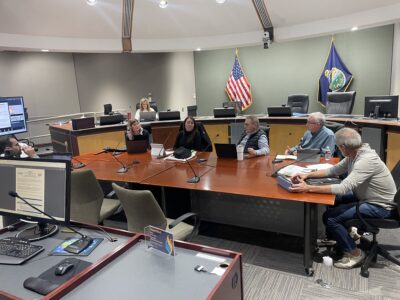
photo by: Sylas May/Journal-World
The Affordable Housing Advisory Board meets on Thursday, Nov. 12, 2026, at City Hall.
When deciding which projects should get the city’s affordable housing funds in 2027, Mark Buhler has a simple philosophy: “I want the most winners I can get.”
And he told his fellow Affordable Housing Advisory Board members on Thursday that he had a few winners in mind.
“I want Ninth Street to win” – Ninth Street Missionary Baptist Church, which wants to replace its aging, affordable four-plex with six new units. “And I want the SENT project to win” – SENT and Tenants to Homeowners’ Holcom Homes, an affordable homeownership community near Holcom Park. “And I want [New Hampshire Street] Lofts to win” – New Hampshire Lofts II, the Low-Income Housing Tax Credits apartments from Tony Krsnich’s Flint Hills Holdings group.
Those were the three new housing development projects that AHAB ultimately chose to recommend for funding on Thursday night, and Buhler said he liked them because they had the best chance of making real progress with the trust fund’s help.
As the Journal-World has reported, there’s less funding than usual to be allocated this time, because of changes to how the grant cycle works. Historically, the money generated by the city’s affordable housing sales tax has been allocated on a once-a-year grant cycle, and for 2026 the Affordable Housing Trust Fund had $1.2 million available to distribute. But in 2027, the city’s new affordable housing incentive policy will create a rolling application process in addition to the yearly cycle. The rolling process will go on throughout the year and will just be for new development and comprehensive housing rehabilitation projects.
To transition over to that system, AHAB decided that it would split its $1.2 million for 2027 into two pools. The rolling applications that come in throughout 2027 will draw on a $500,000 pool, and the other $700,000 of funding was what AHAB had to make recommendations about on Thursday night. AHAB’s members had each evaluated and ranked the projects on their own prior to Thursday’s meeting.
In addition to the three developments, AHAB recommended funding for four housing-related programs by nonprofit agencies. In a few weeks, the Lawrence City Commission will have the final say on what to fund. The recommendations passed 4-1, with board Chair Mariel Ferreiro dissenting.
Here’s a closer look at the board’s deliberations and the projects it identified as the top priorities.
Holcom Homes
This would be a development of 24 new homes – 12 single-family detached and 12 row houses – at 2500 W. 25th St. that would be sold to low-income buyers, and it was the project the board ranked the highest.
The board liked that it would give more renters a chance at homeownership. Ferreiro said it was important to help families own their homes and build wealth, “rather than making it an individual’s chore to be able to try to afford housing when we know that’s becoming more and more difficult.”
“That is my justification for scoring SENT and Tenants to Homeowners the highest,” she said.
And board member Matthew Pauly, who lives near the site, said he thought it would fit well there and fill a role that many other affordable housing projects would not.
“As a neighbor, I think it would be a great asset to the neighborhood,” Pauly said.
SENT and Tenants to Homeowners requested $350,000 from the trust, and the board recommended funding $275,000, or about 80% of their request.
Hope Project 2
This was the second-highest project in the board’s rankings, and it would replace an aging, affordable four-plex owned by Ninth Street Missionary Baptist Church with a six-plex that would add accessible units.
The board did have some questions about the development’s small size compared to other developments that applied. The net gain would be two units of affordable housing, while the other developments that sought funding would each add at least 21 affordable units.
“I still look at these projects that make a lot of beds and I’m like, ‘That is hard to pass up,'” board member Monte Soukup said.
Buhler noted that it would be demolishing existing housing, too. “They are not good units,” he said of the older units that Ninth Street wants to replace, but “they’re still beds. Someone’s putting their heads down at night safely.”
But he did still say it was a good project, and other board members said the unique qualities of the housing that would be created would outweigh the lower quantity. Ferreiro liked that these units would be “deeply affordable” – to people making less than 30% of area median income, not the 60% to 80% range – and that they’d be serving families with children.
“If you do not have something that is affordable that makes sense for the family, I’m not shoving a family into a studio apartment or a one-bedroom house,” she said. “Just because you can build 80 one-bedroom units does not mean it’s going to fit the community.”
Ninth Street Missionary Baptist Church had requested $305,000, and the board recommended funding about a third of that, $100,000.
New Hampshire Street Lofts II
This one, as the lowest-ranking development or program that the board decided to fund, caused some debate, in part because of what Krsnich’s group was asking for.
The New Hampshire Street Lofts II project would add 24 affordable apartments and eight market-rate apartments at 1041 New Hampshire St., the site where the Allen Press building formerly stood. And Krsnich, who specializes in projects that take advantage of Low-Income Housing Tax Credits (LIHTC) and/or historic preservation incentives, was asking for $400,000 in total: a $320,000 grant, and $80,000 for what’s called a “fee waiver.”
The waiver is part of the scoring rubric that the state uses to decide which projects will get LIHTC support, and Krsnich has requested such waivers before, including last year for his 9 Del Lofts II.
What makes the fee waiver different from the other kinds of awards the board was considering on Thursday is that it’s more of an all-or-nothing deal.
For a project the size of New Hampshire Street Lofts II, the LIHTC rubric has just two categories for fee waivers – either it’s an $80,000 waiver, which gives the development 10 points on the rubric, or it’s a $40,000 waiver, which gives it five points. There is no in between.
The board spent some time debating whether to shuffle some funding around to different projects, and some members suggested that New Hampshire Street Lofts II, as the lowest-ranking project that the board had decided to recommend, should be the one from which money was reallocated, even if that would cause it to lose some LIHTC points.
“We are not funding based on LIHTC projects,” Ferreiro said. “We are funding based on what is scored here, and allocating based on that.”
But others said that the New Hampshire Street Lofts II funding would have an outsized impact if it helped secure the much larger LIHTC incentive, and that taking a chunk of the funding wouldn’t make sense.
“There’s no reason to underfund that when there’s a threshold that helps that project,” Buhler argued.
The board ultimately voted to recommend the full $80,000 for the fee waiver. It didn’t recommend funding the $320,000 grant.
Programs
Four of the five programs being considered received funding – one that helps people experiencing homelessness secure permanent housing, and three that repair or modify buildings to help people stay in their homes.
The program that helps get people into housing is Lawrence-Douglas County Housing Authority’s New Horizons. It requested $75,000 and was recommended for the full amount.
The other three applications were for the Friends of the Senior Resource Center’s program that funds specialized home repair work for low-income seniors; Independence Inc.’s Accessible Housing Program, which helps seniors and people with disabilities make accessibility modifications to their homes; and Lawrence Habitat for Humanity’s Critical Home Repairs program, which helps homeowners complete necessary repairs to roofs, plumbing, HVAC and other important systems.
The Friends of the SRC were seeking $25,000, and Independence Inc. was seeking $75,000; the board decided to recommend both for full funding. Habitat requested $205,000, and the board recommended it receive $70,000 in funding.
Soukup said all three of those programs do similar things and collaborate with each other. “We’re talking about kind of the same benefit group, regardless of how we split it, to some extent,” he said.
What wasn’t recommended
The board chose to recommend no funding for four projects: the 711 New Hampshire Street senior apartments, a redevelopment of the East Heights school property by Krsnich’s group, the Locust Street Apartments development in North Lawrence, and Lawrence Tenants’ An Educator for Everyone program.
For 711 New Hampshire, which would be developed on what’s now a downtown parking lot, board members noted that it had already been awarded LIHTC from the state, and funding the fee waiver to help New Hampshire Street Lofts II get its LIHTC would make a bigger difference.
Pauly said the East Heights application wasn’t as developed or clear as he would have liked, and board member Barry McMurphy said that converting a building that old can be expensive “because you don’t know what you’re going to find” – there could quite possibly be hazards like asbestos or lead.
On the North Lawrence application, multiple board members were concerned about the project’s location close to the railroad tracks. “There’s no way that anywhere on the site is going to be anywhere close to acceptable noise levels,” McMurphy said.
And Pauly said he struggled with Lawrence Tenants’ application, because while he supported the organization’s mission, “it was not very clear what they’d be spending the money on.”
Not everyone agreed with that; Ferreiro said the group’s work was making a difference, and pointed to Douglas County’s tenant eviction defense pilot program as evidence of that. Lawrence Tenants had been urging the county to create new protections for renters, and she said the people doing that advocacy deserved to be compensated for it.
“As someone who works in this space, it is incredibly hard to find anybody who will pay to be able to fund organizing,” she said. “We all do that on our own time. I have founded many organizations in which I have put hundreds and hundreds of hours of my life into and never received any payment for that. I think that is fundamentally wrong. I think that it is a job, it is work.”
As the Journal-World reported last month, there was one more request that was not even considered by the board: the Douglas County Housing Stabilization Collaborative’s request for $350,000, which the board chose not to accept because the county filed it late.
Next, the recommendations will go to the City Commission, which will make the final decision on which projects to fund. Here’s the list of recommendations, with what each project requested and what the board said it should receive:
Developments:
Holcom Homes: $275,000 out of $350,000 requested
Hope Project 2: $100,000 out of $305,000 requested
New Hampshire Street Lofts II: $80,000 out of $400,000 requested
711 New Hampshire: $0 out of $500,000 requested
Locust Street Apartments: $0 out of $462,000 requested
East Heights: $0 out of $360,000 requested
Programs:
New Horizons: $75,000 out of $75,000 requested
Modifications and Repairs for Low-Income Seniors: $25,000 out of $25,000 requested
Accessible Housing Program: $75,000 out of $75,000 requested
Critical Home Repairs: $70,000 out of $205,000 requested
An Educator for Everyone: $0 out of $148,000 requested
City Government
Holcom housing development, church’s 6-plex, New Hampshire Street Lofts II recommended for affordable housing funds

Opinion: Celebrating Costco and wondering how large of a northeast Kansas retail hub Lawrence can become

After fire under the Kansas River bridge, city leaders want more action to prevent illegal camping
Fines for illegal parking outside of downtown Lawrence nearly double, to $100 plus court costs

Get your clever names ready for Lawrence’s snow plow naming contest — deadline is this Sunday