

Per aspera: Outgoing Lawrence City Manager Craig Owens looks back on challenges good, bad and traumatic
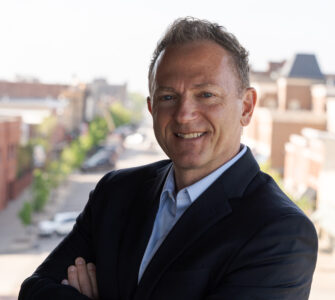
photo by: City of Lawrence
Craig Owens
Craig Owens has spent his whole career looking for challenges – from blue-collar factory communities to suburbs to a densely packed city in Missouri with nearly 50 high-rises.
The place he finally found the “capstone” challenge for his career was Lawrence.
“I have joked, ‘I came here for challenge, and I got it,” Owens told the Journal-World this past week, his final week at work as city manager. “But I got it in ways that were different than expected, which is life, and I’m grateful for those things.”
“It’s a choice to do things that are hard,” he continued. “Not everybody makes those choices.”
In seven years overseeing the city’s operations, he’s proposed plans for closing multimillion-dollar budget holes; helped the University of Kansas bring its Gateway District development to life; championed big investments in the city’s infrastructure, from streets to sewers to fire stations. And he’s had to explain these things and more to a community that hasn’t always liked his ideas.
Soon, it will be someone other than Owens facing the many hard choices at City Hall. Assistant City Manager Casey Toomay is taking over for him as acting city manager, and his permanent successor could be hired in a little over a month.
Owens and his family will be staying in town — “I’m excited to just be a satisfied, well-served, reasonably priced taxpayer in the community with my family and really enjoy that,” he said. But he also said you won’t see him at City Hall giving advice or his opinions on how things should be run.
“I will be taking a pretty hard break from civic affairs here in Lawrence, for a variety of reasons,” he said.
In a final video message to the community at his last City Commission meeting on April 21, he had a list of people to thank, and one of them was his wife, Elizabeth, “who understood what I meant when I simply said, ‘I don’t want to relive it,’ or ‘It was just a very hard night.'”
“So many people in this room know firsthand exactly what I mean,” he said in the message. “It is a trauma I wish we didn’t share.”
Before leaving his 33-year city management career behind, Owens spoke a little more about the challenges – good, bad and traumatic – of running a city like Lawrence, and about what he wants the public and his eventual successor to know.
For his successor, he’d like them to make listening to the community their first priority. And for the public, he’d like them to not make the challenges even harder.
“I love our state motto,” he said in his farewell video: “Ad astra per aspera” – Latin for “To the stars through difficulties.”
“I want to suggest to my fellow Kansans here in Lawrence that our motto is a commemoration of our past perseverance, not a prescription for how we should move together into the future,” he said. “Be kind and patient with each other.”
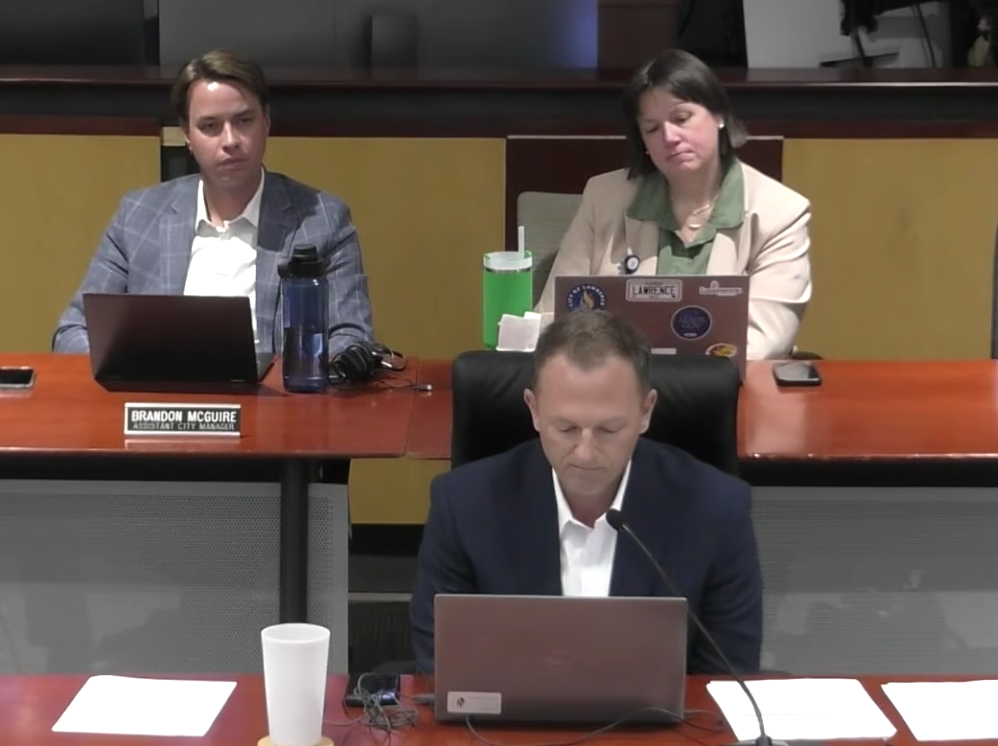
photo by: Screenshot/City of Lawrence
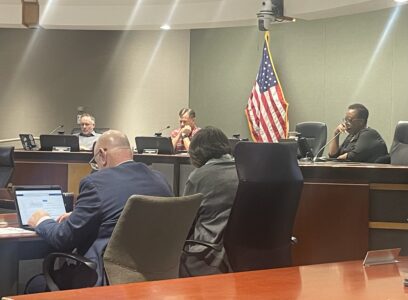
City Manager Craig Owens, front row, addresses the Lawrence City Commission on Tuesday. Seated behind him are Assistant City Manager Brandon McGuire, left, and Assistant City Manager Casey Toomay, right.
Lawrence’s missing piece
Owens, an alumnus of KU’s Master of Public Administration program, started out in the field by interning in a Chicago suburb. Then, he took a job in a blue-collar community near St. Louis, “very different than my suburban upbringing in Overland Park.” Then, a stop in O’Fallon, Illinois, near an Air Force base; then in Rowlett, Texas; then in Clayton, Missouri, a high-density city that’s been called St. Louis’ second downtown.
“Most of my moves were toward something that was at least somewhat uncomfortable, that was going to be challenging for me,” he said, and he’s proud of that.
When he moved from Clayton to Lawrence in 2019, he was well aware of the differences.
“This is a much larger city, geographically and by population,” he said. “While we have Washington University in Clayton, (KU) is a much, much larger university. It is the prominent piece of the community. Here we have a much different economy. It’s a very high service economy, and we have, I believe it’s an 18% poverty rate here in Lawrence.”
One of the most impactful differences between Lawrence and Clayton was how their tax bases looked. And it’s here that many of Owens’ challenges in Lawrence originate.
In Clayton, Owens said, commercial property was huge. “You have a very small population base, and even those homes, the residential population base, those were very high-value homes. And then, obviously, a huge commercial tax base and sales tax.”
Compared to that, Lawrence’s commercial tax base is “very, very tiny,” he said. And that is a structural problem he thinks Lawrence must solve.
“The commercial-industrial tax base is the missing piece in our pie,” Owens said. “It has to grow faster than the proportion of our population growth. We want to see population growth, but we need to see tax base growth that is at 25% assessed value and not 11½%.”
Those percentages refer to how properties in the state of Kansas are taxed. Residential property in the state is taxed at 11.5% of its assessed value, while commercial property is taxed at 25%. But some of Lawrence’s largest employers aren’t paying that 25% rate, because they’re government-run, nonprofit or otherwise off the tax rolls.
“KU, Haskell, the hospital, the city, the school district, the county, all the parks, all the churches, all the not-for-profits, those are great elements – necessary, beautiful elements of Lawrence,” he said. “But they don’t give us property tax revenue, which is so important for us being able to continue to provide all the services that the people in this community expect at a very high level.”
Smaller service businesses and retail, meanwhile, are hurt by Lawrence’s lack of population growth, he said. “My seven years here have been a time of very little residential growth, population growth, and that is a problem when you’re trying to see retail thrive.”
There are good things ahead for the retail and service parts of Lawrence’s economy, Owens thinks. Annexations and growth of the city’s housing stock are coming, and there’s also the Gateway District stadium project at the University of Kansas. The exciting part of that for Owens isn’t the stadium, but the convention center attached to it.
“We’re going to have visitors not just on seven game days a year,” he said. “We’re going to have visitors coming in on Wednesdays, every Wednesday. We’ll have a conference event coming in every week, in the middle of the week. People visiting our community, coming here to dine in our restaurants, bringing new dollar investment into our downtown so that our businesses can make it.”
And when Costco opens on the west side, an entirely different category of customer will be coming in and spending money in Lawrence.
“Costco’s arrival and some of the western growth, I think, will be very much a net importer,” Owens said. “So we’re going to grow that, and that’s necessary so we’ll get more people from Topeka and more people from Wyandotte and Johnson counties, and we probably will continue to be more of a location that people come to for shopping.
“That’s good for our economy,” he said. But Lawrence will still have a problem “if we don’t have primary employers with high-value commercial and industrial investment.”
“The state of Kansas has designed its taxation system to be that we need corporate and commercial taxes to balance out and subsidize the residential,” he said. “Lawrence does not have that, even though we have some wonderful non-taxpaying employers. That is the most critical rebalancing that has to happen for the future to be as bright as it should be here in Lawrence.”
If it doesn’t happen, he warned, “the city managers that come after me are going to be even more challenged than I have been budgetarily.”
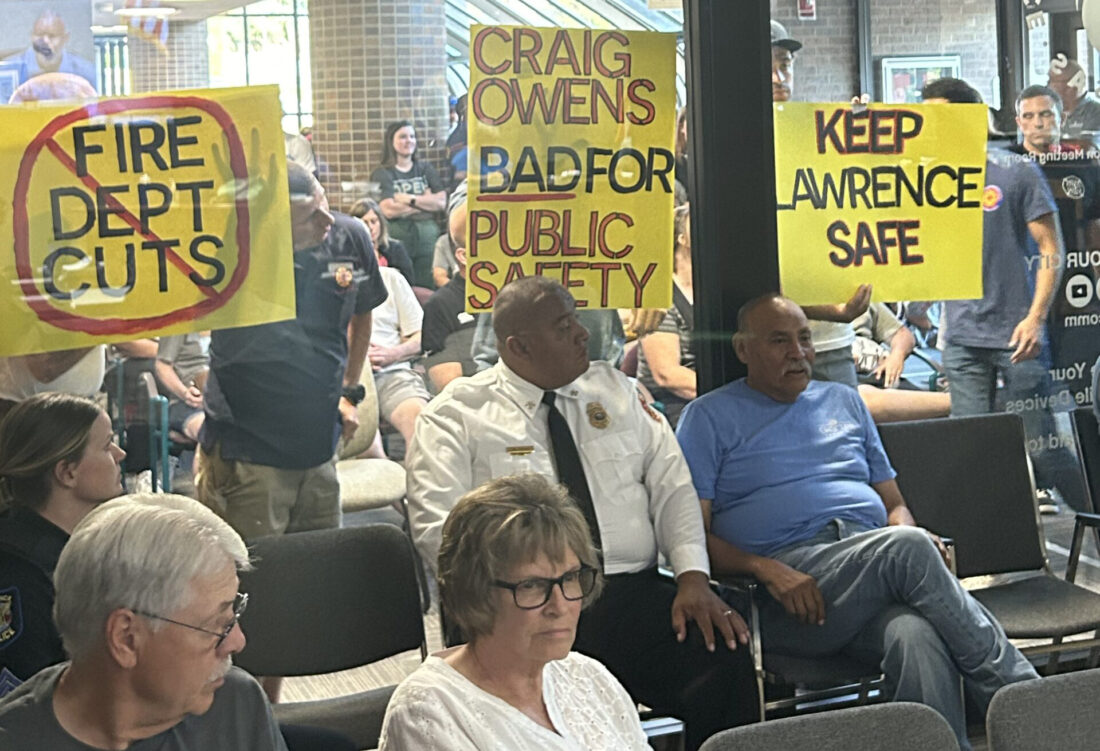
photo by: Bremen Keasey/Journal-World
Protesters hold signs outside of the City Commission meeting room during the commission meeting on Tuesday, July 9, 2024.
‘The compromises are still before us’
The city’s financial reality means it has to make compromises all the time, Owens said.
And compromises are messy.
“A city manager sometimes has to propose the unpopular reality to get the community conversation to move,” Owens said. “I’ve had several of those, and unfortunately the controversial ones are the ones that people remember.
“There’s thousands of other recommendations that went through fine and that people celebrate, but they won’t remember my role in it,” he went on. “But what I’m charged to do sometimes is develop options that may meet some element of the community compromise in the right way.”
One of those was the proposal in 2024 to relocate City Hall to a former call center building at 2000 Bluffs Drive.
This was a proposal to make more space for city employees. The Bluffs property would have given the city 50,000 square feet of space, compared to the 35,000 at City Hall, and would have cost less than renovating the current building. But it would also have moved City Hall out of downtown.
“And, rightfully, the community said, ‘But City Hall belongs downtown!'” Owens recalled.
So, why was the Bluffs property being discussed at all?
“The Bluffs property was $181 a square foot,” Owens said. “That’s why that one was on the table. It solved the need as inexpensively as we could.”
He thinks there was value in having that option available and talking about it. “There are a lot of people that are very tax-conscious right now that have kind of become more prominent,” he said. ‘Those folks probably appreciated a better value proposition to solve a basic need of our local government function.”
But even though the unpopular option has been rejected, he said, the need hasn’t gone away.
Even today, there are offices in City Hall that were built for just one person but have two or three people working in them. “They’re all crammed in here trying to do this work, trying to make sure that the people that are out in the field have the resources they need,” Owens said.
Another compromise that the city is still hashing out is Lawrence-Douglas County Fire Medical’s expansion.
Owens believed the city needed to add two more fire stations so that emergency response times in certain areas would be faster. Building the physical stations wouldn’t be the costly part, he said; staffing them would be. So, in his 2025 budget proposal, Owens proposed decreasing minimum staffing levels on fire trucks from four people to three.
“It is a fact that three per truck is not going to be as effective once they get to the scene,” Owens said. “They’re only about 70% of the effectiveness of a four-person crew. That has been well-documented.”
But, it would allow the city to spread its resources across two more stations, which would allow quicker service to the western and southern edges of Lawrence.
“The proposal to do this was compromise,” Owens said. “We’re going to be compromising in any direction we go. If we go ahead and raise property taxes to build stations, that’s a compromise on the taxpayers. If we drop to three per (truck) but build two stations, it’s a compromise in order to get two more stations.”
When the City Commission had its budget talks in 2024, the crowd spilled out of the commission room. Dozens of people, including many current and retired firefighters, urged the commission to keep staffing at four per truck, and people protested on the street corner outside with signs. The firefighters union came out against the plan.
Ultimately, the commission approved a 2025 budget that retained four-person staffing on trucks, pushed the construction of the stations back and spent down $1.6 million of the city’s savings.
Fast forward to today, and the plan is to build one new station, not two. And this summer, the City Commission will be considering a three-mill property tax increase to fund its staffing needs.
“The compromises are still before us,” Owens said. “The City Commission will be addressing that again, but where we left the budget last year was that they understood that we would be moving forward with the three-mill increase in order to fund and staff at four per station, at our standards, keep our standards up, and we would build one more station. We really need two.”
So, is Lawrence a community that wants to have its cake and eat it, too? “Yes,” Owens said. “And there’s nothing wrong with that.
“It’s just not realistic.”

photo by: Austin Hornbostel/Journal-World
Mayor Bart Littlejohn speaks with City Manager Craig Owens at a reception following the Lawrence City Commission’s meeting on Tuesday, Dec. 5, 2023. Littlejohn’s peers on the City Commission voted to appoint Littlejohn as Lawrence’s next mayor during the meeting.
Exhausted leaders
Owens and the rest of the staff have tried to help people in Lawrence understand this better. One thing they’ve done is heavily promote the city’s online budget simulator tool, called “A Balancing Act.”
The simulation shows various services the city provides and the city’s property tax rate. It lets users change the tax rate, the levels of service, or both, and shows what the impact would be on a median-value home’s property tax bill, and once they’ve completed the simulation, they can submit it to the city to be considered in the budget process.
But you can’t submit it unless it’s balanced. And 2027’s started in a $4.5 million hole.
“The reason we are so strongly promoting A Balancing Act as a tool is because it requires every participant to confront the choices,” Owens said.
This is something he thinks the community isn’t good at doing.
“What I think there’s a long history here of doing is coming to advocate for your position or your cause or your viewpoint, but not having to account for your neighbor’s,” Owens said.
Owens thinks Lawrence has high expectations for government services, and that it’s a community that sees government as a solution most of the time, not as the problem. But when people come to speak for three minutes at a City Commission meeting and basically say, “I don’t care how you’re going to do it, just do it, give me my thing,” Owens said, “that’s not very useful, and it’s really exhausting for leadership in this community.”
“There is an activism that’s deeply rooted in our identity as a community – our community was founded on that kind of activism and idealism,” he said. “And governance, decade after decade, year after year, needs more than activism and outrage. Those things take you only to the first couple steps. Then, compromise and working with your neighbors and reconciling value conflicts is the work that’s necessary, and a lot of people don’t show up for that, and they certainly don’t show up with the right tools for that.”
Owens has seen the toll this takes on the elected city commissioners.
When he first came to Lawrence, one of the things he noticed about its elected leaders was how frequently they turn over. “People just aren’t given a chance, and even when they’re here, they’re not treated very well,” he said.
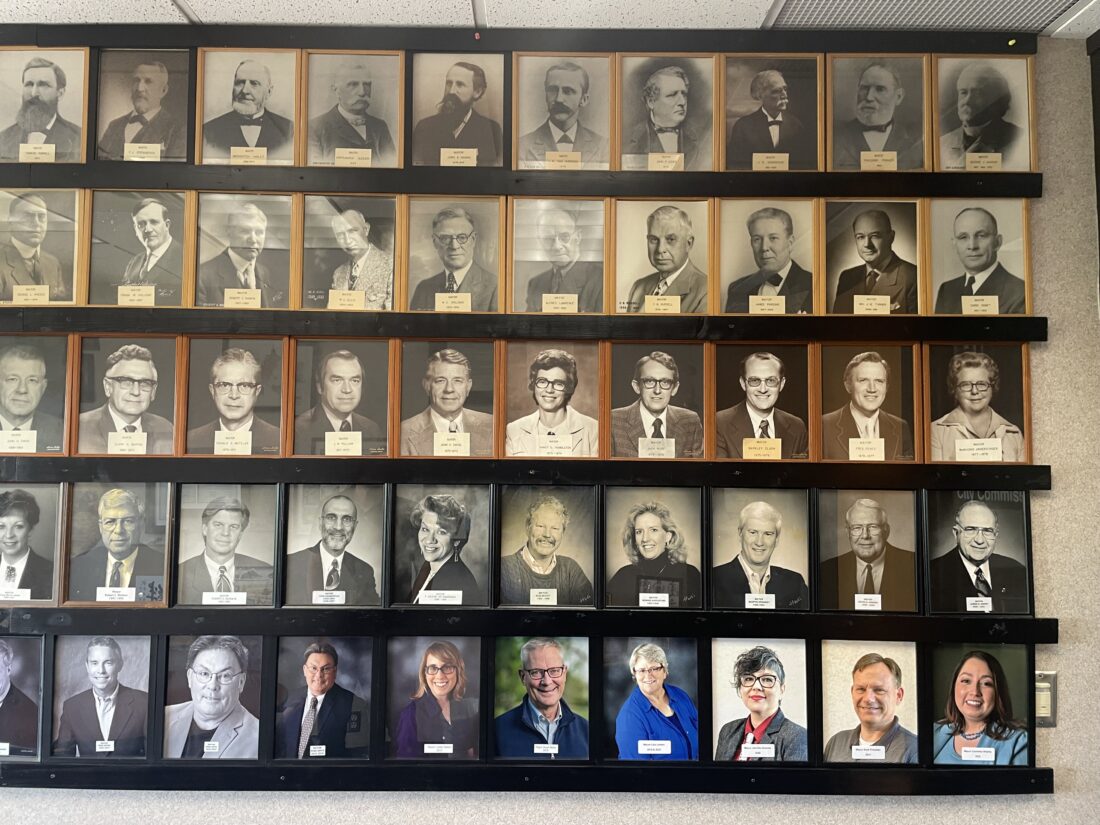
photo by: Sylas May/Journal-World
The wall of mayors in Lawrence City Hall is pictured on April 27, 2026.
In the mayor’s office, a few doors away from the city manager’s office on the fourth floor of City Hall, there’s a wall of nearly 100 portraits of past Lawrence mayors. Four of the five city commissioners who hired Owens are there: Leslie Soden, Stuart Boley, Lisa Larsen and Jennifer Ananda.
No one from that commission seven years ago is still on the dais today.
Curious about the turnover, Owens took a look at how long past elected leaders of Lawrence had served. “If you look over the history … when I got here, the average tenure was 4.8 years,” he said. There’s also a big outlier in the numbers: Mike Amyx, who, before becoming a state representative, served on the commission for more than 20 years and was mayor for six terms.
“If you just took Mike Amyx out of that calculation, it was four years on average, when I got here seven years ago,” Owens said.
Since Owens’ arrival, 12 people have served on the City Commission, and only three incumbents have won reelection: Larsen, who decided last year not to seek another term; current Mayor Brad Finkeldei, first elected in 2019; and current City Commissioner Amber Sellers, first elected in 2021.
“I had certainly never worked in a place that had this rapid of a turnover,” Owens said.
Turnover matters, he said, because being a city commissioner is a complicated job, and one that almost nobody is equipped to do right away.
“This is a very sophisticated organization and operation,” he said. “We teach kids to swim, we restart hearts, we intervene in domestic violence situations in somebody’s living room, we treat millions and millions of gallons of effluent so that it doesn’t hurt the environment. We provide clean drinking water to every single faucet. And the operations required to do that for the population of a city this size are very complex. I’ve been at it for 33 years, and there’s still things I’m learning about the operations that happen across all of those things. … It takes a lot to do them, things that people never even think about.
“And so, when we get these folks that come in and run for office and become city commissioners, they want good things for their community, and then they start peeling back the onion and get to know what it takes to do all of these things. And, 100% of the time, whether they say it out loud or not, there’s some amount of a newly elected official saying, ‘I had no idea what it took to do all of this.'”
They also have to learn how to work together with their fellow commissioners and the public. “How do I make a decision with my four colleagues? How do we set up our processes for conversations? How can I, in this position, really hear and understand the complexity of the people … not just the ones that are showing up in the meeting, but the ones that aren’t showing up in the meeting?”
Owens doesn’t blame people for showing up and advocating for things they’re passionate about. “I think everybody’s intent and heart is in exactly the right place,” he said. What he’s concerned about, though, is the polarization and sometimes the incivility that surrounds these conversations.
“We’re not talking to each other in a way that leads to compromise,” he said. “We’re talking in a way that leads to contempt.”
And “contempt is so toxic and destructive, we will lose who we are. So we need to be consciously building and protecting civility, co-creation, compromise, empathy and love.
“Those ideals should be ones that our community runs to, and that is not the direction that I’ve experienced in seven years.”
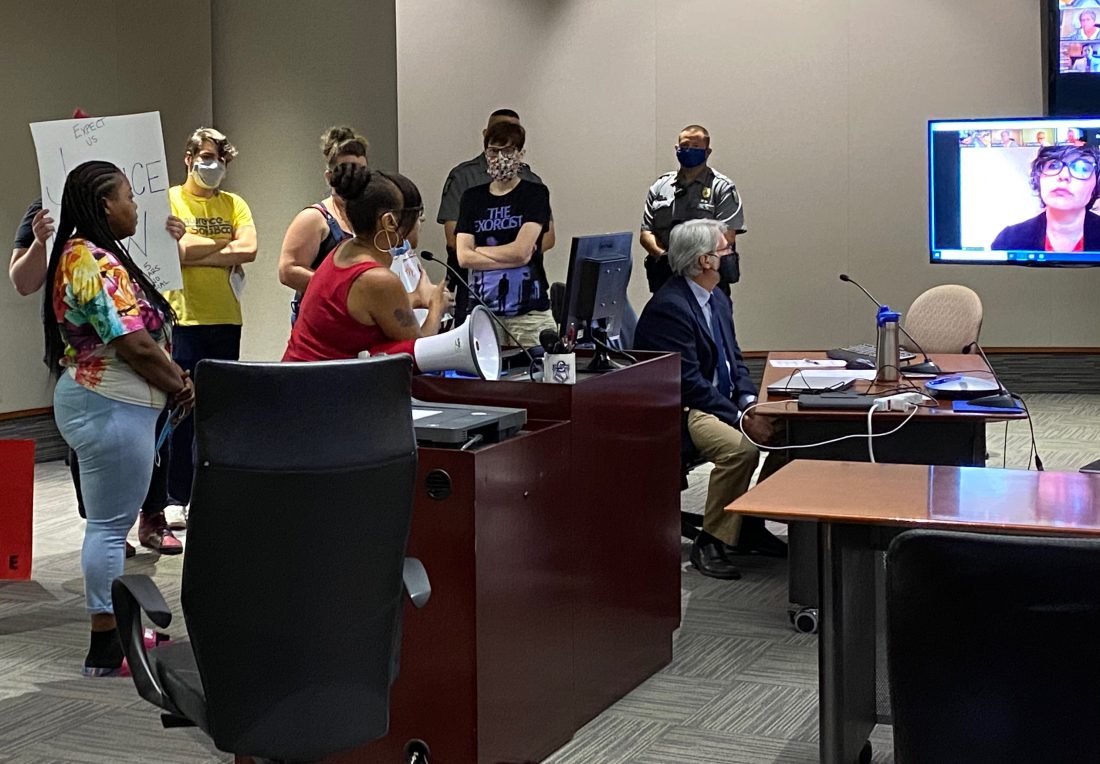
photo by: Mackenzie Clark
Natasha Neal, at center in red, addresses the Lawrence City Commission during its meeting on June 16, 2020. Behind her in the colorful shirt is Kenisha Clark, mother of Rontarus Washington Jr.; on the screen at right is Lawrence Mayor Jennifer Ananda.
Trauma and hope
Owens has a lot of love for local elected officials. He’s worked with nearly 200 of them throughout his career, he said, but it goes back even further than that.
“I grew up in a council member’s household,” he said. His father served for a number of years on the city council in Overland Park, and later, his mother ran and served two terms.
What he’s seen all his life is that “people that run for office have giant hearts. They love their community, come to the work because they want to make a difference.”
That’s why it hurts him to see how poorly people treat their local elected officials today.
“What we’ve unfortunately experienced, and you’ve seen it,” he said, “is just absolutely toxic behavior, toxic language and the dehumanization of the elected and appointed leaders and fellow community members.”
One thing he hears a lot from the public is people saying they’re “the boss” of public servants. “They tell the elected officials, ‘We put you in office; you work for us.'” For several months, he’s been thinking about what that means.
Assuming that city commissioners really do work for the public, he wondered, what does that imply about how the public should treat them?
“Leadership is expected – especially this kind of servant leadership – it’s expected to support the people in your care,” Owens explained. “If this concept of ‘You work for me’ is true, and the population says, ‘We’re the boss’ … Nobody would talk to their employees like that! Nobody would do that!
“And you wouldn’t expect your employees to be high-performing employees if you put them in a work environment like we do.”
During Owens’ time in Lawrence, people have tried to boss the commission around — and also insulted them, hurled racial slurs at them, even threatened them.
Just a year after Owens arrived, in June 2020, a group of protesters interrupted a meeting to demand the release of Douglas County Jail inmate Rontarus Washington Jr., something the City Commission had no power to do. “Like I said, every time somebody talks, I’m gonna talk!” one of the protesters shouted over then-Mayor Ananda as she tried to de-escalate. At times using profanity, the crowd held up the meeting for about an hour, accusing the commissioners of being white supremacists. “This all-white (expletive) commission over here, I know you all don’t care about us!” another protester said, drawing applause. “… So, I’m just gonna say, whatever comes to you, you deserve it.”
In summer 2023, Owens sent a letter to a frequent public commenter about his “threatening and harassing behavior,” including telling two commissioners that he knew where they lived. That commenter was banned from attending commission meetings in person for 60 days.
In April 2024, someone left bricks in paper bags on the porches of three city commissioners’ homes, with notes that accused them of “violating your own law to displace and kill the homeless.”
And in September 2024, Commissioner Amber Sellers decided to stop listening to public comments in person at meetings. Among the reasons she cited: “racial and political slurs directed at specific commissioners” and “campaigns of misinformation designed to undermine the commission’s credibility.”
Even at Owens’ final City Commission meeting on April 21, a couple of citizens were swearing at city officials, shouting at them, even threatening them with legal action because of proposed changes to the commission’s meeting order and public comment rules. One commenter on Zoom asked the commission, “How much of you are for sale?” and shouted this about Owens’ regular city manager report: “That guy up until now hasn’t said diddly (expletive) for almost two years!”
Owens thinks attacks on public servants are things that everybody in the meeting room feels and is harmed by, not just himself or the commission.
“You’re experiencing trauma,” he said. “Even when it’s not directed at you, you’re experiencing trauma. Or the violence, sometimes physical violence but certainly emotional violence that occurs.”
He believes his stance on civility “may be controversial,” but it’s something he thinks a lot about, and something he’d like the public to think more about, too.
It’s something he believes will have to be discussed soon, both at City Hall and across the country. Last month, Mayor Finkeldei proposed reading a civility pledge at the start of the public comment periods at commission meetings as a reminder to respect others in the room. That idea was inspired by the National League of Cities, which passed a resolution in March urging its members to “reduce polarization and create an environment that values shared goals, increased empathy and genuine dialogue.”
And while Owens won’t be back at City Hall, he does intend to keep spreading the word about civil discourse. “Just shine a light on it and think about it, talk about it, be conscious – maybe it would be a little bit better,” he said.
What he hopes is that one day, communities will want to help their leaders flourish, just like the leaders want to help their communities flourish.
“I guarantee you the people that are up there on the dais and those of us that serve along with them in appointed positions and the people in my care, I guarantee you everybody wants to do a good job,” Owens said. “We’re trying to figure a best way how to do our part and play our role in this public service and in this experiment of democracy.
“And if people would just start assuming this to be the case, I think results would go even higher, and I think value to citizens and community members would be even higher, and I think we would retain some of our precious leadership and they will get better and better and better, and I think new people are going to want to come into that system.
“That’s what I hope.”

photo by: City of Lawrence
Craig Owens
City Government
As they approve bikes plan, Lawrence city leaders ask about data collection, Kentucky and Tennessee streets
Lawrence city leaders want to toughen tobacco licensing rules ‘sooner than later’
Algerian government invites Mayor Brad Finkeldei, Lawrence delegation for a visit
Construction on Wakarusa Drive to resume; city manager says KDOT’s secretary has apologized for delay
Evacuation drill planned Tuesday at Lawrence City Hall
