Lawrence city leaders defer decision on selling downtown parking lot for senior housing project
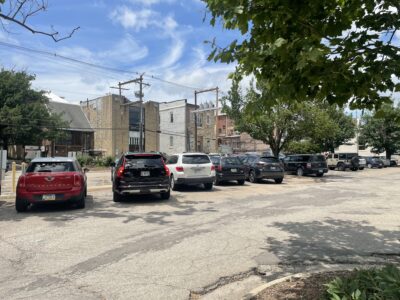
photo by: Sylas May/Journal-World
The parking lot at 711 New Hampshire St. is pictured on Friday, June 5, 2026.
In his experience with senior housing developments, City Commissioner Mike Dever says that often, “these things don’t pencil out because of the parking.”
And parking was a key issue for him and other commissioners as they debated on Tuesday night whether to sell a city-owned surface parking lot in downtown to a developer for an affordable senior housing project.
Ultimately, the Lawrence city commissioners thought there were too many unanswered questions, and they voted 5-0 to defer their decision on whether to sell the lot at 711 New Hampshire St. for $100,000 to developer Cohen-Esrey. That will give city staff time to come up with a new exclusivity agreement with the developer, and will give the developer more time to answer those questions.
“There are too many unknowns for me,” Commissioner Kristine Polian said before the vote.
The lot currently has 74 free, two-hour parking spaces right now, two of which have chargers for electric vehicles. And the proposed development would build 94 rental units for seniors earning between 30% and 80% of area median income, as well as a below-ground parking garage to serve those units.
The proposal’s issues and the commission’s conversation had a lot to do with timing – specifically, when one major funding source of state Low-Income Housing Tax Credits, or LIHTC, would go away.
The development’s story started in 2023, when the city asked developers for proposals to create new commercial projects and affordable housing in certain downtown parking lots. Cohen-Esrey created a proposal and entered an exclusivity agreement with the city for the property – an exclusivity agreement that expires later this month. It then applied for a round of LIHTC in 2024, but it didn’t receive them, so the project was in limbo for months.
In 2025, Cohen-Esrey applied for LIHTC again and did get the financing approved in November – provided it could secure control of the site. That, Mayor Brad Finkeldei said, left it with less than a year to get the project rolling.
Cohen-Esrey planned to fund more than $12 million of the project with the state LIHTC financing, and the firm’s development director, Jack Brenton, said that left the developer in a tough spot. If the city didn’t either extend the agreement or transfer the property, the LIHTC credits would go away.
“I think the state of Kansas would take these really important tax credits and move them to a different project,” Brenton said.
Hilary Carter, a public commenter, said during the meeting’s public comment period that the developer had done what the city had asked, and that affordable housing developers would be watching what the commission did. “Word travels,” Carter said.
“The tax credits awarded to this project are real, they are scarce, and they are time-sensitive,” Carter told the commission “… If this sale doesn’t move forward, those credits will be lost to the community entirely.”
But some commissioners had serious reservations about the proposal in front of them.
For one thing, the lot would have been sold for less than a tenth of the $1.09 million it’s been appraised at. Lea Roselyn, the city’s affordable housing administrator, said that Cohen-Esrey had first requested that the land be donated, and later in discussions with the city it changed to the $100,000 amount.
Vice Mayor Mike Courtney asked about what would happen if the developer had to pay the $1.09 million appraised value instead. “Would that make this project unviable?” he asked. Brenton said it would.
Another variable was the city’s Affordable Housing Advisory Board and the Affordable Housing Trust Fund money it makes recommendations for. The project had previously sought money from AHAB and the trust, but had not received it, and Cohen-Esrey was hoping to secure $1 million in funding from the trust.
Some on the commission believed that was unrealistic. “I don’t see you getting a million dollars from AHAB,” said Commissioner Amber Sellers.
Courtney asked what the contingency was if that funding didn’t materialize. Brenton said they’d have to look for other sources of funding to fill the gap, but that “we’re committed to making this project work.”
Yet another issue was how long the project would remain affordable. The developer was proposing 30 years of affordability, but in response to questions from the commission, Brenton said he would be willing to explore 50 or 99 years.
Then there was the parking issue, which Dever called “literally the focal point of this project and its largest pitfall.”
The housing project as currently proposed would build a below-grade garage with enough parking to serve all of the apartment residents. But some commissioners were concerned that they would be effectively removing public parking and then subsidizing its replacement with private parking.
“We’re taking away parking to do a project that would require us to put parking in that won’t be available,” said Polian. That, she said, was “a tough sell.”
Some of the discussion focused on whether some of the parking in the development could be made available to the public. But Finkeldei wondered if doing that would also endanger the LIHTC funding. “Can you go back to the state and say can we build that with 54 private parking spots?” he asked, and Brenton said that could be discussed with the state.
“We’ve been trying in good faith to respond to community concerns,” Brenton said. “… This is really day zero for us.”
The commission heard from members of the public on both sides of the issue, including several downtown business owners.
Malcolm Miller, of Amyx Barbershop, said he was opposed to the sale: “I don’t think we should be selling our infrastructure, full stop. I don’t think we should be selling our public infrastructure at a 90% discount.”
And Patrick Watkins of Watkins Law Office said the city needed both parking and density, because it was losing businesses “every month.” He encouraged the city to work with Cohen-Esrey to add another layer to the parking garage in the development.
“We need this investment. We need to preserve our parking. We can do both,” Watkins said.
Now, with the deferral, the commission will be having these conversations at a later date. The commission directed city staff to come back with a 60-day extension to the exclusivity agreement.
When it comes back, Sellers said, the commission will need to focus on “the bigger issue at hand”: “What do we want affordable housing to look like in this community, and what are our priorities?”
“A lot of the conversation tonight, I think, is around folks are not sure what they want affordable housing to look like in this community,” she said.
City Government
As club cancels ‘Beetlejuice’ screening at Oak Hill, city says there are no specific rules about events at cemeteries

Opinion: An $80 million Hail Mary that combines Costco and Lawrence’s love of trails
Lawrence Police Department receives KDOT’s top traffic safety award for second straight year
Lawrence City Commission approves extra layers of oversight for data centers, asks for patience on further regulations
Lawrence to participate in program that helps nonprofits rehabilitate abandoned properties as affordable housing