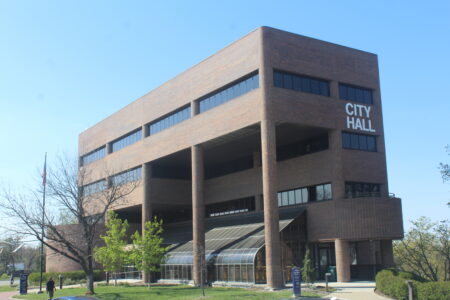
When Lawrence’s public works campus opens, employees say the difference will be ‘night and day’
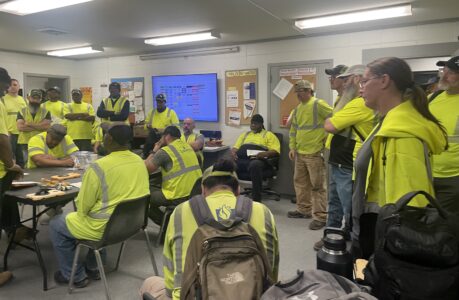
photo by: Sylas May/Journal-World
A crowd of workers listens to the morning briefing in the break room of the Solid Waste building on Tuesday, April 14, 2026.
It’s 5:45 a.m. at Lawrence’s Solid Waste facility, and the noise would wake anyone up.
“You haven’t seen all the people yet,” says Mike Lawless, deputy director of Lawrence’s Municipal Services and Operations, as dozens and dozens of workers in yellow gear chatter and get ready for their shifts. “Give it another 2 to 3 minutes and another half of them will come in.”
The break room they’re in was built in the ’70s and wasn’t built for this many people. Some of them spill over into the neighboring rooms and look in through the doors. Everyone can hear everyone else’s conversations.
After a few chaotic minutes, it looks like everyone’s here, and the supervisors call the meeting to order.
“LISTEN UP!”
If you weren’t awake yet, you are now.
This is night turning to day at one of the several Municipal Services and Operations, or MSO, sites that the city currently operates. But what will it look like when the city opens its $130 million MSO campus?
“Night and day,” said Ron Green, general manager for the solid waste division. “Night and day.”
Construction started in December 2024 on the campus at the former Farmland fertilizer plant site, which will bring MSO’s functions under one roof. Its first phase includes streets, utilities, traffic, inspections, construction management, engineering and administrative services, and these services are scheduled to move in this summer. The second phase, including the central maintenance garage and solid waste, is expected to be completed by fall 2027.
When it’s all done, it will replace a hodgepodge of buildings like the small Solid Waste building near 11th and Haskell – buildings that may have been built in the ’70s or ’80s, and that sometimes have so few accommodations that crews can’t meet comfortably, take a shower, store their clothes or eat lunch there.
The Journal-World spoke to representatives of multiple MSO branches this past week, some with decades of experience in the current facilities. All of them were looking forward to the new campus, and said it would greatly improve the way they store their materials, collaborate and generally do their work.
Michael Leos, MSO’s spokesman, says these workers don’t always get the appreciation they deserve. He says his team “is often quiet and doesn’t like to brag about themselves.” And he’s glad they’ll be getting facilities that can make their work safer and better.
“I’ve never met a group of people that care more about their job than the folks that work here,” Leos said.
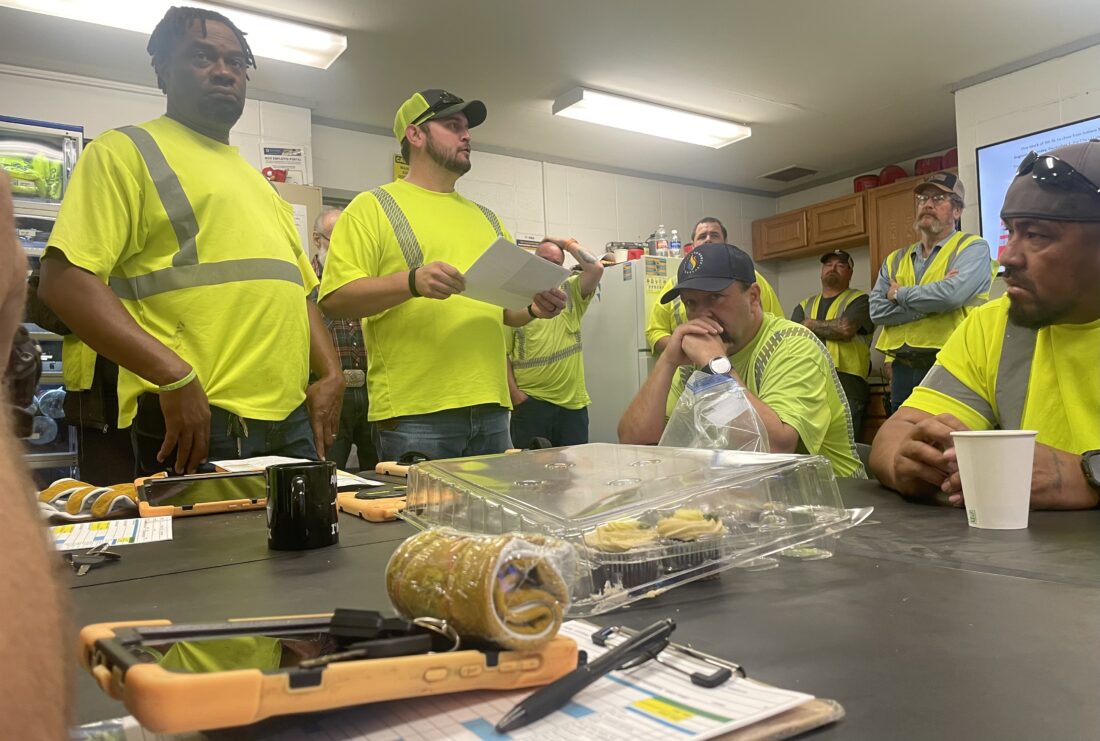
photo by: Sylas May/Journal-World
A crowd of workers listens to the morning briefing in the break room of the Solid Waste building on Tuesday, April 14, 2026.
In the madhouse
When he describes the Solid Waste facility at the start of the shift, Green is frank. It’s a “madhouse,” he says.
Solid Waste has 81 people in total, and its building, during the morning briefing, has to hold the people manning the trucks and the administrative staff. There used to be even more people working out of here, the division’s leaders say.
Green wishes the morning briefing could be a little less hectic and easier for the workers to follow.
“What we’d like to do is divide them up into groups,” Green said, such as for commercial, residential trash or residential recycling service, and then talk individually to each group. “There were four different groups that we’d like to meet and talk about their specific concerns for the day. But I don’t have that luxury, because I don’t have four places to put them.”
Instead, the announcements are for everyone. The first one on Tuesday morning is a reminder about the construction on Ninth. “You are supposed to back down from Eighth Street,” a supervisor says, carefully and distinctly enunciating each word. “Do not drive through the parking lot.” He says this two more times and which crews it pertains to.
Lawless said that there will be one big cafeteria space in the new campus, but also smaller rooms where each employee group can meet with its own supervisor without distractions.
“It’s hard to have a conversation in here,” Lawless said. “And so you get that smaller group, you’ll be able to have that better conversation, you’ll be able to have one-on-one with your group rather than kind of with the whole room.”
photo by: Sylas May/Journal-World
A sign in the Solid Waste building is pictured on Tuesday, April 14, 2026.
The current building also lacks other conveniences. Its locker room doesn’t have enough lockers for everyone, and its bathroom has just two showers. Those situations are fairly common across MSO facilities, and Lawless said they will improve with the new campus.
It’s a small thing, but it can make a difference after a long day in the field, said Brandon Spencer, a field supervisor for solid waste.
“Generally, most people don’t change in and out of clothes when they’re at work, and if they had a locker room, they could actually do that,” he said. “Because it can be a dirty job, and I certainly don’t want to get into my personal vehicle and drive home in some nasty clothes.”
How do the drivers feel about the old building?
“You know, the storm last night, I was hoping it’d just blow the building over,” jokes driver Tim Reeves.
He doesn’t know much about the new facility himself. But what he does know, he likes: it will be “a bigger facility, and a lot more space.”
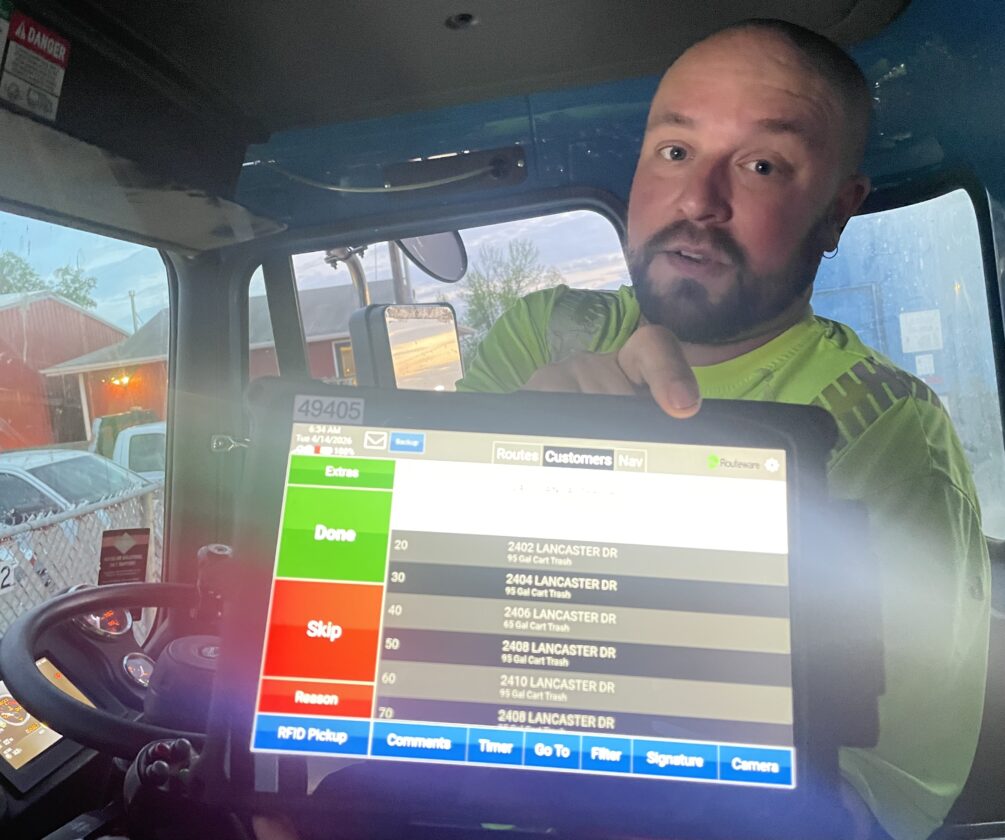
photo by: Sylas May/Journal-World
Solid Waste driver Tim Reeves demonstrates how the truck’s smart technology works on Tuesday, April 14, 2026.
Working smarter
The Solid Waste staff isn’t just looking forward to more space on the campus; they’re also excited about new “smart trucks” that MSO is testing out right now.
Currently, MSO has five smart trucks in its pilot program, but it expects to eventually deploy about $200,000 worth of the equipment on about 40 trucks, Lawless said. The trucks have a tablet that can display a map of the day’s route, with pins on each customer’s location, and a progress bar of what percentage of the route has been finished.
They’re also outfitted with a sensor that can read the RFID tags embedded in customers’ carts. When Reeves tips a trash cart into the truck, it goes past the sensor, which reads it, and there’s a “ding” noise to let him know it scanned.
“It’s about a billion ‘dings,'” he says. “Ding!”
The smart truck software now knows that this house is done, and it removes the pin from the map. That keeps a record of where he’s been – not a problem for Reeves, who’s been working here for 20 years, but helpful for a new driver or for someone who’s filling in for a sick co-worker on a route they don’t know as well.
Without a smart truck, substitute drivers are often told, “Here’s your route, do the best you can,” Green said.
A smart truck can also record when there’s no cart at an address, which can be helpful when customers complain about their trash not being picked up, Lawless said.
“We have cameras on the truck, and they’ll actually take a picture, a timestamped picture, and then that comes back into the software,” he said. “And when somebody calls in, we can look up that address and say, ‘Oh, no, I have a picture – and video – at 7:23 this morning when our truck was there, and there was no cart there.”
Don’t be fooled by the fancy lighted buttons in the center of the truck, though. Reeves says only a few of them are ones he uses frequently.
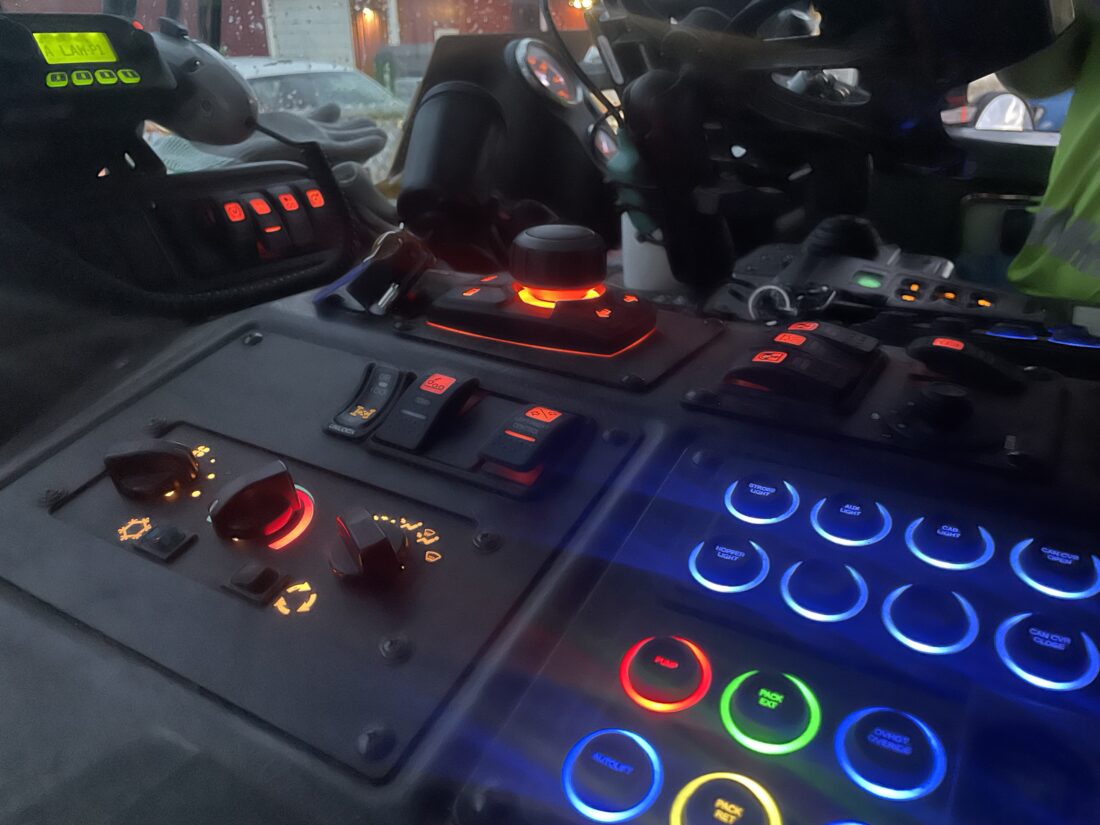
photo by: Sylas May/Journal-World
Colorful lights shine in the center of Tim Reeves’ truck on Tuesday, April 14, 2026.
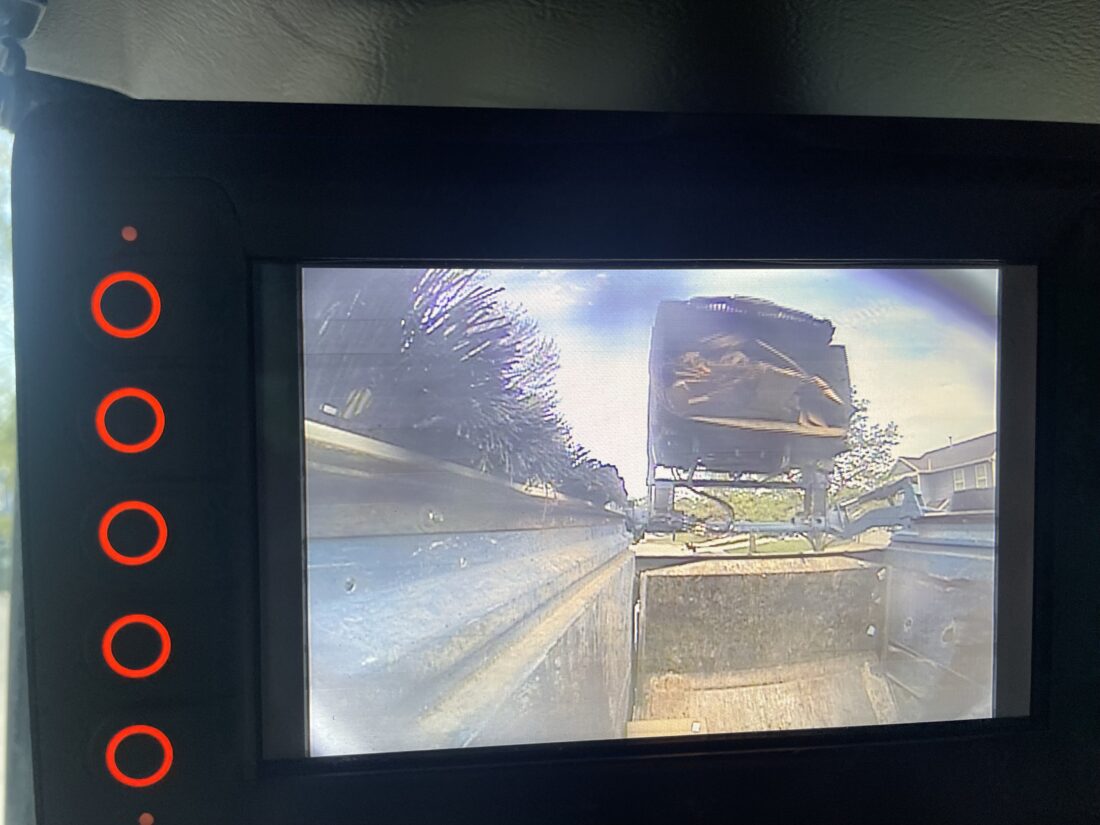
photo by: Sylas May/Journal-World
A screen inside of Tim Reeves’ truck shows trash as it’s dumped into the hopper.
Smart trucks are far from the only new thing Reeves has had to learn how to operate in his time at MSO. He’s a trainer now, and has been here since before the department had its one-armed, side-loading trucks. When the first of those arrived, “I was one of the very first drivers.”
“They didn’t know how to work it; we didn’t know anything about them,” he said. “My supervisor said, ‘Here’s the keys. Good luck.'” He took his time and figured out how it worked, and it’s now his preferred type of truck to drive.
With its controls and the hand-eye coordination required, it feels like playing “a giant video game.” And it doesn’t need extra crew on board.
“I don’t have the extra responsibility of looking out for two other people’s lives, hanging off the back of the truck,” he said. He was one of those guys once, and he said he prefers when “it’s just me.”
But wherever he’s needed, he’ll fill in, because he can do basically any job Solid Waste needs him for.
“I know how to run every truck,” he said. “I’ve been on every route. I’ve been here 20 years. So I know a thing or two.
“But don’t tell anybody.”
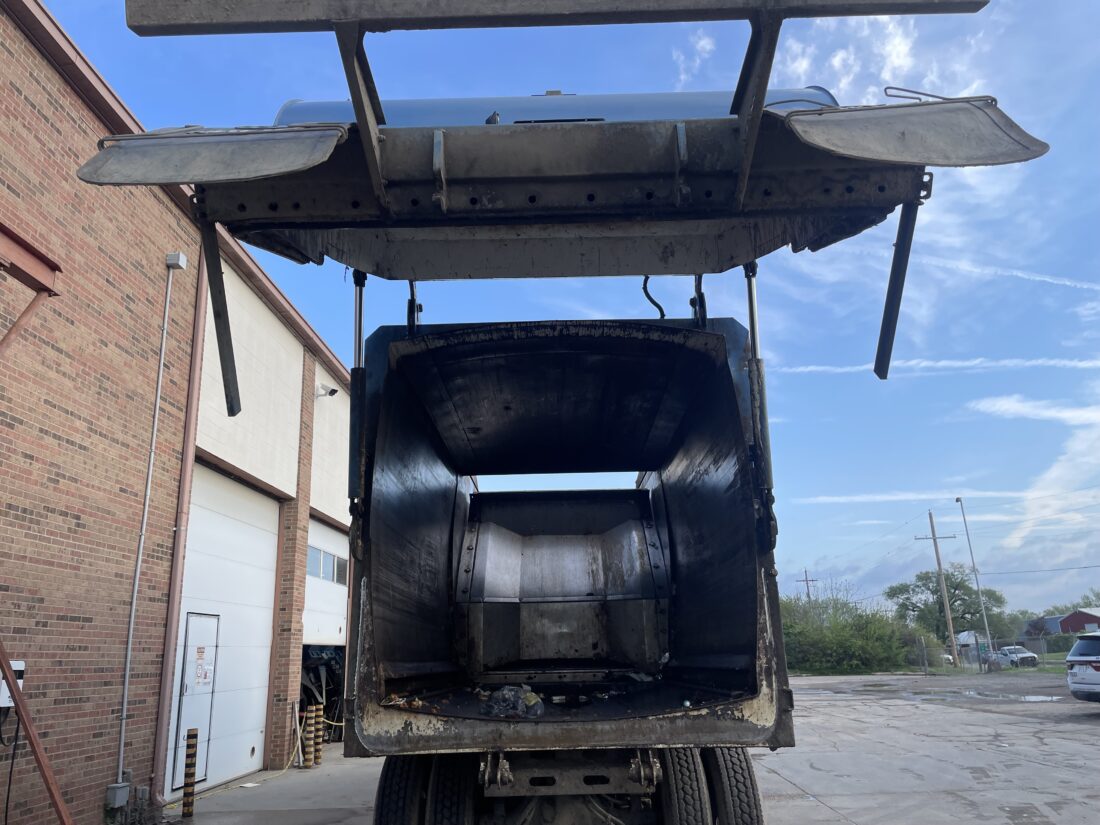
photo by: Sylas May/Journal-World
A garbage truck is parked outside the central maintenance garage on Tuesday, April 14, 2026.
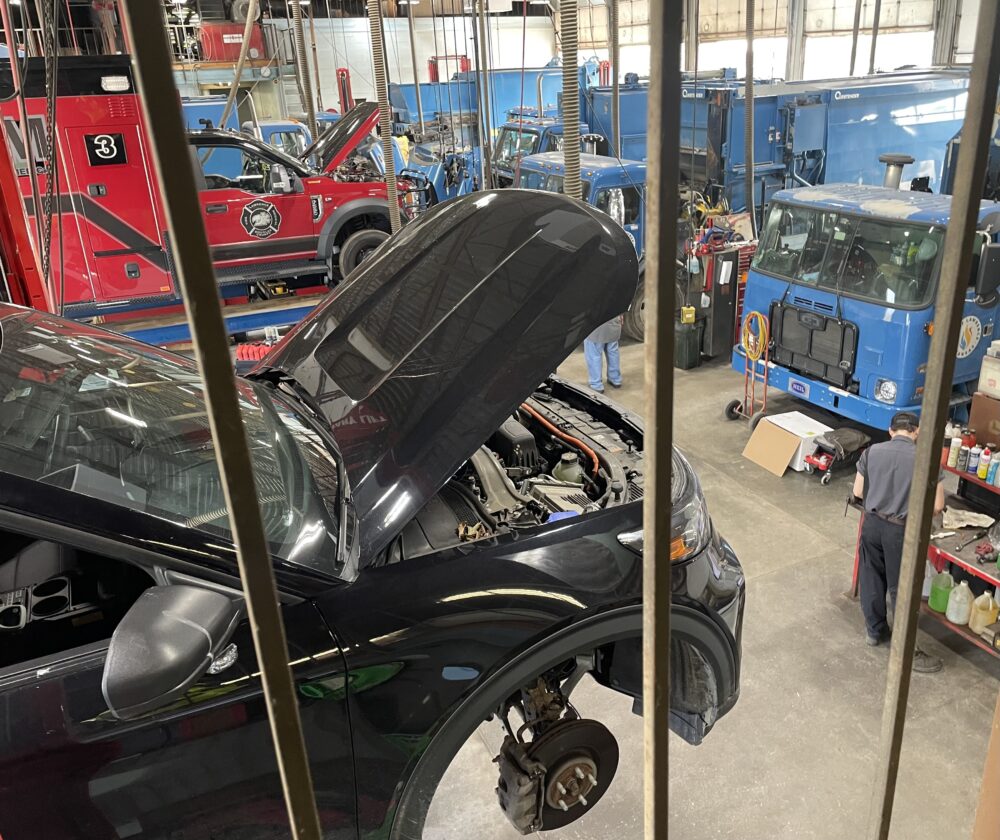
photo by: Sylas May/Journal-World
A view from above the floor of the city’s central maintenance garage on Tuesday, April 14, 2026.
‘Space is the number one’
Not just every trash truck, but all of the city’s more than 800 pieces of rolling stock get serviced at the central maintenance garage, across the street from the Solid Waste building near 11th and Haskell.
The problem, fleet manager Robert Aaron says, is getting them to fit inside.
“Today, you probably have the most room you’ve ever seen,” Aaron says as he navigates the cramped garage with a few other staff members. On Tuesday, many of the 12 bays have garbage trucks in them, and sometimes there are only a couple of yards of space between them.
“Matter of fact, today is a little bit more breathing room, because we don’t have fire apparatus in here,” he says.
The central maintenance garage was designed for work on a much smaller fleet, Aaron says – both numerically and in the sizes of the individual vehicles. Even though it has 12 bays, two of them are so small that they can only be used for light vehicles, like police cars.
“Probably 65% of any given day of our work is heavy vehicles,” Aaron said.
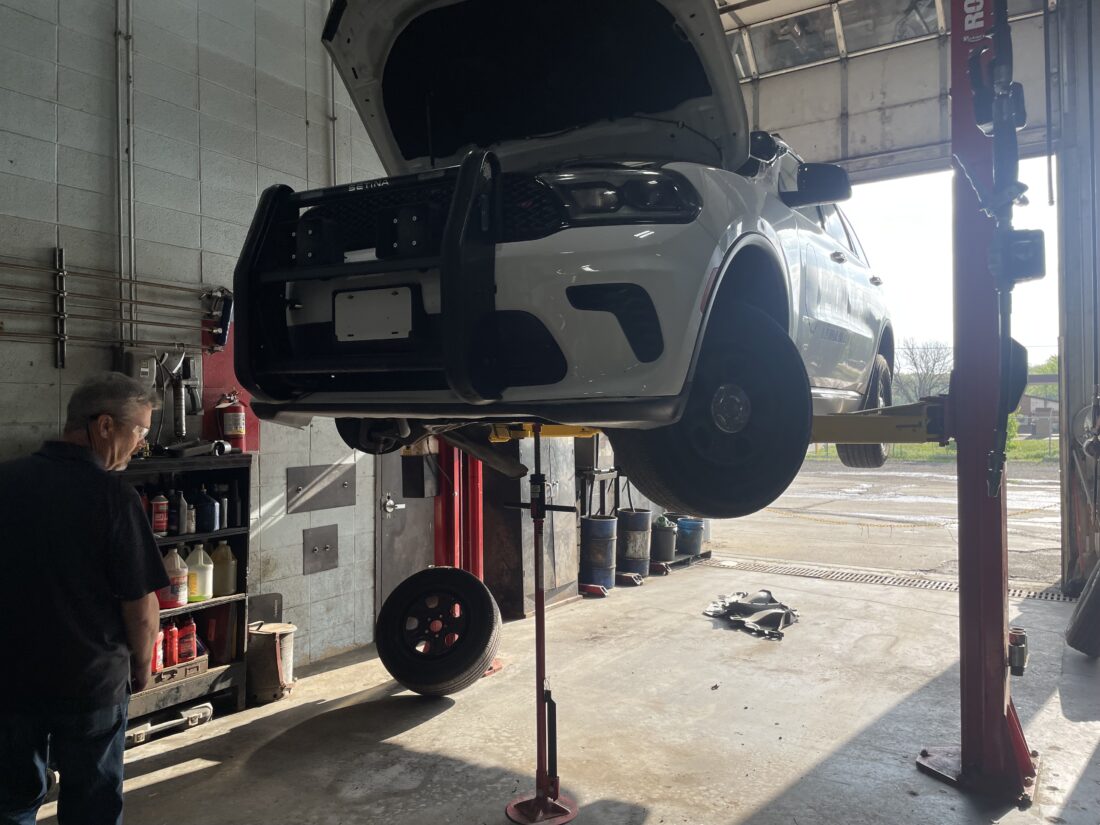
photo by: Sylas May/Journal-World
Robert Aaron, the MSO fleet manager, stands by a police car in one of the light vehicle bays in the central maintenance garage on Tuesday, April 14, 2026.
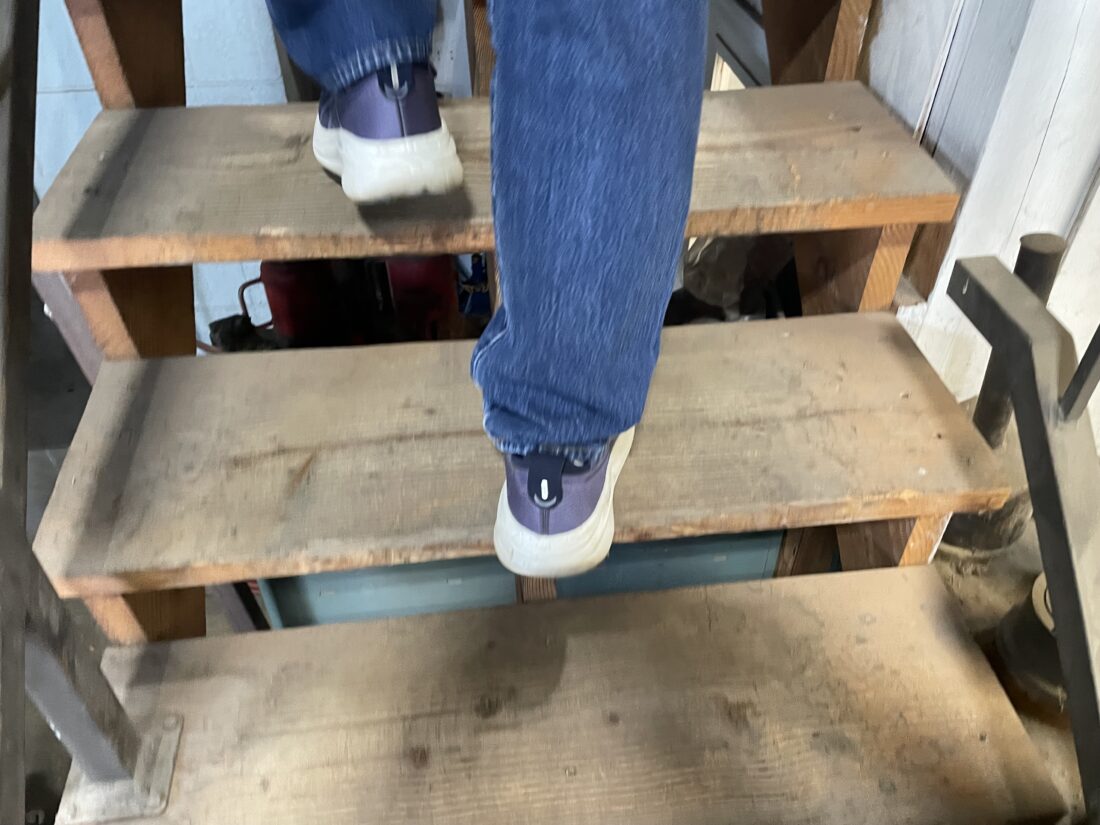
photo by: Sylas May/Journal-World
Wooden steps lead up to the landing above the central maintenance garage’s shop floor on Tuesday, April 14, 2026.
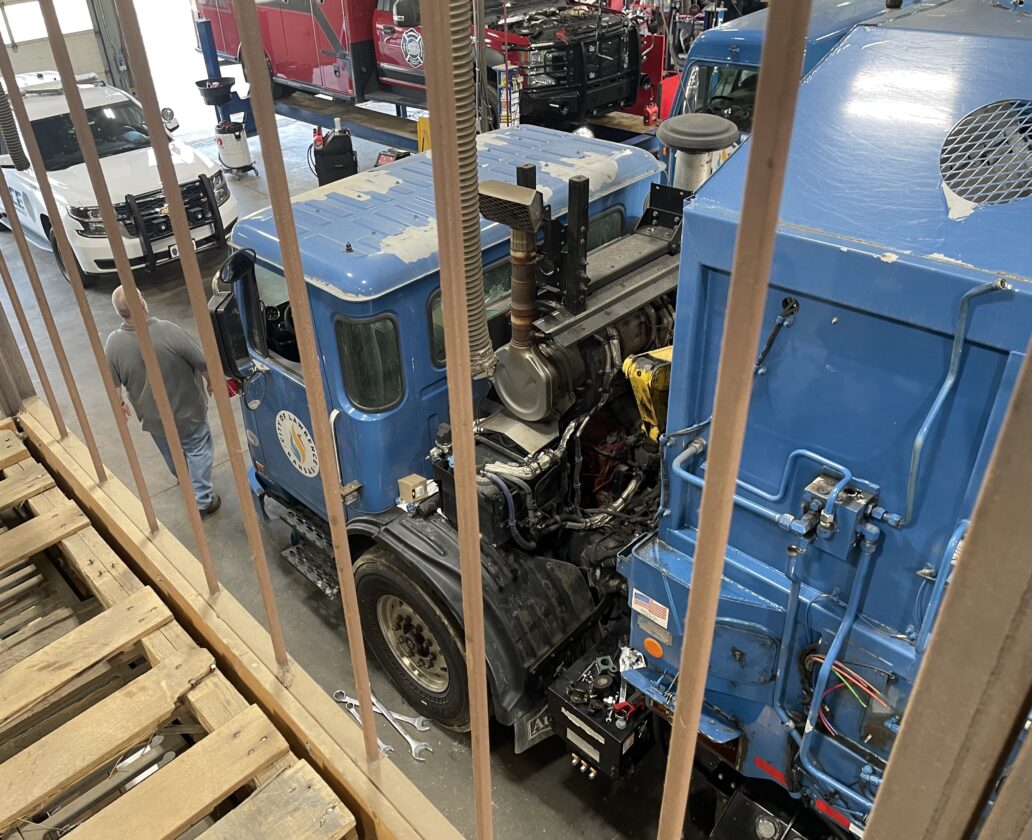
photo by: Sylas May/Journal-World
A view from above the floor of the city’s central maintenance garage on Tuesday, April 14, 2026.
The new facility will have around 27 to 29 bays, staff said, and it will have a lot more room to maneuver, too. A lack of elbow room is “a work comp and a staff concern,” Aaron said.
“Obviously as you’re pulling wheels off of vehicles and doing work, a lot of the work we do is beside the vehicle and on the vehicle, so those are safety concerns from trips and falls. It’s not uncommon to have somebody pull something off and lose a little bit of their balance and hit their back on the back of the toolbox,” he said. “Once they’re in here, it’s tight.”
On the floor of the shop, one worker has a yard or less of space between his toolbox and the trash truck he’s working on. Because the truck’s arm is so close, Aaron and his staff said, it would probably be impossible to fully open the toolbox’s lower drawers.
“This is a very typical scenario you see,” Aaron said.
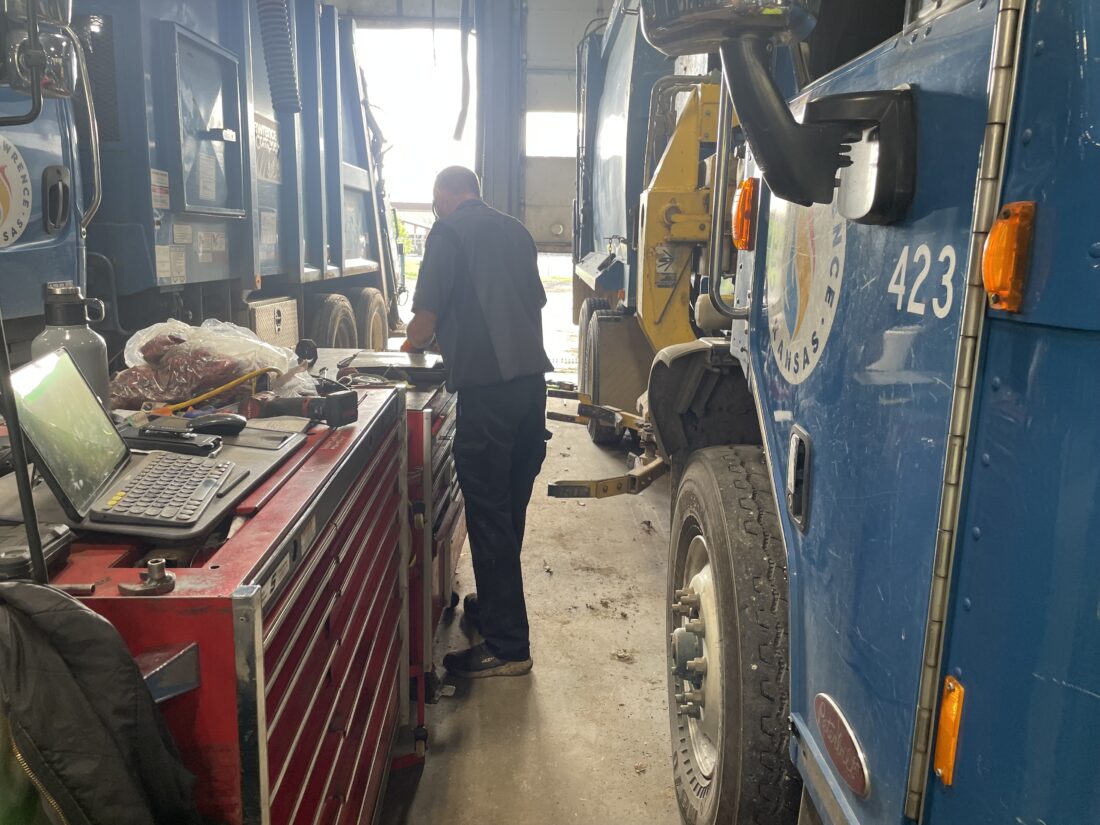
photo by: Sylas May/Journal-World
A mechanic works in the tight space between the toolbox and a truck in the city’s central maintenance garage on Tuesday, April 14, 2026.
Some extra-heavy vehicles take up more than one bay. For instance, at Fire Station 5, there’s a type of fire truck called a “tiller” that’s built like a semitruck with a ladder trailer on the back. When it’s in the garage, staff said, it stretches all the way across two bays, with only about 2 feet between it and the garage doors.
Sometimes, things just don’t fit. “When you take two trash trucks in the wintertime, you can’t fit them inside the doors and shut the doors, because you can’t walk between them,” Aaron said.
With so many people and vehicles, it also gets hot in the garage, and Aaron said the building isn’t designed to dissipate the heat well. “When you take engines that have been running that are 300 degrees, hydraulic systems that could be 200 degrees … It’s almost a cooking event when the vehicles come in,” he said.
The new garage won’t have true air conditioning, but it will have an air exchange system that will keep the temperature at a reasonable level.
Material storage is a major problem, too.
“Keeping stuff in stock is important to us,” Aaron said. But the garage’s size limits how much they can store in their parts room. Some items won’t fit and have to be purchased on demand.
In the new facility, the parts room will almost triple in size, Aaron said. It will also include fluids, which currently are stored in a room on the opposite end of the building from the parts room. That room was probably a body shop when the garage was built, Aaron said, and was never designed for storing the many different liquids that modern vehicles need.
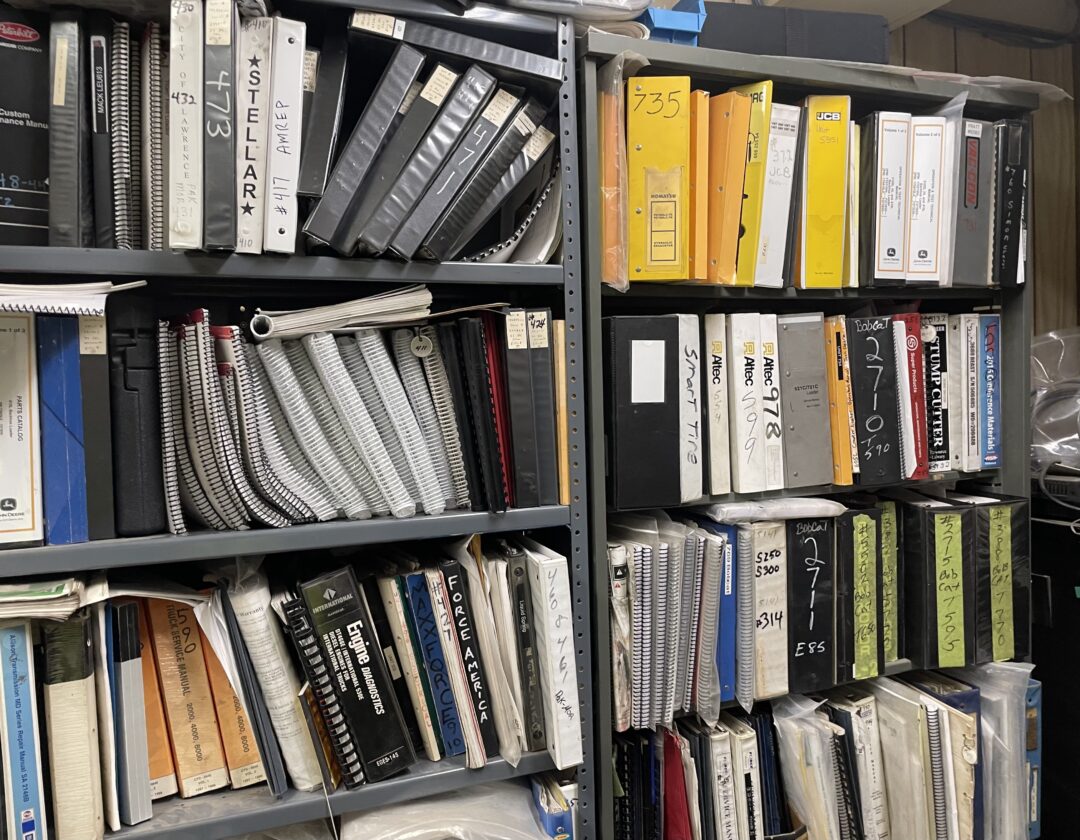
photo by: Sylas May/Journal-World
Shelves of manuals are pictured in the city’s central maintenance garage on Tuesday, April 14, 2026.
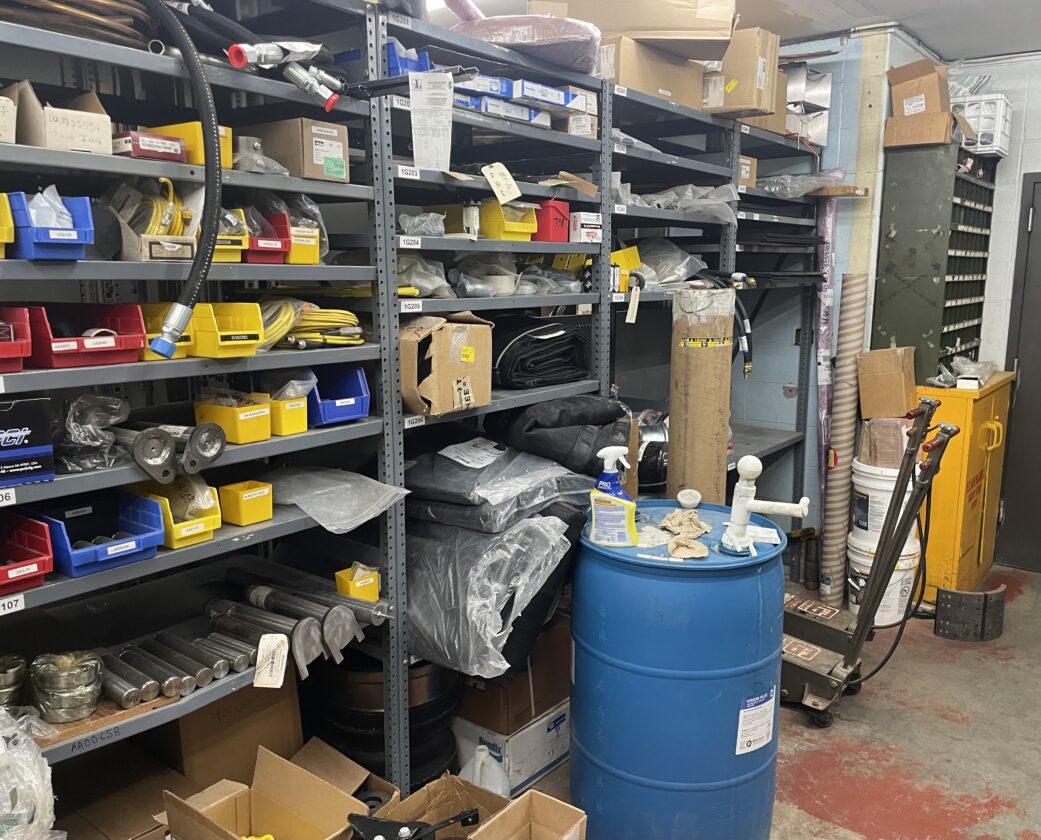
photo by: Sylas May/Journal-World
The parts room of the city’s central maintenance garage is pictured on Tuesday, April 14, 2026.
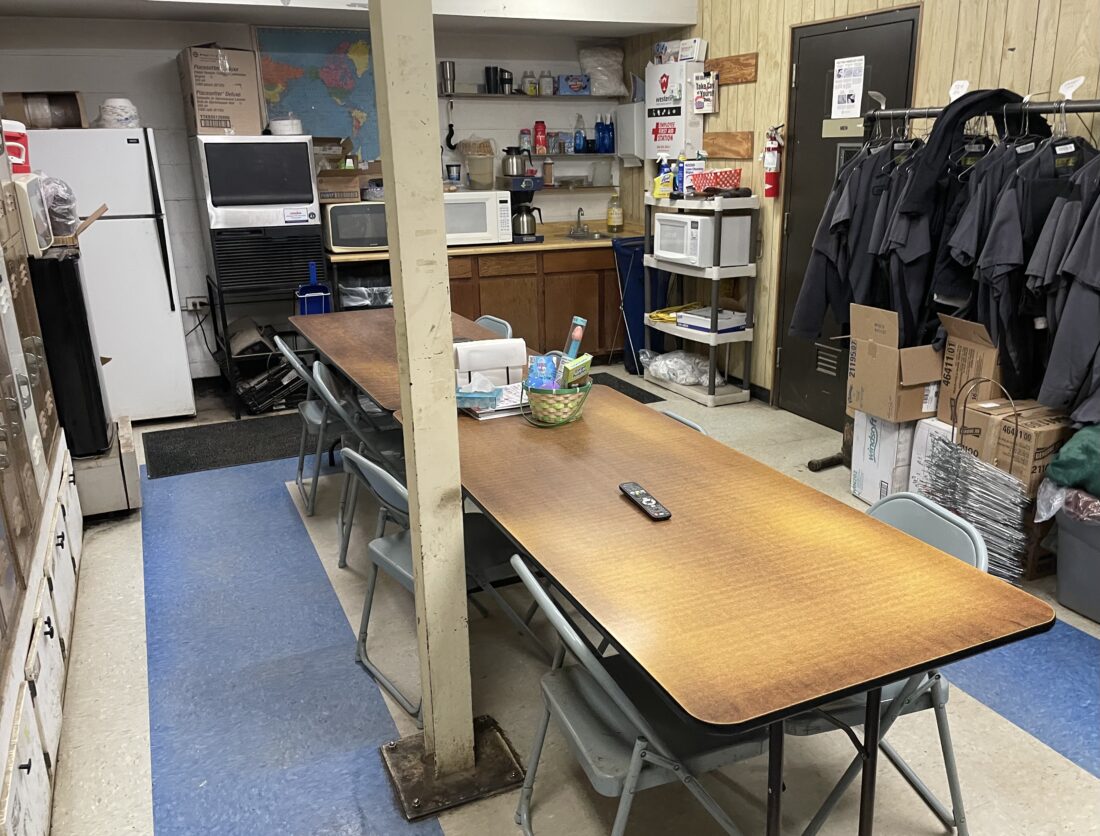
photo by: Sylas May/Journal-World
This is a combination locker room/break room at the city’s central maintenance garage. The door to the bathroom is on the right.
Other rooms in the garage look like they’ve been repurposed, too, like the locker room and lunchroom facilities. They’re both in the same room, and it has a small window in its door. It’s also connected to the bathroom, and the wood paneling on the wall makes its age clear.
“Very vintage early ’80s,” Aaron says. “If it was ’70s, it’d be a lot darker.”
However old it is, it’s a sign that an update is long overdue – especially, Aaron says, for a building that touches almost every other part of the city’s services.
“When you conceptually think about everything the city does, it doesn’t happen without a vehicle,” Aaron said. “This is kind of, I don’t want to call it the heart of operations, but it’s definitely an artery.
“We try to keep things moving, and we have lots of challenges … Space is the number one.”
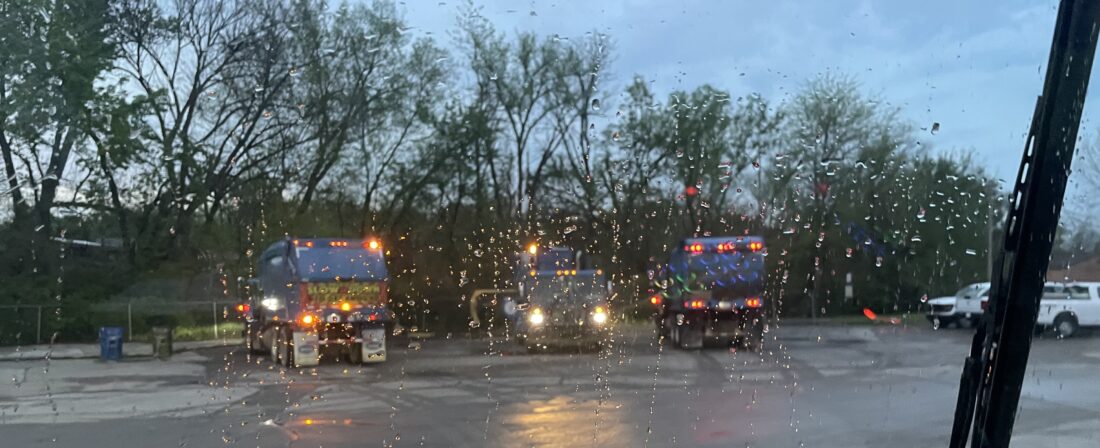
photo by: Sylas May/Journal-World
A few Solid Waste trucks are seen through another truck’s windshield on Tuesday, April 14, 2026.
‘We’ve been lucky’
Not all of the problems with the current facilities are as obvious as that. Early on Tuesday morning, before the sun has come up, Lawless points out one potential danger hiding behind a row of trees.
It’s Burroughs Creek, just to the south of the 11th and Haskell complex.
“This is all in the floodway,” Lawless says.
On the flood risk maps on the state of Kansas’ website, much of the complex is covered in blue to show its high flood risk. It’s all over the parking area, and also entirely covers the central maintenance garage.
“There’s floodplain, but then there’s floodway,” Lawless said. “That’s where the main water flows, and this area is in that. So you have all this equipment – not only the solid waste folks, but the streets folks, are all in this same area.
“We’ve been lucky,” Lawless adds. “For a long, long, long time.”
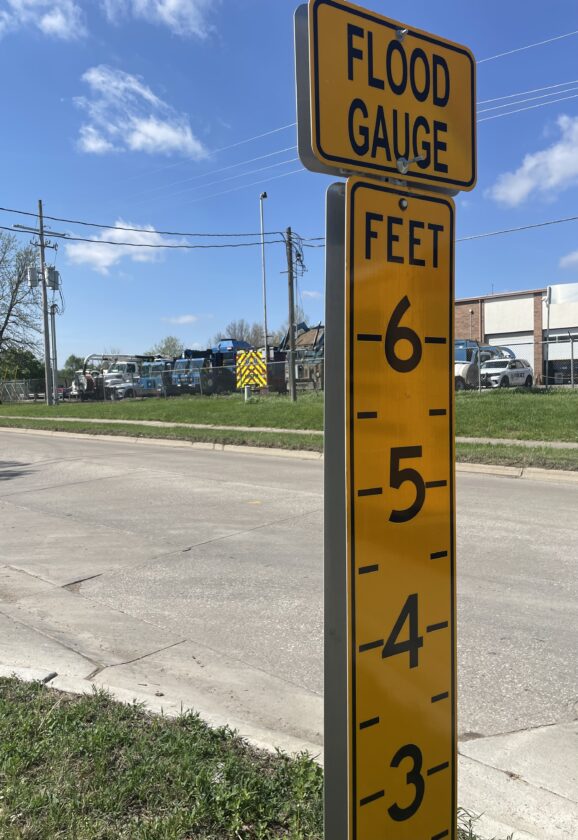
photo by: Sylas May/Journal-World
A flood gauge outside the city’s MSO buildings near 11th and Haskell is pictured on Tuesday, April 14, 2026. The area is near the Burroughs Creek and is at risk of flooding.
The oldest buildings at the complex have been there since the early or mid-’70s, and there hasn’t been a catastrophic flood here since they were built, he said. Back then, he said, there was less development and the creek wasn’t as likely to flood.
But statistics aren’t in MSO’s favor. The blue on the map stands for “AE” flood risk, which is an area that has a 1% annual chance of flooding. For context, if you have a federally backed mortgage in an AE zone, you’re legally required to have flood insurance.
The MSO campus site, just one and a half miles away, doesn’t have any blue.
Beyond just the buildings and vehicles, there are fuel and oil storage areas that are in the floodway near 11th and Haskell. Aaron said one that worries him is the underground oil storage tank at the maintenance garage.
“Obviously, whenever you have underground storage next to waterways, that’s always something to keep you up at night, because it’s a potential for failure,” he said. “… So, yeah, risk mitigation is one of those components to this campus migration.”
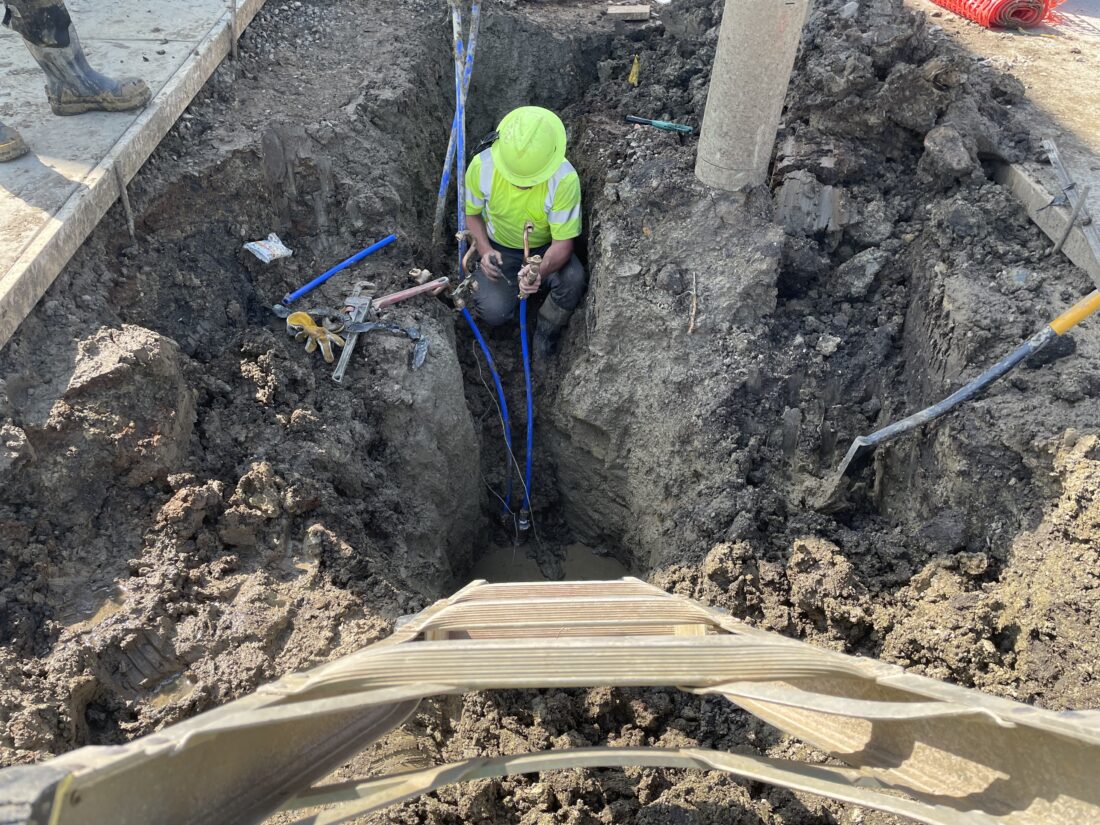
photo by: Sylas May/Journal-World
A city MSO worker installs water services for a home in western Lawrence on Tuesday, April 14, 2026.
‘We can’t add any more’
Shane Golden, field supervisor for utilities with MSO, does all kinds of water-related work with his team: “install water services, water mains, maintain fire hydrants, valves, all that sort of stuff out in the field, outside the plants.”
The problem is that they don’t have a central location for their equipment and parts. Those are scattered across the city’s water and sewer plants and nearby sites, where buildings have been gradually added on as the need has arisen.
Caleb Pettengill, of streets and traffic, has a similar problem.
While the streets division does have a presence at the 11th and Haskell site, the traffic side of the operation is in another building, tucked away in the Pinkney neighborhood. The salt used to de-ice roads is stored in a warehouse on the former Farmland fertilizer plant site. And some of the orange cones and construction markers might even be stored in the utilities buildings.
And there are times when Golden’s and Pettengill’s teams need to work together, such as when there’s a water main break that damages a street.
“Like the one on Haskell that also has some road reconstruction there,” Pettengill said; that water main broke earlier in the week. “… We’ve got to communicate real closely on that.”
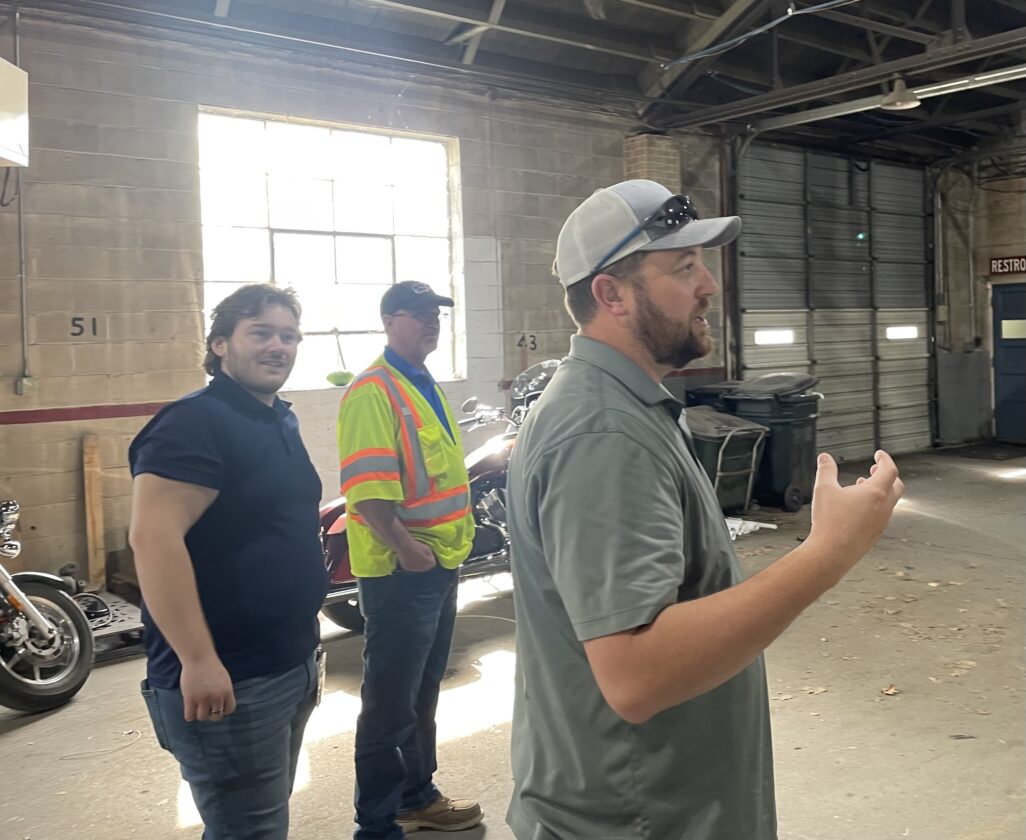
photo by: Sylas May/Journal-World
Pictured from left to right at the city’s traffic building on Tuesday, April 14, 2026: MSO spokesman Michael Leos, utilities field operations supervisor Shane Golden and streets field operations supervisor Caleb Pettengill.
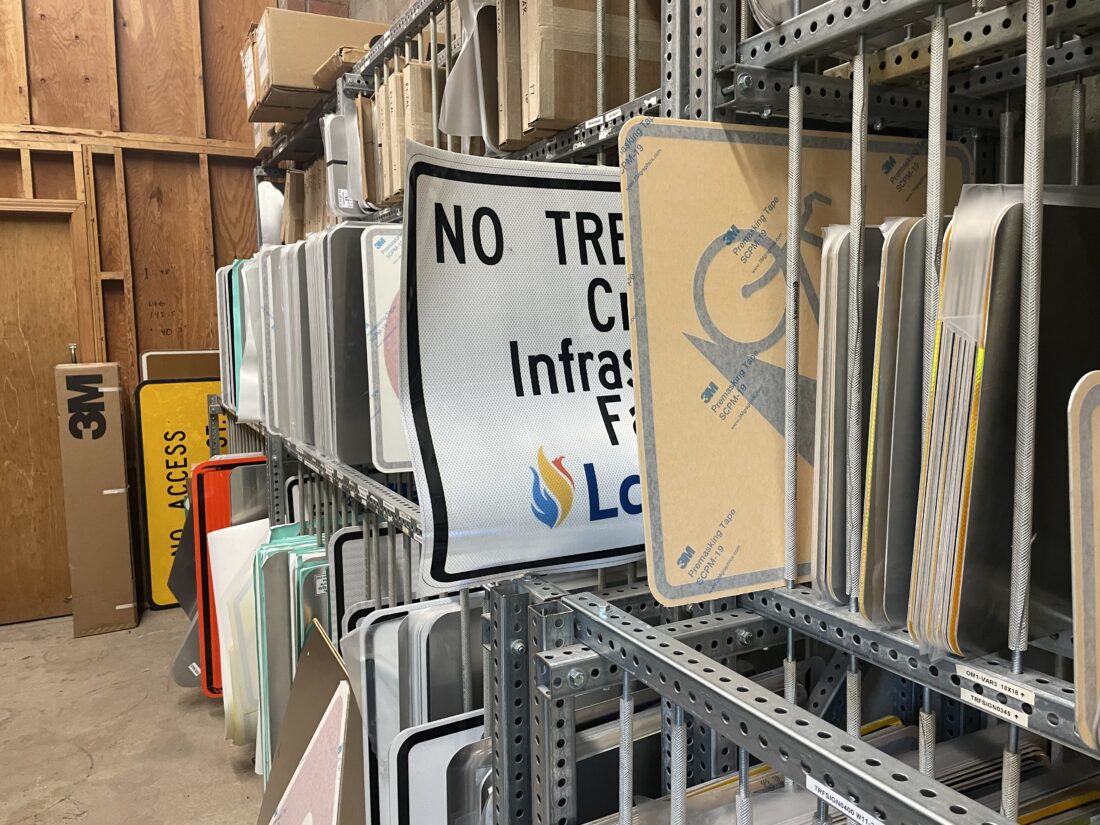
photo by: Sylas May/Journal-World
Rows of signs at the city’s traffic building in the Pinkney neighborhood are pictured on Tuesday, April 14, 2026.
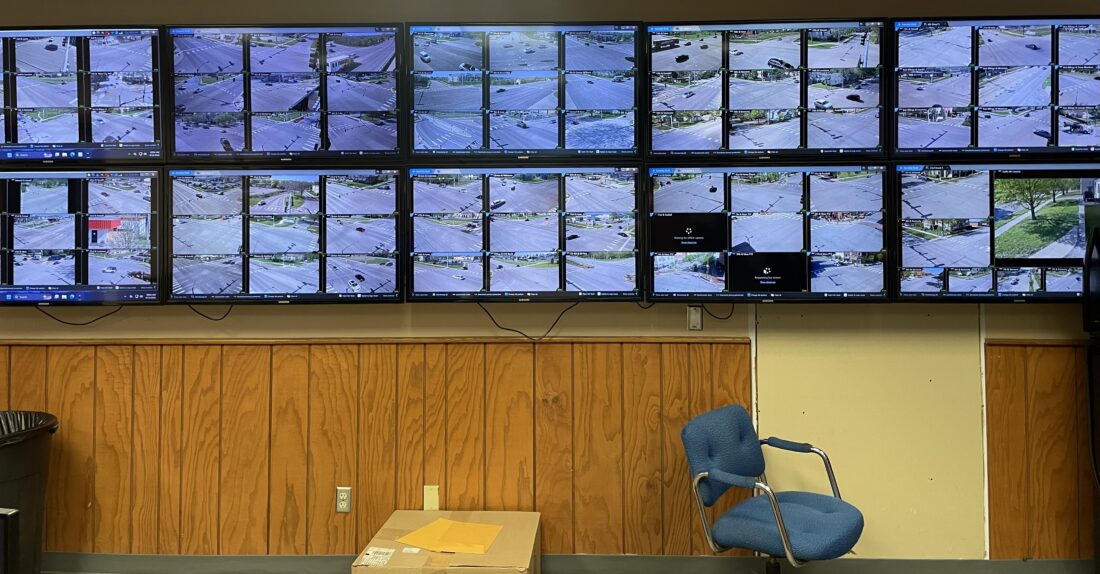
photo by: Sylas May/Journal-World
A bank of screens is pictured on Tuesday, April 14, 2026, in the city’s traffic building in the Pinkney neighborhood.
The reason the facilities are so disjointed is that utilities and public works weren’t originally part of the same department. MSO was formed by a merger of the two in 2018, and the goal of that merger was to make these similar departments more efficient – for example, by putting sanitary sewers (originally utilities) and stormwater (public works) under the same organization.
With the new campus, Lawless said, the facilities will finally catch up.
“That will allow us to bring everybody together,” he said.
Golden says a lot of the arrangements for MSO have just gradually evolved over time, and the assortment of MSO buildings near the Kansas River Wastewater Treatment Plant shows that.
One structure there he describes as a “lean-to.” It stores piles of orange construction barriers. Other structures have been added over the years, piece by piece, as more capacity was needed.
“We have several parts in here,” Golden jokes in a warehouse filled with hundreds of pieces used for repairing water lines and other utility infrastructure. (All several of them will be moving to the new campus when it opens.)
Golden doesn’t know how old this warehouse is. He says it’s been here since before he started in 2002. He asks a colleague how long it’s been here. The colleague says it was here when he started in 1992. Upstairs at the Kansas River plant, there’s an old sepia photo, and in this one the warehouse isn’t there. Golden has no idea when that was taken.
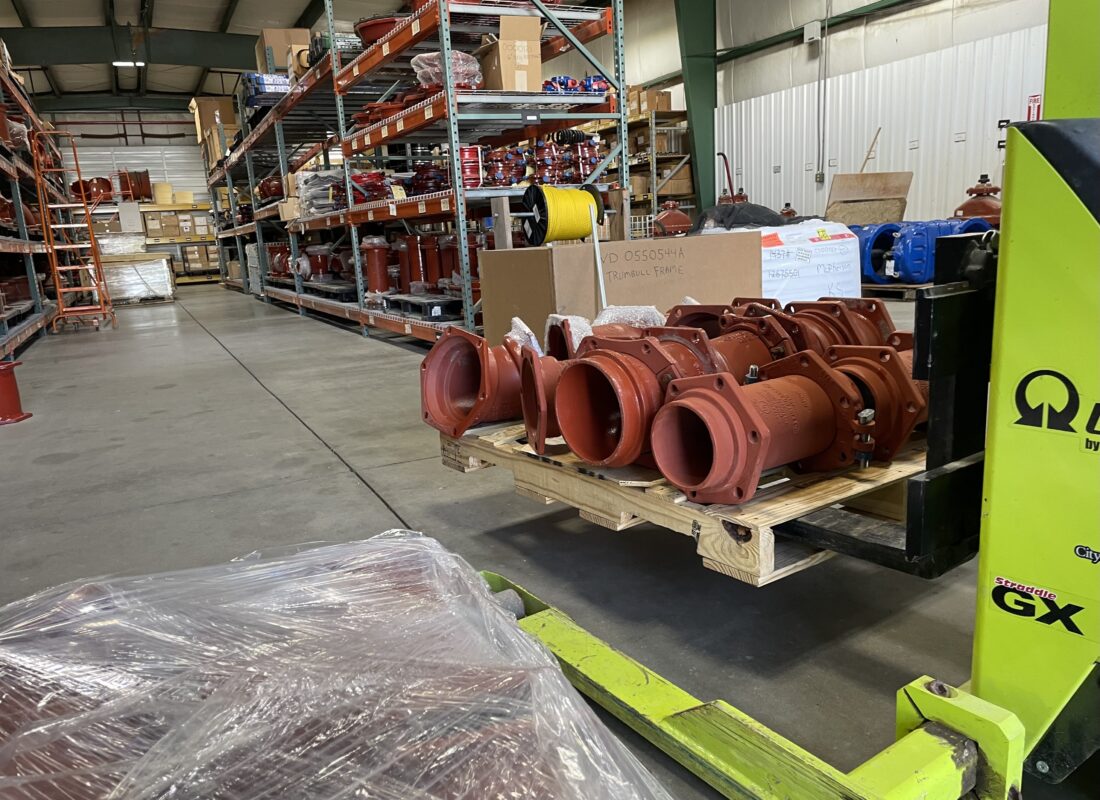
photo by: Sylas May/Journal-World
A warehouse full of “several” water infrastructure parts is pictured on Tuesday, April 14, 2026.
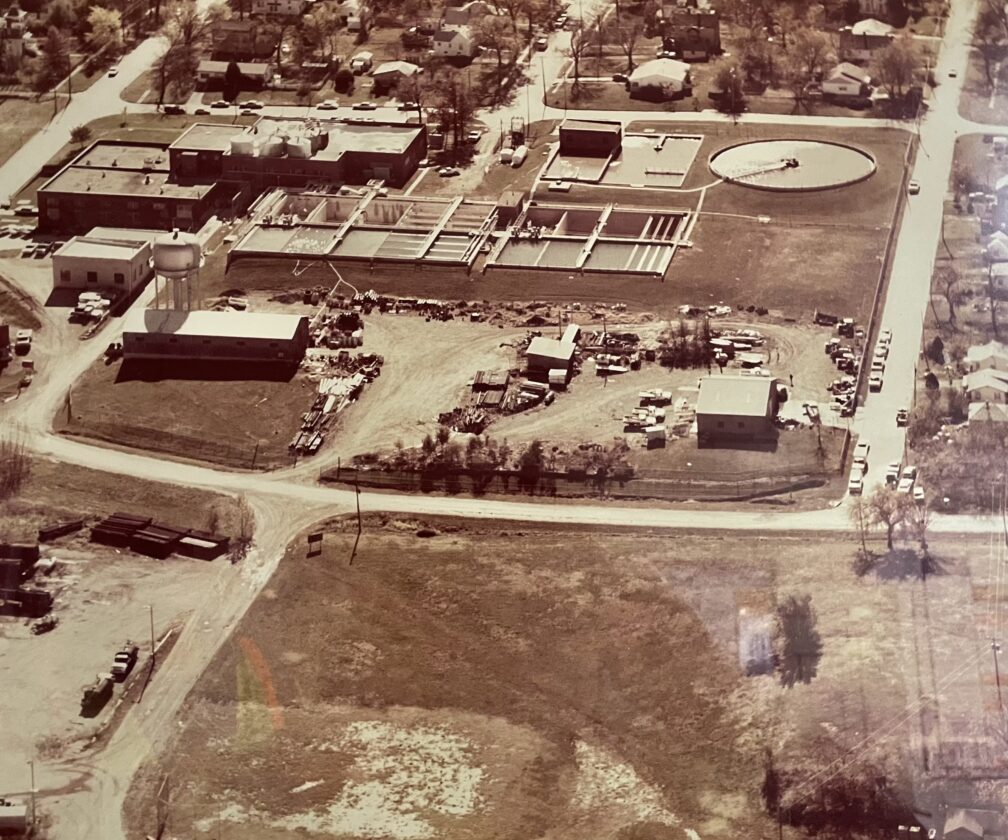
photo by: Sylas May/Journal-World
This historic photo in the Kansas River Wastewater Treatment Plant shows an old warehouse at center left. Now, there’s another warehouse (that’s also decades old) in the space right next to it.
The older warehouse right next to it is visible in that photo, and that warehouse now has rust on the outside and yellowed walls on the inside.
Then, there’s the building where the water workers meet in the morning to go over assignments. Sheets of insulation are peeling off of the walls and ceiling. The break room is too small for a lot of people to be in there at once, Golden said, so “a lot of times guys will have lunch out in the field, in their trucks.”
“They’ve got these smaller microwaves on their trucks so they can heat their food up to eat,” he said.
Even parking near these buildings is difficult. Golden and Pettengill pointed out that most MSO facilities have gravel lots, and around the utilities buildings, workers often have to park their personal vehicles on the side of the street in a residential area. As they drive past an asphalt shoulder, they say it was installed specifically to add more parking space for MSO.
It’s clear to Golden that the ad-hoc facilities arrangements aren’t sustainable.
“We can’t add any more,” he said.
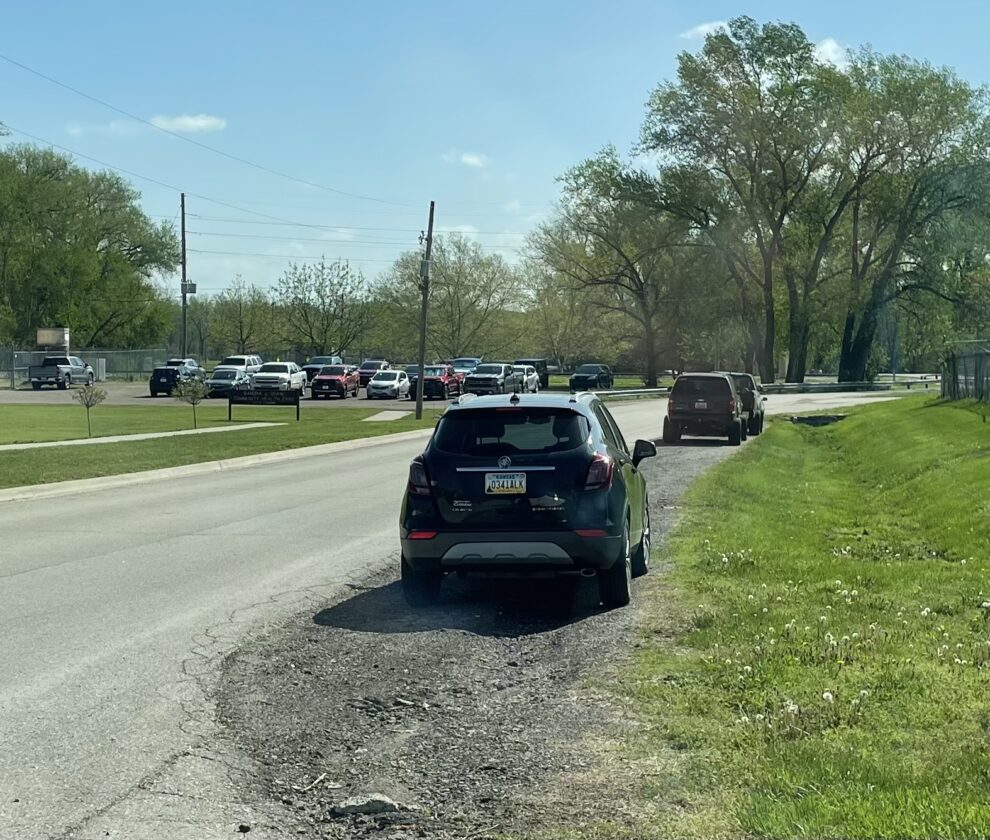
photo by: Sylas May/Journal-World
A shoulder that MSO installed just to give its workers more space to park is pictured near the Kaw River Wastewater Treatment Plant on Tuesday, April 14, 2026.
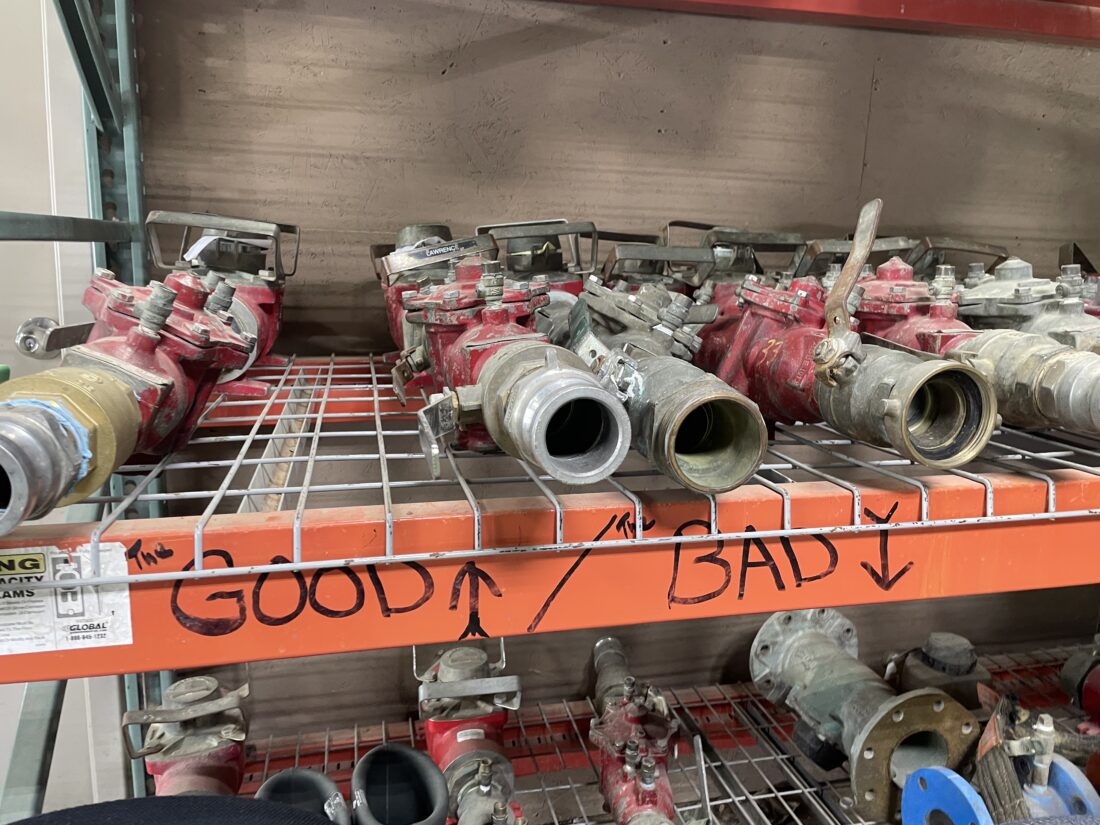
photo by: Sylas May/Journal-World
Parts sit on a shelf in an MSO utilities building on Tuesday, April 14, 2026.
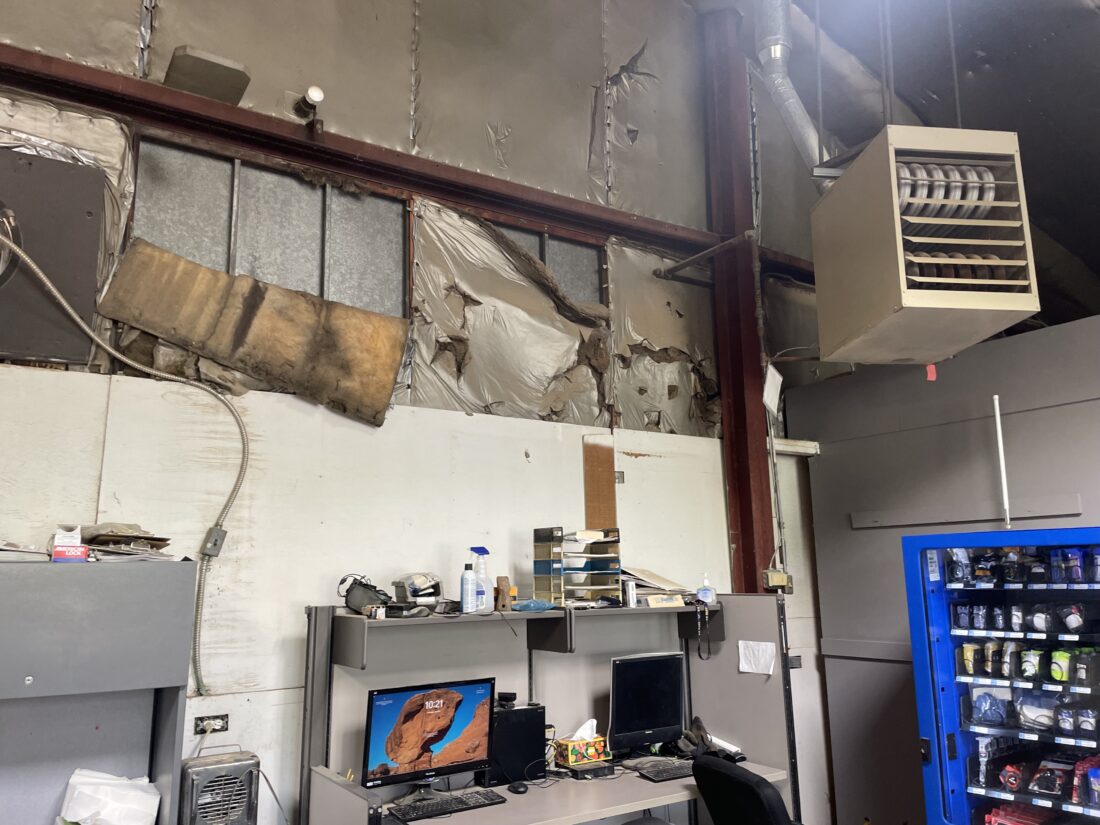
photo by: Sylas May/Journal-World
Old insulation is in poor condition in this utilities building for the city’s MSO department.
From the other side
Spencer, the solid waste supervisor, knows that some Lawrence residents aren’t happy with the MSO campus project. He realizes that to those outside of MSO, the need for it might not be obvious.
“The average resident is just seeing, ‘Oh, we’re spending $100-some-million on a building,'” he said. “They don’t really understand what’s going on with it.”
That’s similar to how Reeves thinks about his work: People don’t always understand it, he says, and they take it for granted.
Driving the side-loading truck through a neighborhood in north-central Lawrence, he comes upon a cart near the curb with an awkwardly parked car nearby that prevents him from getting to it. In residential areas, “not everybody pays attention, and they just park,” he said.
Reeves climbs out and pulls the cart out a little bit from the curb so the arm will reach, then gets back in, tip, ding, done.
In the first hour of his route, he gets out a couple more times to move a cart or throw in items like some bags sitting beside a cart or an old vacuum cleaner.
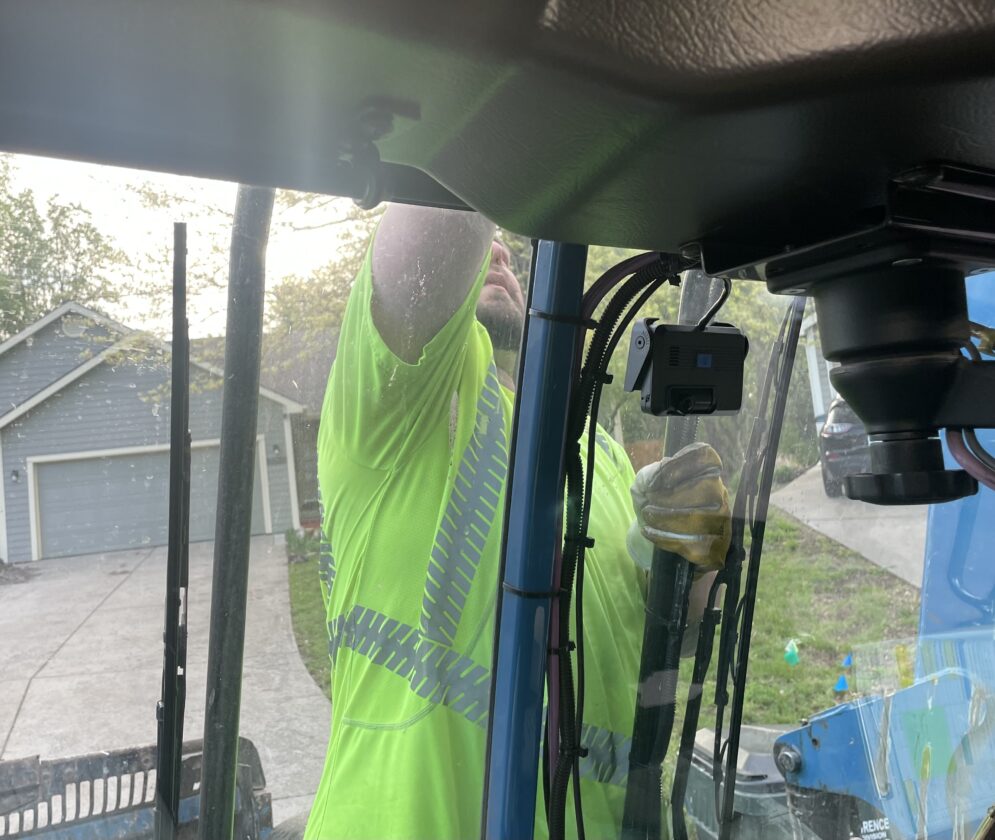
photo by: Sylas May/Journal-World
Solid Waste driver Tim Reeves clears some trash off the top of the truck on Tuesday, April 14, 2026.
Sometimes, “there are those out there who just don’t care,” he said. “‘I put it out there, you pick it up.’ … ‘I pay you for a service, your job is to pick up my trash: pick it up.'”
But there’s another category, too.
There’s a house with two carts and an extra-long box wedged between them. Reeves stops and gets out to throw it in the truck, and says he gets why they did it that way.
“We understand, the purpose is because your big box didn’t fit, and you’re trying to hold it together,” he said. “They don’t realize that now I have to get out and move that, because now it’ll knock everything over.”
“The logic is sound,” he says.
It’s just that they don’t see it from the other side.
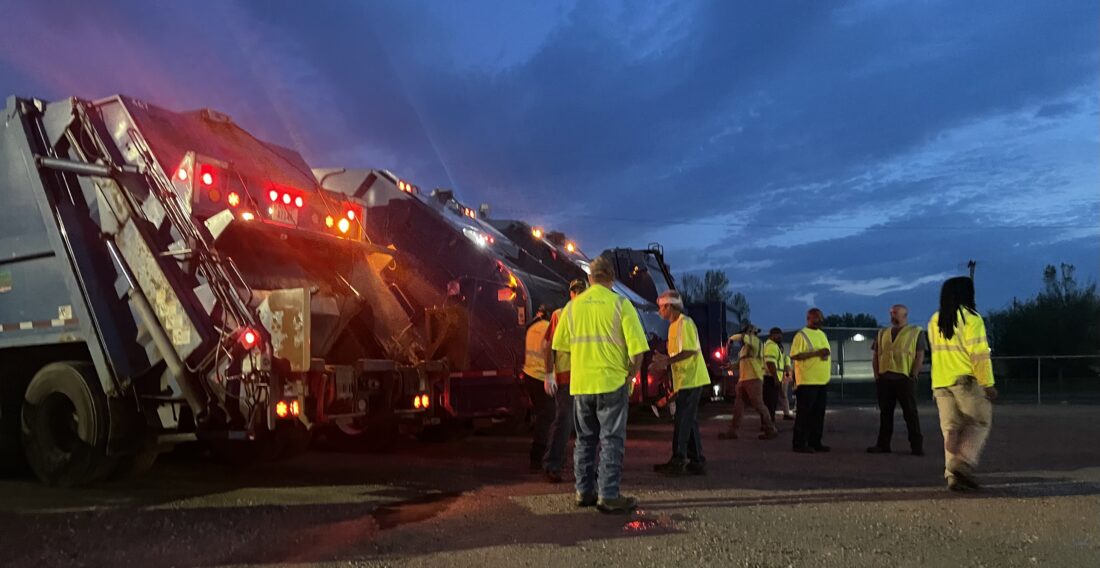
photo by: Sylas May/Journal-World
Before starting their shifts on Tuesday, April 14, 2026, the city’s Solid Waste employees perform their routine checks.
City Government
Lawrence City Commission to weigh whether Costco should be included in STAR bond district
As they approve bikes plan, Lawrence city leaders ask about data collection, Kentucky and Tennessee streets
Lawrence city leaders want to toughen tobacco licensing rules ‘sooner than later’
Algerian government invites Mayor Brad Finkeldei, Lawrence delegation for a visit
Construction on Wakarusa Drive to resume; city manager says KDOT’s secretary has apologized for delay