U.S. Sen. Roger Marshall tours Bert Nash Community Mental Health Center, discusses its new certification

photo by: Austin Hornbostel/Journal-World
U.S. Sen. Roger Marshall, right, speaks with Bert Nash Community Mental Health Center CEO Patrick Schmitz during a tour of the agency Friday, Oct. 20, 2023.
U.S. Sen. Roger Marshall was in Lawrence Friday, and he spent his visit learning more about Bert Nash Community Mental Health Center.
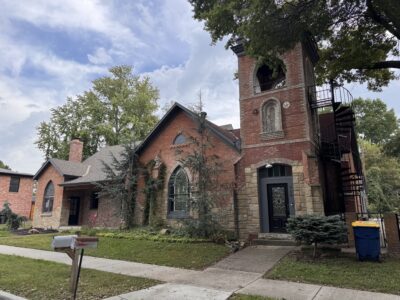
Bert Nash CEO Patrick Schmitz gave Marshall a tour of the center’s clinic space at 200 Maine St., and the two also spoke about Bert Nash’s services.
Marshall, who is a physician, recently co-sponsored bipartisan legislation with Sen. Bernie Sanders that proposes more than $26 billion in funding to expand primary care and address a shortage of health care workers across the country. In part, the bill includes a focus on expanding mental health care in community health centers.
On Friday, Marshall wanted to know more about Bert Nash’s status as a Certified Community Behavioral Health Clinic and how that differs from a Community Mental Health Center. Bert Nash has been provisionally certified as a CCBHC since July of 2022 and recently earned full certification from the Kansas Department for Aging and Disability Services.
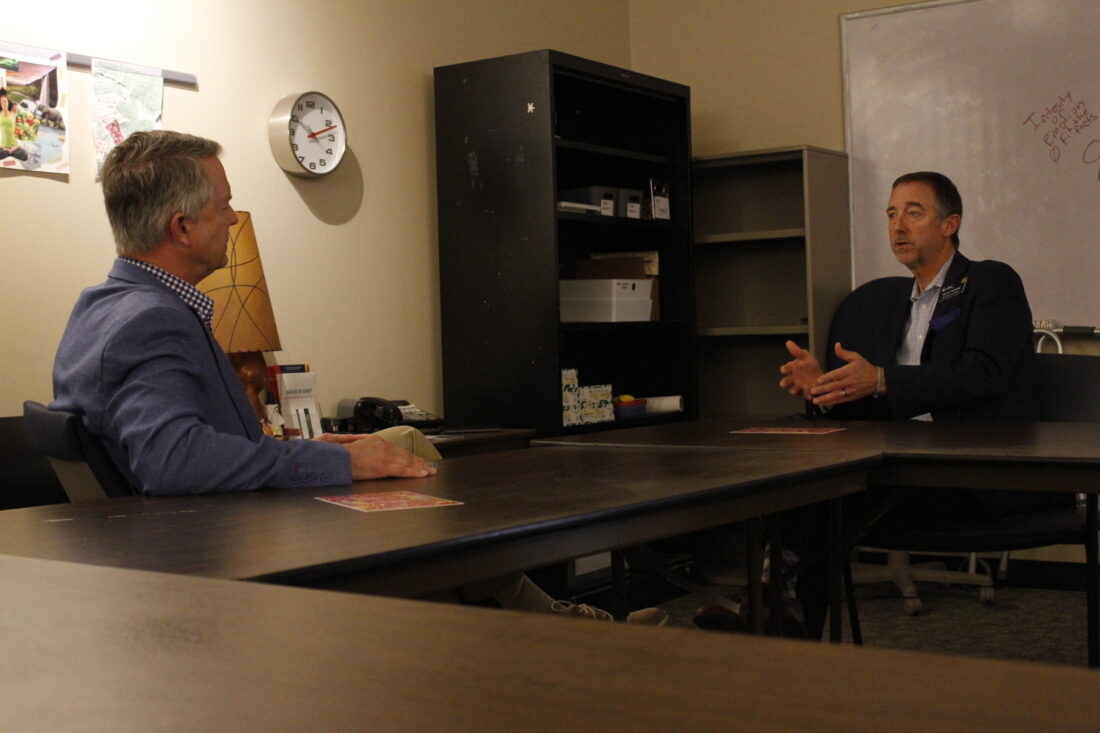
photo by: Austin Hornbostel/Journal-World
During a tour of Bert Nash Community Mental Health Center on Friday, Oct. 20, 2023, Bert Nash CEO Patrick Schmitz and U.S. Sen. Roger Marshall sat down to speak in more detail about the agency’s work and future plans.
Schmitz said a CCBHC designation is a “game-changer” for a variety of reasons. For one, he said it lays out both the core services each center needs to provide, which aren’t uniform otherwise, and also the measurements and outcomes each center has to meet.
Schmitz said the other significant difference is the CCBHC payment methodology, which is based around “cost-based reimbursement” — a system where the payer agrees to reimburse the provider for the costs incurred in providing services to the insured population. That allows Bert Nash to account for the “true cost” of providing care when serving patients on Medicaid, which applies to the vast majority of people receiving services at Bert Nash.
By extension, Schmitz said that capability has become a cost-saving measure for the agency. It’s allowed Bert Nash to increase staff salaries between 10% and 30%, depending on position, and to be able to ensure the agency can afford needed technology and resources.
“This is the story — this is why Bernie Sanders and I are working so hard to improve access to primary care, especially in mental health,” Marshall said. “We have standards for what does a cardiac unit look like, what does an orthopedic unit look like. Well, what does an outpatient behavioral health unit look like? Let’s take best practices — many of these practices (Bert Nash was) already doing — and measure them; we can’t expect to keep doing the same thing and get a different result. Our vision that I shared with Senator Sanders is that our community health centers, behavioral centers or (federally qualified health centers), we have to meet patients where they are.”
Schmitz also highlighted some of Bert Nash’s new and future projects. One of them was the Treatment and Recovery Center of Douglas County, a dedicated facility for people experiencing a behavioral health crisis. Bert Nash has been operating the Treatment and Recovery Center at 1000 W. Second St. — which includes a front-of-house urgent care center and an observation and stabilization unit for patients who need to stay for anywhere from 23 to 72 hours — since spring of this year. Schmitz added that the facility works hand in hand with another newer Bert Nash program, its mobile crisis response team that dispatches therapists and case managers to assist people who call the 988 national suicide and crisis lifeline or whose calls have been forwarded from community partners and law enforcement officers.
He also told Marshall about Bert Nash’s planned 24-unit supportive housing complex for people struggling with homelessness and behavioral health disorders, and another project aiming to develop a children’s crisis center similar to the Treatment and Recovery Center.
“I think our biggest challenge is ensuring that the Certified (Community) Behavioral Health Clinic model gets stood up here in Kansas, and that it eventually becomes a federally supported program,” Schmitz told Marshall. “You probably know that (a U.S. Senate bill) was recently introduced, and that is ensuring the CCBHC model (is adopted) across the country.”
Other News
Clinton State Park and other state parks will increase overnight camping, vehicle permit fees starting next month
‘No day is like the other here’: Students from Lawrence’s German sister city discover football, new foods and new friends on exchange
GCSAA celebrates 100 years with new plaza and statue honoring its founder and first president

Go, See, Do: Library book sale, candidate forum and more

Gas station at Lawrence’s new Costco will be open starting next Wednesday