‘I love a challenge’: Tonganoxie Army vet gears up to tackle 2,200-mile Appalachian Trail
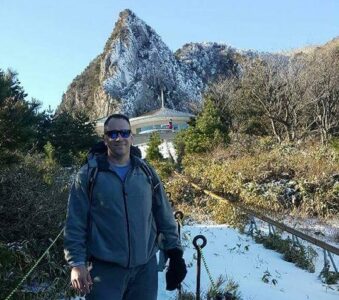
photo by: Dan Yunghans
Tonganoxie Army veteran Dan Yunghans is pictured on a New Year's Day 2017 hiking trip to summit Mount Hallasan on Cheju Island in South Korea. Yunghans is preparing to hike the nearly 2,200-mile-long Appalachian Trail starting in March.
For 51-year-old Army veteran Dan Yunghans, the prospect of hiking the nearly 2,200-mile-long Appalachian Trail isn’t just an exciting what-if; it’s a challenge he’s eager to tackle.
“I love a challenge,” Yunghans told the Journal-World recently. “I was in the Army for 20 years, and (what) I did in that wasn’t necessarily easy. It was always a challenge. I get out in the civilian world and all of the sudden it’s like, ‘What am I going to do, man?'”
Call it “wanderlust” if you want, Yunghans said, but he just can’t stay still for too long. He’s always looking for an adventure, and he’s hoping to find his next one on one of America’s longest hiking trails, which spans from north Georgia’s Springer Mountain to Mount Katahdin in the middle of Maine. He plans to start on March 3.
Yunghans retired from the Army in 2017 after two decades of service as a linguist in the military intelligence corps. His Army career saw him bounce around the United States to California, Texas and Washington, plus deployments of three years in Germany and around six combined years in South Korea. He’s a sixth-generation Kansan from Lansing who now lives in Tonganoxie.
One of Yunghans’ friends from the Army completed the Appalachian Trail in 2018, and that’s who turned him on to tackling the feat. Yunghans was actually invited along for his friend’s trip but had to decline; though he’d retired from the Army in 2017, he was a single parent with a son in high school. That has left him with a lot of time for the anticipation to build.
“I’ve been waiting five years for this,” Yunghans said.
Those years haven’t just been filled with waiting idly, though. Yunghans has completed other trail hikes during that time, like the rigorous 26-mile Eagle Rock Loop in Arkansas. Earlier in 2022, he also completed the 126-mile-long Centennial Trail in South Dakota’s Black Hills, stretching from Bear Butte State Park to Wind Cave National Park. Yunghans described a memorable trek on the latter trail, during which he was able to hike right up to Mount Rushmore and came face-to-face with a buffalo.
Through his forays on other hikes, Yunghans has become close friends with a group of fellow hikers he describes fondly as his “trail family.” He refers to them by their trail names, nicknames used on the trail that are often granted by other hikers. There’s “Professor,” “Moose,” “KneeDeep” and “Socks,” plus one friend who’s yet to get a trail name of his own, Sean.
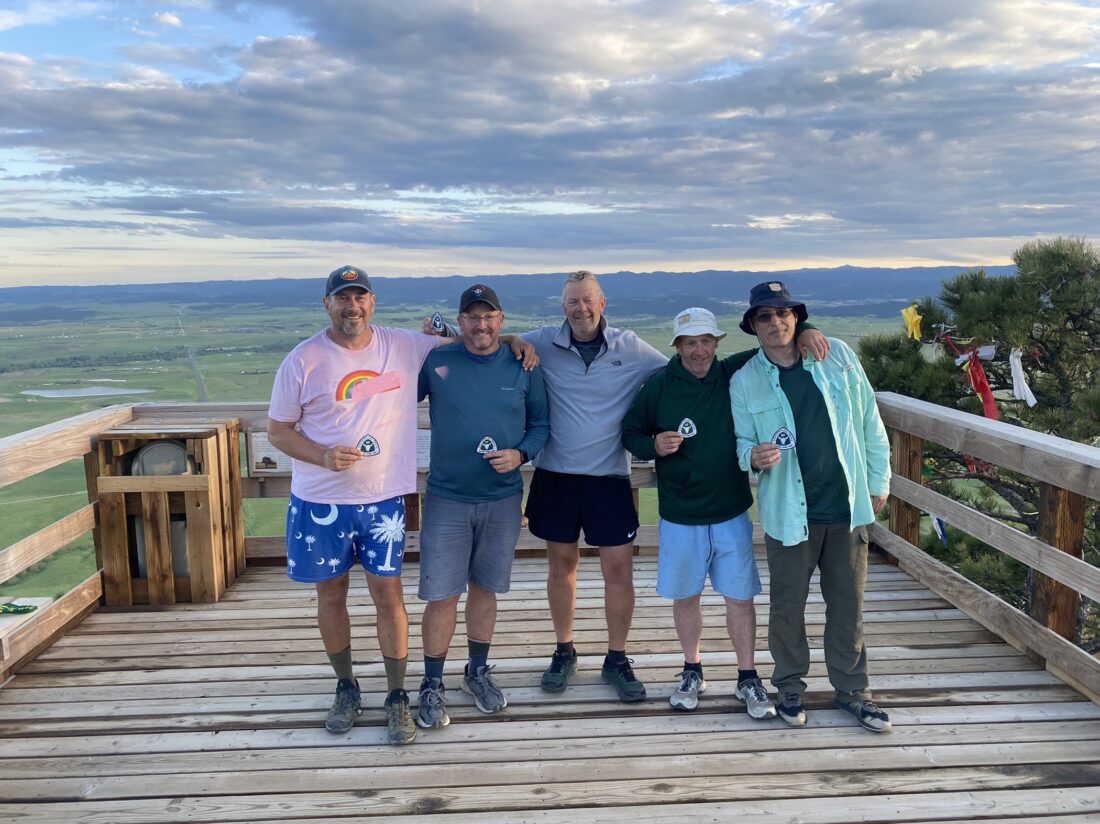
photo by: Dan Yunghans
Dan Yunghans is pictured here at left on a hiking trip with his “trail family” — from left to right, Sean, “KneeDeep,” “Moose” and “Professor.”
They’re all going to join him at the start of the Appalachian Trail, Yunghans said. “Professor,” who’s based in San Antonio, has already completed the Appalachian Trail himself and will be joining Yunghans for about three weeks of his six-month journey. “Moose,” from Maine, has finished all but 500 miles of the trail and will also be joining for some time. Sean is based in Arizona, and Yunghans said he’ll be the one giving him a ride from Kansas to where he plans to start — an 8-mile approach hike to Springer Mountain in Georgia.
Hiking is something of a subculture, Yunghans said, and all the folks he has met while doing it have been the most thoughtful and grateful people he’s been around. He said it’s almost shocking how willing they’ve all been to help him along the way and how quickly they’ve held the door open for him. The group that makes up his “trail family,” for example, is a crew Yunghans only recently started hiking with on the Centennial Trail trip.
Like Sean, Yunghans doesn’t officially have a trail name yet, since he’s relatively new to hiking. He said it’s typical that on a trail like the Appalachian, the group you’re hiking with will “figure you out” and grant you a trail name themselves. But he’s hoping a longtime nickname of his — “DannyBoy” — will be the one that sticks.
“I’ve been ‘DannyBoy’ since, I think, St. Patrick’s Day in 2000,” Yunghans said. “It’s been ‘DannyBoy,’ that’s how everybody knows me. I think I’m just going to walk in there and just start calling myself ‘DannyBoy.'”
…
According to the Appalachian Trail Conservancy, thousands of hikers attempt to hike the entire trail each year, with only about one in four making it all the way. Yunghans said he’s anticipating it’ll take six months for him to complete the entire 2,200 miles.
But how do you adequately prepare for a hike that’s thousands of miles long? Yunghans said some hikers might recommend taking up a cardio regimen, while others might go as far as to say there’s nothing at all you can do that will prepare you for a hike this intense.
Yunghans hasn’t been doing anything too intense himself; he has been practicing tai chi to stay limber and has been exercising to strengthen his core muscles and hip flexors. He stretches and walks, and he’ll continue to stay active between now and March.
“Usually, I try to do a little something every day,” Yunghans said. “I’m 51, man. …I’ve got to make sure I’m limber.”
One thing to look out for as far as physical health is concerned is what Yunghans calls “hiker hunger.” Many seasoned hikers will recommend putting on weight before a longer trek, and that’s because the extra pounds will be lost by the time the hike’s complete. It’s hard to eat a balanced diet on the trail.
Not only that, a hiker can end up practically “emaciated” by the end, Yunghans said, because the amount of calories you can burn while on the trail is downright impossible to replace as you go.
“I’m excited for that, for that weight loss,” Yunghans joked. “I’ll look all svelte like I’m 30.”
He said the food list in a hiker’s pack might consist of items like oatmeal, freeze-dried fruit and other foods, tortillas and Knorr-brand pasta sides, which come in a pre-packaged pouch. When he comes across a town, Yunghans said he anticipates taking advantage of the opportunity to buy fresh green vegetables and other foods that he can’t just bring along the whole time.
Yunghans said he’ll carry everything he needs on his back. Along with food and water, that includes a sleeping bag, sleeping mat and the tent he’ll pitch wherever he stops to sleep along the trail.
“I’ll sleep, I’ll wake up, and I’ll start hiking again,” Yunghans said.
Yunghans’ expedition won’t be restricted to only hiking, though. He said he already has plans to come off the trail and see some sights along the way. That’ll include “checklist” spots like Times Square in New York City and the national monuments in Washington, D.C. One activity, though, will involve a flight away from the East Coast to remote Chicken, Alaska — a tiny community with a population of 12 as of the 2020 U.S. Census — for the town’s annual “Chickenstock” Music Festival.
That’s part of a philosophy, he said, called “hiking your own hike.” You go at your own pace, whether that means hiking 10 miles per day or simply taking a coffee break.
A lot of people want to take on a hike like the Appalachian Trail but they can’t, Yunghans said, or at least they think they can’t. In taking on the challenge himself, he’s hoping in part to inspire people to do whatever it is they want to do.
“You’ve just got to put your mind to it, you know?” Yunghans said. “You’ve just got to allow yourself to do it. I would like to inspire like that. That’s what I did in the Army; I inspired people to be better than they were, and I was good at it, and I’ve missed it.”
If you’re looking to follow along as Yunghans tackles the trail, he’s made an Instagram profile to document his progress — @havedan_willtravel.
Other News

Douglas County commissioners to discuss proposed changes to funding agreements with community partners

RJ Mitte, ‘Breaking Bad’ actor and disability rights champion, dies at 34

Clinton State Park and other state parks will increase overnight camping, vehicle permit fees starting next month

‘No day is like the other here’: Students from Lawrence’s German sister city discover football, new foods and new friends on exchange
GCSAA celebrates 100 years with new plaza and statue honoring its founder and first president