Lawrence-Douglas County Fire Medical receives five-year accreditation, but also gets list of improvements to consider
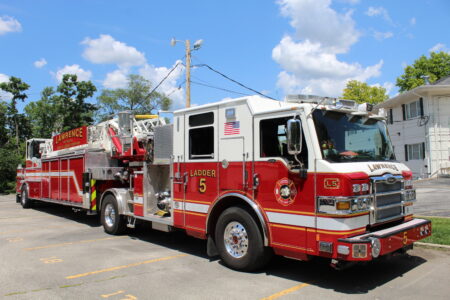
photo by: Chris Conde/Journal-World
LDCFM Firetruck Ladder 5 in July 2023.
Lawrence-Douglas County Fire Medical works with a whole lot of agencies as it provides firefighting and ambulance services, but often the department lacks formal agreements with its key partners.
That may be creating unnecessary costs, department leaders were told as part of LDCFM’s recently completed five-year accreditation process.
Partnerships noted in the report from the Commission on Fire Accreditation International include the establishment of a facility-use agreement with neighboring fire agencies, as well as a paid-service and training agreement with the University of Kansas for large-scale and planned special events.
It was discovered during an audit, according to the report, that “several (LDCFM) practices are completed without formal agreements.” Not using formal agreements, the report noted, could be hindering LDCFM’s ability to recover the full costs of its investments.
“It is recommended that the agency explore mutually beneficial relationships and cost recovery opportunities,” the report said.
The issue with partnerships was one of 20 recommendations that LDCFM was provided as part of its accreditation process. The department received full accreditation — basically a stamp of approval from outside experts — and Douglas County commissioners were told last week that the 20 recommendations were not an unusual number for a department to receive during accreditation.
“It’s typical to get anywhere from 10 to 30 recommendations from the (accreditation) peer team, in the spirit of continuous improvement,” said McKenzi Ezell, LDCFM data analyst/accreditation manager.
How much money the department might lose as a result of not having formal agreements with KU or other partners wasn’t estimated in the accreditation report. However, LDCFM Chief Rich Llewellyn said that formal agreements with outside agencies have “been big on (his) radar screen” since assuming the department’s top post in July 2022.
“When I got here, the fingernails on the chalkboard were handshake agreements,” Llewellyn told commissioners.
Llewellyn didn’t cite specific examples, but indicated that “handshake agreements” with outside partners were common.
“So a best practice is to formalize those agreements, and that’s an area we’re moving forward with and trying to work through,” Llewellyn said.
Other issues
The report made several other recommendations. They included:
• An increased focus on public education programming. That could include fire safety programs geared to school-age children; slip, trip and fall avoidance training for seniors; and cooking safety for college-age adults.
The report says LDCFM has found that staffing shortages have affected its ability to consistently deliver its public education programming.
“The lack of a consistent point of contact for public education has proven to impact the agency’s ability to deliver uninterrupted public education sessions,” the report read. “It is recommended that the agency analyze the workload and workforce of the fire division program to meet community expectations and goals of reducing risk.”
• An increased emphasis on mentoring for employees, with a goal of preparing them to move into higher-ranking positions.
• Improvement in the “tracking and compliance of annual physicals” related to the department’s BeHealthy wellness and fitness program.
• Further review of staffing levels for some of the department’s most critical tasks. The report found that the number of firefighters available for certain fire suppression tasks “does not match the assets at risk.” The report recommended the department revisit how it assigns certain tasks.
• Creation of more specific geographical planning areas for the department. The report found some of the planning zones used by the department covered large geographic areas. Narrowing those zones might allow the department to better focus on specific needs within specific communities.
“Douglas County right now has some really big planning zones,” Ezell said. “And through creating a community risk-assessment (document), we realized that it might be beneficial for us to reassess that and potentially break those down for the city of Lawrence, Eudora and Baldwin. That will not only help us when we’re looking at data, but also in the community risk reduction area.”
County Government
Housing Stabilization Collaborative’s new system directs rental and utility aid to more vulnerable households, review finds
Housing Stabilization Collaborative’s request for city trust fund aid won’t be considered because it was filed late
Douglas County commissioners discuss tracking results of awarded funding to community partners
General Election Voter’s Guide

An incumbent Douglas County commissioner faces no opponent in general election