Next draft of revised regulations for wind energy projects could come to Planning Commission later this month
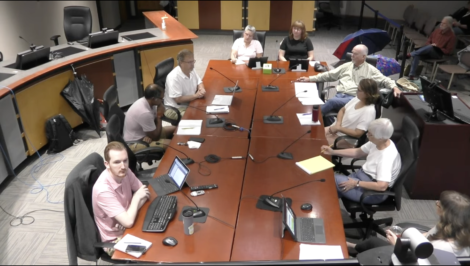
photo by: Lawrence-Douglas County Planning Commission screenshot
Members of the Lawrence-Douglas County Planning Commission heard more about the process of revising the county's regulations for wind energy projects during the group's Wednesday, Aug. 9, 2023 meeting.
Visits to a pair of Kansas wind farms, meetings with multiple industry experts and a line-by-line review of the revised regulations for wind energy projects in Douglas County have all been part of the work to produce a second draft of those rules for further public input.
The Lawrence-Douglas County Planning Commission met for a study session Wednesday morning, during which planning commissioners heard from the ad hoc committee formed back in March specifically to conduct further research and propose changes to the regulations outside of the full Planning Commission’s regular meeting time. According to Planning Commissioner Gary Rexroad, who’s serving as the lead for that committee, the next draft could be ready for review by later this month.
“We’re going to be working to completely clean up all the work in draft two, get it ready to publish,” Rexroad said Wednesday morning. “We (hope that) will happen sometime in August. And then we go into reviews.”
Even after a second draft is presented to the Planning Commission, it won’t yet be time for it to move on to the Douglas County Commission for final approval. That will happen after another months-long review process involving county staff and the community, likely lasting until October or November.
Rexroad said Wednesday that the group’s goal is to write regulations that reflect the character, values and goals of the county while not hindering the renewable energy industry. To that end, Rexroad outlined a long list of actions the ad hoc committee has taken since March to make that goal a reality. Some of that work has happened internally, such as meetings with numerous county planning departments and staff members.
But many other items on the list were related to external groups and experts. For example, the ad hoc committee has heard from industry experts with construction engineering firm Black & Veatch and the Kansas Department of Wildlife and Parks, along with an acoustic engineer and an environmental consultant. The group also met three times with the Douglas County Rural Preservation Association, a grassroots group of Douglas County residents who believe industrial-scale solar and wind projects would have a negative impact on rural residents, and examined regulations from 15 other counties.
The ad hoc committee even paid a visit to Prairie Queen Wind Farm, which is located about an hour and a half south of Lawrence in Allen County, and Marion County’s Diamond Vista Wind Farm, which is a little over two hours away from Lawrence.
That’s all on top of a line-by-line review of the first draft of the revised regulations, Rexroad said.
“We walked through the code line by line making recommendations for things as small as punctuation, because that sometimes can make a difference in the meaning,” Rexroad said. “And in some cases, (we made) substantial and material adjustments to what the meaning of the code was.”
That’s resulted in “hundreds” of changes that tightened the recommendations first made by planning staff back in December. Perhaps the most significant change is that the second draft now differentiates between “non-participating” landowners — people who live near a potential project and haven’t leased their land for a future turbine placement — and “participating” landowners. That group of stakeholders was a “constant” part of the ad hoc committee’s day-to-day conversations, Rexroad said.
That distinction is intended to allow for more deference for the non-participating group while simultaneously imposing fewer restrictions on the participating group. Rexroad called that an effort to provide some “balance” in the “regulatory footprint” laid out in the county’s rules.
One difference between the revision and the previous version is that the revision focuses more on the people who live on or near land that would be affected by the projects — and less on people who are for or against renewable energy or commercial energy projects in general.
“One of the things we worked to parse through in almost every conversation we had was where is that line on policy?” Rexroad said. “We’re talking about land use, and policy is the (Douglas County Commission’s) decision, so we wanted to stay focused on the land use questions.”
Many county residents aren’t participating in a potential wind project simply because they haven’t been asked to, or because a company hasn’t expressed interest in developing one in their area, but Rexroad said most comments and feedback so far have come from areas of the county that are being targeted for potential wind energy development.
He didn’t specify any potential project, but it could be Florida-based energy firm NextEra Energy Resources’ proposed Larksong Wind Energy Center. The company was exploring the viability of bringing the project to southwestern Douglas County and parts of Franklin County, but it hasn’t yet filed any plans to proceed with developing it.
“We’re not writing for that project, we’re not writing because of the project,” Rexroad said. “We’re writing for all of Douglas County, but just want to be clear that that differentiation shows up. So when we write these (regulations), we’ve thought about how do we write with those two groups in mind?”
Rexroad also highlighted some other, more technical, changes the ad hoc committee has recommended related to “active” topics like specifications for tower height and clearance, sound, flicker and setbacks.
The limits for sound generated by wind turbines, for example, may be based upon whether a landowner is or isn’t participating in a project in the next draft of regulations. The subcommittee settled on limits of 50 decibels from the property line and 45 decibels from an occupied structure — or home — for any non-participating landowners, and no sound limits for participating ones. The potential changes to sound requirements could also bar any “pure tone” noise — a classification of sound that is more annoying than common broad-spectrum sounds — from being audible to non-participating landowners.
“I just want to remind everybody — we’re not voting on this today; discussion is fine across the group,” Rexroad said. “But when we get ready to adopt or adjust these regulations, that’ll be done in a public meeting with full public comment.”
Other News
U.S. Sen. Roger Marshall faces Democratic, Libertarian challengers in general election

Incumbent Douglas County commissioner and newcomer challenger face off for District 5 seat
Primary winner faces incumbent’s write-in campaign in Douglas County Commission District 4
A student-run coffee shop will open at Community Connections at Pinckney next week
Douglas County commissioners to discuss proposed changes to funding agreements with community partners