Lawrence city leaders say they are ready for city to expand into area west of Kansas Highway 10
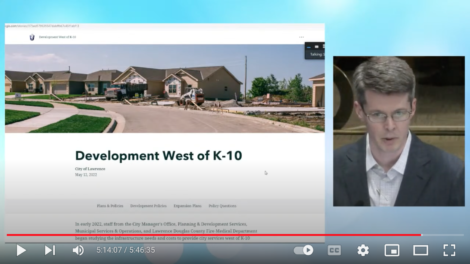
photo by: City of Lawrence
Planning and Development Director Jeff Crick addresses the City Commission as part of its meeting May 17, 2022, at City Hall, 6 E. Sixth St.
Lawrence city leaders say they are ready for the city to expand beyond its longtime border along Kansas Highway 10, and some are even interested in expediting that process by requiring areas to join the city instead of waiting for property owners to opt in.
As part of its meeting Tuesday, the Lawrence City Commission received a presentation on a study of the infrastructure and service needs — anticipated to cost more than $100 million — to add an area generally west of K-10 to the city’s boundaries. A few commissioners explicitly said they were interested in moving forward with those plans and prioritizing westward growth, rather than in another area, and Commissioner Brad Finkeldei said the city should consider requiring certain areas to join the city, a process called annexation.
“So I could see a point to say, we know we’re growing west, we should take some of this area, annex it, and say this is where we want to grow,” Finkeldei said. “That sends the positive message that that’s where we want people to look rather than reacting.”
The planning area is located primarily west of K-10, also known as the South Lawrence Trafficway, and north and south of U.S. Highway 40, according to the city’s planning website. The planning area also contains some land east of K-10.
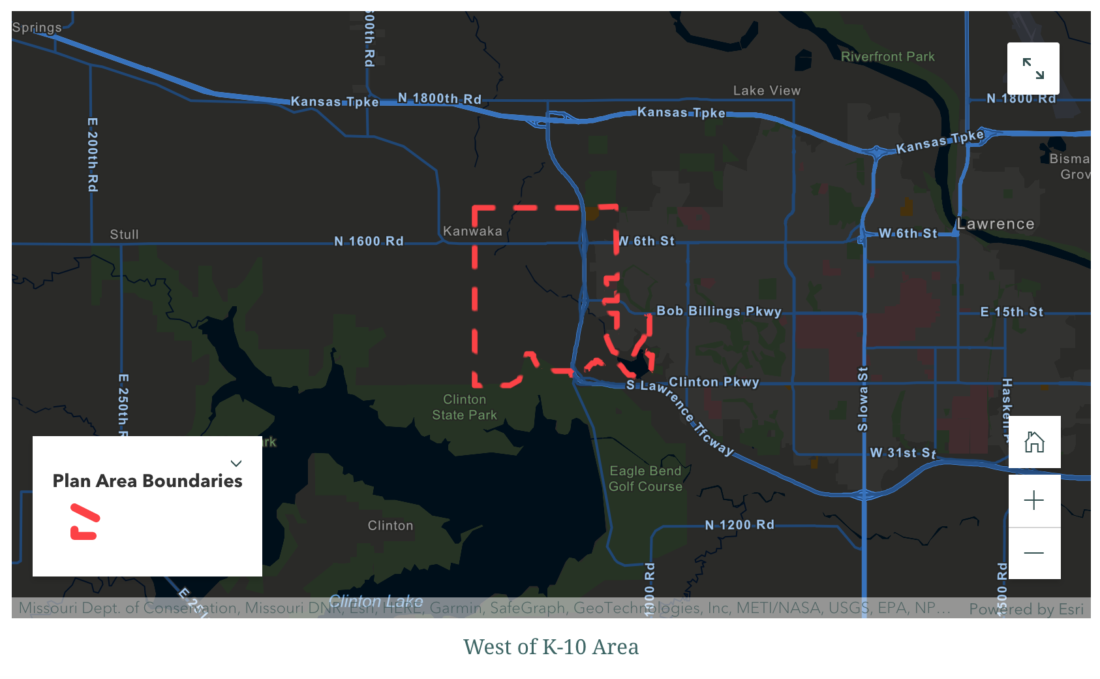
photo by: City of Lawrence
A city map shows the West of K-10 growth area, outlined in red. It also includes some land east of K-10.
Planning and Development Director Jeff Crick told the commission that typically the city’s approach has been to use what is known as consent annexation, where a property owner requests that land be incorporated into the city. However, Crick said the city can also compel an annexation, as long as certain state requirements are met. Those include creating a plan to extend city services to the land being annexed.
Finkeldei was responding to one of the policy questions Crick posed to the commission, namely whether the city should pursue approaches other than consent annexation. The other questions were whether the city should prioritize the infrastructure projects needed to expand west in that area and whether the city should begin studying revisions to the city resolutions that lay out how new development is paid for.
Finkeldei said that while property east of town also made “good sense,” he thought the city would eventually grow west, and that the city should prioritize infrastructure and services to be ready for that. Vice Mayor Lisa Larsen agreed, but said she was surprised that the city estimated that under current land development code the area could only accommodate 18,000 people.
Larsen said the city needed to plan for denser growth if it wanted new areas to efficiently use city infrastructure and provide more affordable housing options.
“We have to be much denser in order to really capitalize on the money that we would have to invest to do that,” Larsen said. “And so I would be looking at very high-density-type growth so that we can utilize our services the best, and I don’t think 18,000 people in that area would really represent that.”
Commissioner Bart Littlejohn agreed with Larsen that the city needed to be intentional about how it grew, and that higher density would lower the city’s costs. The city is in the process of updating its land development code, and commissioners agreed the update would be an important component of the city’s plans to expand.
City policy generally requires developments to pay for infrastructure such as streets and sewers within new subdivisions, but the city helps pay for certain infrastructure if it benefits a larger area. Major city infrastructure projects required for the expansion include a $19 million sewer corridor, an $11.5 million expansion of a water pressure zone, and multimillion-dollar extensions of Bob Billings Parkway and West Sixth Street that are currently broken into two phases.
Before their discussion, the commissioners heard from representatives of residential real estate and home building organizations, who both said the expansion was sorely needed.
Danielle Davey, governmental affairs director for the Lawrence Board of Realtors, spoke to rising home prices over the past few years. Davey said that as of the end of April, an extremely low supply of houses for sale had resulted in a “heavily biased” seller’s market. Compared to this time last year, she said the average sale price was up 15.6% and the median sale price was up 24%, and that was on top of increases in recent years.
“That’s not considering the massive increases we saw in 2021 and in 2020 before that, so this market is not sustainable,” Davey said. “We are quickly getting housing opportunities out of reach for a lot of Lawrencians.”
Bobbie Flory, executive director of the Lawrence Homebuilders Association, said that in addition to the commission determining which direction it wanted infrastructure to expand, it would take public-private partnerships due to the cost involved. Flory emphasized that to help bring home prices down, what was needed was more housing.
“The best way to build more affordable housing is to build more housing, and that’s what we’re hopeful for if the west side expands,” Flory said.
Discussions about the city’s expansion will likely continue as part of the city’s budget process, which includes planning for capital improvement projects. A couple of the infrastructure projects needed for the area west of K-10, such as the new sewer corridor, are already included in the city’s budget plans, but the majority are unfunded. The process to revise the city’s land development code began this year and is anticipated to take one to two years.
City Government
Evacuation drill planned Tuesday at Lawrence City Hall

Bond issue for water and sewer projects, bike plan, Wakarusa Drive update on Lawrence City Commission’s agenda
Opinion: Environmentally conscious Lawrence is not focused on the biggest problem with electric vehicles
Locust Street apartments, Holcom housing development among this year’s applicants for $700K in Affordable Housing Trust Fund money
Business owners hurting from Wakarusa Drive closure say they’re getting no answers, no signs, no accountability