City leaders begin debate on $100M in capital projects, including affordable housing, fire stations, Wakarusa Drive extension
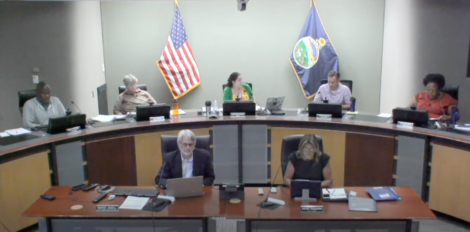
photo by: City of Lawrence screenshot
Lawrence City Commission members discuss plans for capital improvements as part of their meeting June 21, 2022.
City leaders discussed more than $100 million in proposed capital projects for next year, expressing support for spending more money on affordable housing development and queuing up a debate about when the city should build additional fire-medical stations.
As part of its meeting Tuesday, the Lawrence City Commission discussed two strategies for allocating funding for the city’s 2023-2027 Capital Improvement Plan, one of which focuses more on improvements to existing infrastructure over new projects. While commissioners were roughly split on which plan they favored, they agreed some of the new infrastructure projects should be considered for funding.
Both proposals are approximately the same in costs and include more than $100 million in projects for 2023 and about $400 million in projects total over the five-year plan. The two options, A and B, have significant overlap, but option B forgoes funding for several new projects — affordable housing development, fire-medical station expansions, a Kaw River Commons area, electric vehicle infrastructure for city vehicles — and instead allocates an additional $32.9 million for street repairs.
Vice Mayor Lisa Larsen said she was generally in favor of option B, with the caveat that she would be interested in including the funding from option A for affordable housing development and the addition of electric vehicle infrastructure for city vehicles. Larsen said while some new infrastructure will be needed at some point, the commission needed to consider the long-term impact on the budget.
“But as we build more infrastructure, it’s just going to really tax our operating budget down the road, and we’re struggling just taking care of what we’ve got right now,” Larsen said.
Option A includes $350,000 for affordable housing development in 2023 and $1.45 million over the five-year plan, as well as $500,000 for the Affordable Housing Advisory Board in 2024. The electric vehicle infrastructure calls for $50,000 in 2023 and $550,000 total.
Larsen did not support funding for two new fire-medical stations included in option A. She said though they would need to be funded at some point, she didn’t think they needed to be funded in the coming year. Larsen said the topic deserved a broader conversation, including the personnel costs that would be required to staff those stations and how those expenses would be funded. Option A includes about $18 million for two new fire-medical stations, with $1 million planned for 2023.
Commissioner Brad Finkeldei said he also generally liked option B better, but also agreed with Larsen that he’d like to see the funding for affordable housing development and electric vehicle infrastructure included. He said he thought the city would need to figure out how to build some fire stations in the next five years, but that the city had to identify how it would fund the personnel first. He also said he would consider moving forward funding for improvements to Centennial Skate Park within the five-year plan, but that he probably wouldn’t move it up to 2023.
On the other side of the debate were commissioners Bart Littlejohn and Amber Sellers, who said they generally favored funding option A. Littlejohn said he leaned toward option A because it included more movement toward some of the commission’s goals. Littlejohn said that because some residents were already seeing slower fire-medical response rates, one of the fire-medical stations should be funded next year.
Sellers said while she also wanted to see more information about how personnel for a new fire-medical station would be funded, that wasn’t a project she was ready to push aside. She also said she would be willing to swap funding, potentially for improvements to the South Park wading pool, to fund the skate park improvements sooner.
Mayor Courtney Shipley did not come down specifically in favor of one option, but in clarifying direction to city staff, said she was hearing a list of projects everyone seemed to agree on. Those included affordable housing and electric vehicle infrastructure, as well as direction that the commission would rather see the Lawrence Loop completed before funding is allocated for a pedestrian bridge over Iowa Street that would tie into the loop.
As part of the discussion, the commission also heard opposition to a project that would extend Wakarusa Drive south of Lawrence through an undeveloped area and build a bridge over the Wakarusa River. Shipley has previously expressed strong opposition to the $10.3 million project — about $4.1 million of which would be paid for by the city and $6.2 million by the county — and Larsen also previously expressed environmental concerns.
On Tuesday, Larsen said she was open to funding about $2.5 million for the portion of the roadway within the city limits, from Kansas Highway 10 to Clinton Parkway, but was not interested in extending it south.
“The environmental aspect is obviously extremely important,” Larsen said. “The other part is that we are agreeing to pay for a road that isn’t even in the city limits when we struggle to even pay for what we’ve got now. I’m definitely not interested in that.”
Funding has already been allocated for the design of the project, and both CIP options include funding for the extension in 2024 as part of a larger plan to spend $6.5 million on multiple local projects related to the expansion of the South Lawrence Trafficway. Other commissioners did not specify their position, though Finkeldei said he didn’t think that leaving the funding in the CIP — the $6.5 million represents a local match required for the SLT project — necessarily meant that the city was committed to extending Wakarusa south.
“Lots and lots of discussion and work has to be done before we decide necessarily to build that road as it exists (in plans), but for the purposes of the CIP and the purposes of tonight, I think we have to leave the $6.5 million in there because we are going to spend it one way or the other,” Finkeldei said.
City engineer Dave Cronin told the commission that a proposal to proceed with design plans for the project would be coming forward soon for discussion.
Commissioners have already said they are committed to keeping the city’s property tax rate flat, and they agreed Tuesday that they were not in favor of increasing utility rates beyond the city’s current utility rate model, which has called for annual rate increases of about 7% in recent years. With those stipulations in mind, funding additional projects beyond what is laid out in either plan would require delaying or eliminating funding for others.
The commission will ultimately allocate funding for the 2023 projects as part of the 2023 budget process this summer, with the remaining years serving as a planning document for upcoming budget years. Input from Tuesday’s meeting will inform the city manager’s recommended CIP, which will be included in the recommended budget presented to the commission on July 12.
City Government
Evacuation drill planned Tuesday at Lawrence City Hall

Bond issue for water and sewer projects, bike plan, Wakarusa Drive update on Lawrence City Commission’s agenda
Opinion: Environmentally conscious Lawrence is not focused on the biggest problem with electric vehicles
Locust Street apartments, Holcom housing development among this year’s applicants for $700K in Affordable Housing Trust Fund money
Business owners hurting from Wakarusa Drive closure say they’re getting no answers, no signs, no accountability