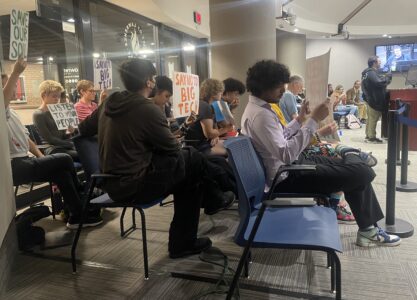
City leaders to review proposal to form work group to reconsider city’s process for complaints against police

photo by: Journal-World Illustration
Lawrence Police Department logo, Lawrence City Hall
City of Lawrence leaders will soon consider a proposal to form a work group to review and recommend changes to how the city handles complaints against police.
As part of its meeting Tuesday, the Lawrence City Commission will consider a proposal to form a Community-Police Oversight Work Group to review and make recommendations related to the police complaint process and the city’s Community Police Review Board. Dozens of complaints have been made against police since the board was created in 2018, but the board has yet to review any because of the way it was set up, and its members have called for stronger oversight.
The proposal, which was developed by the board in collaboration with the police chief and city staff, calls for the work group to review and make recommendations regarding the complaint process and the board’s role in that process. The proposal lays out expectations regarding the work group’s purpose, membership in the work group and particulars of the process, including a four-month timeframe for the review and facilitation of the process by a third party. The city anticipates it would cost $30,000 or less to hire a third-party facilitator, according to a city staff memo to the commission.
Under the city’s current process, complaints against police filed both internally and by members of the public are investigated by the employee’s direct supervisor or by a division of the police department. The board only reviews complaints dealing with racial and other bias and only if the person involved decides to appeal the department’s decision. An appeal must be submitted in writing within 14 days to be valid. The board has never reviewed a complaint under the current process, and board members have previously called the process a “rubber stamp” and “window dressing” for the police department.
The City Commission directed the board to review its governing ordinance in June 2020, and the board worked for over a year to draft changes in its governing ordinance. The draft changes included the ability to review all complaints made against police and the police department’s internal investigation with the ability to recommend an outside investigation if the board disagrees with the department’s finding. But on Jan. 5, before that draft had been submitted to the commission, the commission directed the board to launch a new, broader process to consider police oversight and other issues. That action was based in part on a study of the police department completed by a city-hired consultant in May 2021 that recommended the formation of a new task force to consider the issues at hand, and which ultimately led to the proposal for the new work group.
The board reviewed and made changes to the draft proposal for the work group as part of its April and May meetings. One of the key changes the board agreed to was that the scope of work should — in addition to a review of the complaint process and the ordinance governing the board — specifically assess whether the board should serve an advisory, oversight and/or review role in the complaint process. In addition, the proposal states the work group will review relevant findings and recommendations from the police study, as well as relevant laws, regulations, policies and procedures.
The scope of work outlined in the proposal comprises 10 elements, including the following:
•Assess the existing complaint process to identify concerns and conflicts as well as opportunities to improve trust and transparency.
•Research and review evidence-based and best practices, policies and procedures for receiving, investigating, resolving and reporting on complaints against law enforcement officers.
•Review the board’s proposed draft ordinance to determine if it supports the goals of the work group for improving the complaint process and enhancing citizen oversight.
•Assess and make recommendations regarding the board’s role and authority in serving in an advisory, oversight and/or review capacity.
•Identify goals for board membership, including number of board members, qualifications and strategies to achieve diverse and inclusive board composition.
•Review evidence-based and best practices for board member appointment that advance goals for diverse representation and inclusion.
•Review evidence-based and best practices and make recommendations about public reporting related to the complaint process.
The proposal also calls for the following membership and appointment process for the work group, consisting of representatives from the community, the board, the police department and the police union:
•Community Members: Five community members representing diverse communities. Each city commissioner will nominate one community member for consideration by the full commission. Each nominee will be appointed and confirmed by a majority vote of the commission.
•Community Police Review Board: three members of the board, selected by the board.
•Police department: The chief of police and a member of the department command staff, selected by the chief.
•Lawrence Police Officers’ Association: Two members of the LPOA, selected by the LPOA.
In a memo to the commission, city staff lays out four questions for the commission to consider regarding the formation of the work group. Those are whether the proposed scope of work meets the commission’s expectations; whether the commission agrees with the proposed membership of the work group; whether the commission supports hiring a third-party facilitator; and whether the commission would like to make any changes to the plan for public participation.
The Lawrence City Commission will convene at 5:45 p.m. Tuesday at City Hall, 6 E. Sixth St.
City Government
Evacuation drill planned Tuesday at Lawrence City Hall

Bond issue for water and sewer projects, bike plan, Wakarusa Drive update on Lawrence City Commission’s agenda
Opinion: Environmentally conscious Lawrence is not focused on the biggest problem with electric vehicles
Locust Street apartments, Holcom housing development among this year’s applicants for $700K in Affordable Housing Trust Fund money
Business owners hurting from Wakarusa Drive closure say they’re getting no answers, no signs, no accountability