Churches can advocate for or against the Kansas abortion amendment without risking their tax-exempt status
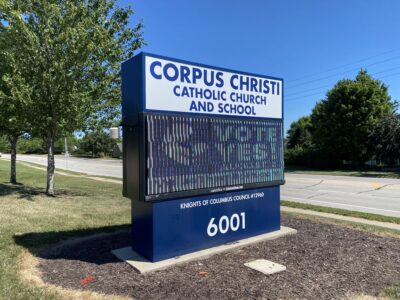
photo by: Austin Hornbostel/Journal-World
One of the slides displayed on the outdoor video board outside Corpus Christi Catholic Church in west Lawrence reproduces a yard sign urging voters to approve the so-called "Value Them Both" amendment. According to the IRS, that sort of political activity is legal for tax-exempt 501(c)(3) organizations like churches.
As the Aug. 2 primary election approaches, many voters are sounding off on whether the Kansas Constitution should continue to protect abortion rights — and churches are getting involved in the conversation, too.
But when churches advocate for or against the abortion amendment that’s on the primary election ballot, are they at risk of losing their tax-exempt status? According to the Internal Revenue Service, the answer is no.
The proposed constitutional amendment on abortion, if approved by voters, would reverse a 2019 Kansas Supreme Court ruling that says the right to bodily autonomy in the state’s constitution includes the right to decide whether to continue a pregnancy. The amendment would allow laws that completely ban or further limit abortions beyond the various regulations that are already in place in the state. A “no” vote would maintain the 2019 Kansas Supreme Court ruling, leaving the constitutional right to an abortion intact.
Ahead of the vote, some churches in Lawrence have displayed signs or held events about the abortion debate in Kansas and have sometimes urged people to vote a certain way in the primary.
The messages from churches in Lawrence aren’t all on the same side of the debate.
Corpus Christi Catholic Church in west Lawrence, for instance, has reproduced a pro-amendment yard sign, which instructs voters to vote “yes” for the ballot measure, on its outdoor video board. The church has also shared social media posts from the Value Them Both Coalition, a group lobbying for the amendment to be approved, as recently as July 7.
On the other side of town, Plymouth Congregational Church, a United Church of Christ congregation in downtown Lawrence, began a series of public conversations on abortion rights in late June. A news release announcing that series said that the United Church of Christ “has joined many faith groups to safeguard equal and fair access to abortion and family planning.” For the first event in the series, the church invited a number of University of Kansas professors to speak about abortion rights from a legal and historical perspective, and it plans to host sessions on July 20 and 27 featuring health care practitioners and community organizers, respectively.
A 1954 congressional ruling prohibits 501(c)(3) organizations, including charities and churches, from engaging in political campaign activity at the risk of losing their tax-exempt status. But information on the IRS’ website suggests that none of the activities described above would put a church’s tax-exempt status at risk. The reason is that even though they’re advocating for a political cause, they’re not endorsing a specific political candidate.
According to the IRS, a 501(c)(3) organization is a group “which does not participate in, or intervene in (including the publishing or distributing of statements), any political campaign on behalf of (or in opposition to) any candidate for public office.” However, the IRS notes that churches and other charitable organizations can engage in a limited amount of lobbying, including for or against ballot measures, and can advocate for or against issues that are in the political arena. Churches are also permitted to conduct certain voter education activities like the public forums Plymouth Congregational Church is hosting, and can also encourage participation in the electoral process through voter registration and get-out-the-vote drives. Churches aren’t, however, allowed to stump for a certain political candidate from the pulpit.
The abortion vote in Kansas has taken on more importance following the U.S. Supreme Court’s decision last month to overturn Roe v. Wade, the landmark 1973 case that guaranteed the constitutional right to an abortion nationwide.
Tuesday, July 12, is the last day to register to vote in the August primary election. Any registered voter can vote on the abortion amendment, regardless of party affiliation. The ballot also includes partisan contests for statewide offices and state representatives, the Democratic nomination for the Douglas County Commission’s 1st District, and precinct committee members and township officers.
The deadline to request an advance ballot is July 26. Advance voting by mail and in person begins on July 13 and continues on weekdays through July 29 and on Saturday, July 30; advance voting ends at noon on Aug. 1. Polls will be open on Aug. 2 from 7 a.m. to 7 p.m. More information and links to register to vote are available on the Douglas County elections office website.
Other News

RJ Mitte, ‘Breaking Bad’ actor and disability rights champion, dies at 34

Clinton State Park and other state parks will increase overnight camping, vehicle permit fees starting next month
‘No day is like the other here’: Students from Lawrence’s German sister city discover football, new foods and new friends on exchange

GCSAA celebrates 100 years with new plaza and statue honoring its founder and first president

Go, See, Do: Library book sale, candidate forum and more