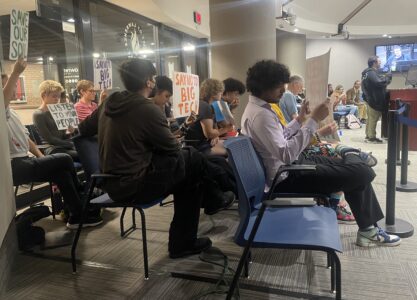
Despite concerns of community police board, city leaders agree to launch new process to consider police oversight
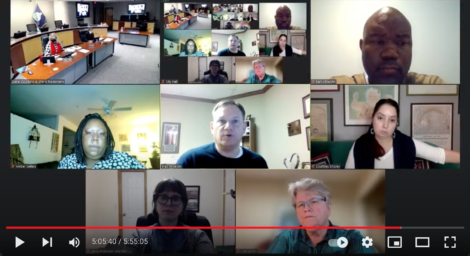
photo by: City of Lawrence
The Lawrence City Commission meets with members of the Community Police Review Board and city staff as part of its meeting Jan. 5, 2021.
City leaders have directed the Community Police Review Board to form a larger work group that will more broadly consider police oversight.
As part of its meeting Tuesday, the commission provided new direction to the board based on the recommendation of an outside consultant that the board stop its long-running process of drafting a new version of its governing ordinance to expand its purview over complaints and instead create the new work group. The board, however, expressed multiple concerns about the recommendation and the potential that a new process could create competing outcomes.
Part of the board’s working draft ordinance calls for the board to be able to review all complaints made against police and the police department’s internal investigation, with the ability to recommend an outside investigation if the board disagrees with the department’s finding. CPRB Chair Jenny Robinson told commissioners that while they may see the work group as facilitating the board’s current work, without a new ordinance the board is not able to serve its oversight purpose.
“We cannot do any work until we have an ordinance,” Robinson said. “…Yes, it’s a part of a bigger conversation and a part of bigger systemic change that we need to do in our community; however, it’s something that we need to do in order to start doing our work.”
The commission directed the board to review its governing ordinance and improve its oversight in June 2020, hired Citygate Associates to conduct the study of the police department later that same year, and received the consultant’s subsequent report in the summer of 2021. Citygate recommended that the board stop “unilaterally” drafting the new version of the ordinance so the city could instead convene a new work group that included the board and additional stakeholders, including the police chief, a representative of the police union and at least three minority residents. The recommendation states: “The result will be the reconstitution of a Community Police Review Board with an expanded scope of public engagement duties.”
Part of the board’s concern stemmed from what it saw as the consultant’s limited understanding of the board’s work to draft a new ordinance; the consultant’s citation of a 20-year-old source to back up its recommendation regarding police buy-in through the process; and the importance and urgency in addressing the lack of community oversight of complaints. Though dozens of complaints have been made against police since a reformatted version of the board launched in 2018 — a process encouraged by the local chapter of the NAACP that resulted in a long debate and pushback from the local police union — the board has reviewed zero of those complaints.
Under the city’s current process, complaints against police are filed both internally and by members of the public, and they are investigated by the employee’s direct supervisor or by a division of the police department, the Office of Professional Accountability. The board’s current governing ordinance allows the board to review only racial and other bias complaints and only if the person involved appeals the police department’s decision in writing within 14 days. As the Journal-World reported in 2020, apart from the board only seeing complaints under certain limited circumstances, the department releases very limited information about the nature and resolution of complaints.
Citygate’s report also noted that in listening sessions with community members, consultants learned that of those who had negative encounters with Lawrence police, no one filed a complaint. Consultants said that many said they lacked confidence in the police department to investigate its own officers, and others said their stories would not have been believed given their race, ethnicity, sexual orientation or gender identity.
The consultant’s recommendation itself was also a point of discussion and confusion on Tuesday, as it was not necessarily clear what was meant by “reconstitution” and what would become of the existing working draft of the ordinance. In the past year and a half, the board has researched best practices, collected public input and gotten legal advice from the city as part of its creation of the working draft. Prior to the recommendation, the board had been planning to begin focus groups, which would have included community members, police and the police union.
Vice Mayor Lisa Larsen, the only commissioner who was on the commission in 2017 when it created the current ordinance to reformat the board, was the only commissioner who explicitly stated Tuesday that she’d like to see the board’s current work on the ordinance continue. Larsen said that she read the recommendation to reconstitute the board as one to redo the board and that she did not necessarily want to see a redo of the working draft ordinance.
“I think we’ve got a good foundation to build on with what (the board has) done to date and that we should build on that and not start over with it,” Larsen said.
Though the commission did not vote as part of Tuesday’s meeting, the consensus among other commissioners was that it was better to form the larger work group and that the group should consider the ordinance as well as broader systemic issues regarding police oversight, accountability and community-police relations.
Commissioner Brad Finkeldei said that he thought those efforts were part and parcel of the same project and that if the board continues its work on the ordinance independent of the broader work group, the board’s recommendation may or may not align. However, he said he didn’t see the board’s current work as lost if the city adopts the new process.
“I think the information they have, the direction they’re going is all important and … helpful, but I think putting that into the context of a bigger solution is what’s going to get us to the finish line,” Finkeldei said.
Commissioner Amber Sellers said she agreed, and along with Mayor Courtney Shipley, said she would also like to see broader community engagement from the beginning of the process.
“I don’t see it as time lost; I see it as time to step back, to reset, refocus,” Sellers said. “A reconstitution does not mean wiping your work away; it’s how do we build CPRB to be better, to be what it is that not only you as (board members) want it to be, but what the community wants it to be.”
Robinson, the CPRB chair, said that of course board members, who are all volunteers, have feelings about changing direction after the effort they’ve invested in the working draft, but that ultimately the board serves the community, operates under the direction of the commission and shares the same goals.
Ultimately, there was a consensus among a majority of commissioners that city staff and the board should work together to develop a recommendation regarding the work group’s membership and a proposal for the group’s scope of work. Assistant City Manager Brandon McGuire said that recommendation could be brought back to the commission and that if the commission agreed, the city could then seek an outside consultant to facilitate the work group and community engagement efforts throughout the process. Tuesday’s meeting did not conclude until after the Journal-World’s print time.
City Government
Evacuation drill planned Tuesday at Lawrence City Hall

Bond issue for water and sewer projects, bike plan, Wakarusa Drive update on Lawrence City Commission’s agenda
Opinion: Environmentally conscious Lawrence is not focused on the biggest problem with electric vehicles
Locust Street apartments, Holcom housing development among this year’s applicants for $700K in Affordable Housing Trust Fund money
Business owners hurting from Wakarusa Drive closure say they’re getting no answers, no signs, no accountability