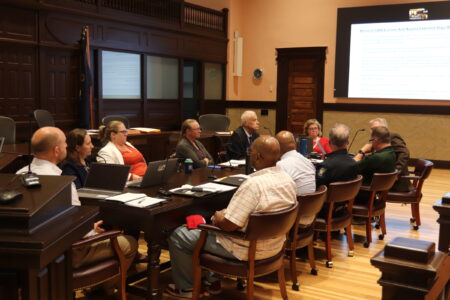
Pilot program aims to connect people with social services, peer support via all the libraries in Douglas County

photo by: Mike Yoder
Lawrence Public Library, 707 Vermont St., is pictured Aug. 20, 2015.
A peer support program to help community members struggling with poverty, addiction or other challenges navigate social services is looking to expand countywide.
The Douglas County Commission recently approved $45,000 in one-time funding for the project, which is a collaboration between the county, the United Way of Douglas County and the Eudora Community Library. The project’s goal is to connect Douglas County residents with social service providers and resources via “community navigators” who will eventually operate out of the county’s libraries.
Bob Tryanski, the county’s director of behavioral health projects, said the program includes peer support and the recognition that people who have experienced challenges like drug addiction or food insecurity have perspectives and familiarity with resources that can help others who are dealing with similar issues.
The coalition hopes the program will grow enough that it eventually becomes part of all Douglas County libraries, potentially even the library at the University of Kansas.
The project isn’t starting from scratch, Tryanski said, citing two foundational programs already in place.
One is the Douglas County program launched about three years ago to develop a peer support workforce, placing peers in places like LMH Health’s emergency department and later the Lawrence Public Library. The Journal-World previously reported on the program as it expanded to the library and the Lawrence-Douglas County Housing Authority.
Tryanski said that’s when the county realized that libraries, already prominent community centers, could be especially helpful hubs for people who need a hand navigating the social service system.
“It’s a workforce development program,” Tryanski said. “We need this type of first responder embedded in the community. We don’t have that kind of workforce in place, so this is an effort to develop that. It’s going to take time, but what’s exciting is we’ve got clarity (that) the libraries in our community value the idea of the library being a touch point for this kind of expertise and service.”
Another project in the county is also bolstering the navigator concept. Last year, the United Way of Douglas County launched a community navigator project funded by pandemic relief dollars. In that project, Mary Kirkendoll, an AmeriCorps volunteer, was placed at the Eudora Community Library from October 2020 through August 2021 to assist people in locating resources for various issues. She also helped to establish the United Way’s Eudora Resource Center to support her community navigation work.
Community navigators like Kirkendoll receive ongoing training to help build their expertise, Tryanski said, and they’re certified as peer specialists through the state’s Department for Aging and Disability Services.
After Kirkendoll’s AmeriCorps service ended, she continued as Eudora’s full-time community navigator, helping community members to “connect the dots” and circumvent barriers to locating social services that could help them. She’s simultaneously trying to bring resource navigation services to Baldwin City’s public library next, then to Lecompton, where the coalition is currently seeking a point person for that role.
The idea, she said, is to bridge the gaps between the county’s smaller communities and their awareness of what resources are available to them in Lawrence.
“I see the barriers for people getting to Bert Nash (Community Mental Health Center),” for example, Kirkendoll said. “How can we make it accessible in Eudora, in Baldwin? How can there be like a Lego piece, somebody who can almost hold your hand as you reach out to whatever resource you need? I have seen that be very helpful for Eudora’s community members.”
Needs vary from one community to another, Kirkendoll noted. To find out what those needs are for people in Eudora, Kirkendoll has even gone door to door asking community members what social services would be most helpful for them.
Such community involvement and commitment give people hope, Tryanski said.
“This is a really tough time; people are really struggling,” he said. “Everyone has been assaulted with the need to adapt, respond, change or be disappointed. This is a community that rises to challenges, and there is so much unspoken will to make things better. When we have folks like Mary and agencies like United Way and the libraries and our behavioral health partners really invested, it just gives you a lot more reason to be hopeful that we will move through the challenges that we’re facing.”
Other News
Kobach’s team puts on parents, cops, other witnesses to support Kansas’ anti-trans law SB 244

Go, See, Do: Theater performances, Kaw Valley Farm Tour, astronaut talk and more
Kansas’ 1st Congressional District candidates to appear at Lawrence forum
Douglas County Commissioner Gene Dorsey announces write-in campaign after losing in primary election
State’s anti-trans law harms people while not making anything better, experts testify