‘You’re forever branded’: One man’s search to find an apartment comes up empty after prison, homelessness
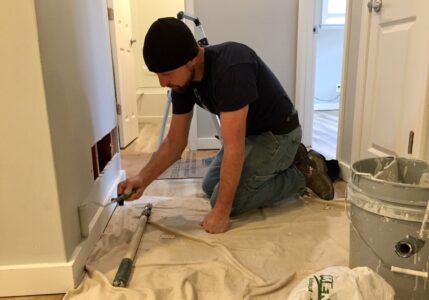
photo by: Rochelle Valverde/Journal-World
Scot works at remodeling an apartment in Lawrence.
When Scot arrived back to Lawrence after serving three years in prison, he didn’t expect he would still be looking for somewhere to live more than six months later. With the local homeless shelter full, initially he stayed with others or slept outside.
“I started just couch surfing, sleeping outside, sleeping in the parks,” he said. “This is still summertime at the time, and it was warm, so I could do that.”
Scot (the Journal-World is not using his full name due to his situation) had lived in Lawrence for about 20 years before being incarcerated, but he said the prison didn’t do anything to prepare him for the transition back into the community. He eventually went to homeless outreach staff with Bert Nash Community Mental Health Center, who initially offered him a tent and a sleeping bag. But he said as someone almost 4.5 years sober who previously struggled with alcohol and drug addition, he was adamant that living at one of the campsites in town was not a good option for him.
“I refused it,” he said. “I said you’re going to do something to help me.”
He said Bert Nash ended up providing him assistance for a motel room for 90 days, and he went from doing odd jobs to working full time. Scot said he previously had his own home improvement company, and he now works about 50 hours per week for a private contractor, where he does repairs and remodeling for landlords and property management companies. He said he has now been at the motel for more than four months, and though he has applied or inquired with about 20 property management companies and landlords, they have all denied him because of his criminal background.
He said the first apartment he applied for charged him more than $200 in nonrefundable fees, including an application fee, a service fee and a fee to check his criminal background. After that application was denied, he began asking before he applied about whether they would accept someone with a criminal background.
“They just told me outright, well, you probably wouldn’t qualify,” he said. “They’re saying no.”
While Scot, who also does some work for the motel, has been allowed to stay on beyond the 90 days initially arranged through Bert Nash, he said that situation could end anytime, landing him back outside, this time in the cold of winter. He said even though he has a full-time job and the money for an apartment, he feels like his criminal history will continue to keep him homeless.
“There are so many barriers, there are so many obstacles, there are so many fees involved,” Scot said. “I made some mistakes, and I paid my due to the community and society: I went to prison, I was punished, and now I’m still dealing with the backlash of it because I’m branded. All that, ‘you pay your debt to society, you’re finished,’ that’s not true. You’re forever branded.”
Scot said he suffered abuse as a child, and has had problems with depression, anxiety and post-traumatic stress, and now goes to therapy and takes medication through Bert Nash. He said he had relapsed into alcohol and drug use when he was convicted of aggravated domestic battery, which resulted in his three-year prison sentence. He said he has been sober now for more than four years, and began seeing a therapist as soon as he got out of prison to try to deal with his mental health. He said he was willing to do the work, and just wishes someone would give him a chance.
“Housing is all I need,” he said. “Housing and some therapy is really all I need.”
But Scot said it seems he faces stigma both because of his criminal record and because of his efforts to address his mental health and his involvement with homeless outreach. He said sometimes as soon as he mentioned he was working with Bert Nash to landlords or property management companies, he immediately felt people’s demeanor change. He said he’s now begun focusing his apartment search with private landlords instead, hoping they will be more flexible, but he continues to get denied and said he needs more help if he is ever going to find an apartment. He said that could be just more consistency in the rules for criminal background checks, assistance with his apartment search, or some type of co-signing program that would vouch for him as part of his rental applications.
Mathew Faulk, director of housing with Bert Nash, said the difficulty of finding housing for people with criminal backgrounds is a problem. He said there are currently only a handful of landlords in town who will consider renting to someone with a criminal background, a number that has been decreasing in recent years. He said Lawrence has seen more corporately owned property over the years, and those companies often have strict policies about criminal background, credit scores and income levels that create barriers for many renters. In addition, he said with the very low vacancy rates Lawrence is currently experiencing, there is less pressure for landlords to rent to a wider selection of clientele. Faulk said the situation was illustrated last week, when an apartment that accepted people with criminal backgrounds became available.
“There were people lined up for that unit,” Faulk said. “The level of competition is extremely high.”
As far as solutions go, Faulk said he sees a couple of options. One would be for there to be federal, state or local legislation that prohibits or limits the use of criminal background checks in the rental application process. The Lawrence Human Relations Commission recently recommended that the city consider setting a time limit for how long someone must disclose rental history/evictions and criminal history, but that and other recommendations still need to undergo a legal review by the city attorney’s office before going to the City Commission for consideration. Apart from the legal questions, Faulk said there are many views on that issue, and it speaks to a wider societal question about the criminal justice system.
“There is oftentimes the perspective that if someone has taken care of all their legal obligations, to use a colloquial term, ‘they’ve done the crime, they’ve done their time,’ then why do we continue to hold them accountable, why do we continue to punish them for that after they’ve taken care of their legal obligations?” Faulk said. “And something like criminal background checks is a part of that, right?”
Faulk said other changes for criminal background checks could be to also show rehabilitation efforts people have made, so landlords are not just seeing the offense that was committed. He said another option would be for nonprofits to provide more housing so that criminal history and other factors are not a barrier to housing. He said Bert Nash was working on increasing its housing options, but that will be a slow process and the organization is still 99.99% dependent on the private market when it comes to finding housing for its clients.
In the absence of that or other solutions, Scot and others in his situation are left with very limited housing options. As Scot works 10-hour days remodeling and doing repairs at apartments, he is approaching seven months since his release from prison and the beginning of his homelessness. He said he continues to search online rental listings daily and to reach out to landlords, but still has no prospects. Meanwhile, he said he is going day by day at the motel.
“(The motel owner) just let me know, this is only temporary, really temporary,” Scot said.
Other News
Report projects enrollment at Lawrence schools to decrease over next five years; board members approve enrollment analysis contract
Lawrence school district celebrates opening of new Family Engagement Center
New Haskell Indian Nations University president thinks collaboration, communication key to school’s success

U.S. Army says cleanup at Sunflower Army Ammunition Plant is ‘slowing down’; PFAS investigation at site still needs funding
‘One of a kind’: Sale at the Lawrence Arts Center will find new homes for late musician’s unique custom guitars