City leaders to consider temporarily suspending alcohol sales cap put in place to help preserve downtown retail
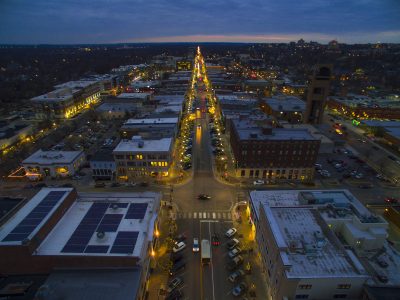
photo by: Nick Krug
Massachusetts Street is illuminated by holiday lights and vehicles on Thursday, Dec. 14, 2017.
Lawrence city leaders will soon consider temporarily suspending a cap on alcohol sales that was put in place nearly 30 years ago to help preserve the retail character of downtown.
As part of its meeting Tuesday, the Lawrence City Commission will consider adopting a resolution to temporarily suspend enforcement of the city’s cap on downtown alcohol sales, but only for buildings under a certain size. The suspension will be in effect until the city completes its ongoing rewrite of its land development code, or until Dec. 31, 2025, whichever is sooner, according to a city staff memo.
The discussion of the alcohol sales cap arose following a request from a downtown business that has struggled to adhere to the city’s limit on downtown alcohol sales. John Brown’s Underground, which since its opening in 2014 at 7 E. Seventh St. has on multiple occasions failed to meet the city’s requirement that it derive no more than 45% of its sales from alcohol, requested an amendment to city code that would allow the percentage to be 90% under certain conditions.
The alcohol sales limit, which dates back to 1994, was put in place as downtown was losing retailers, with the goal of preserving the retail character of downtown and preventing it from becoming a bar district.
The commission last month heard from downtown businesses for and against the amendment proposed by John Brown’s. That included a representative of John Brown’s, who said the change would allow for “small, experienced-focused” drinking establishments, and another downtown bar owner in favor of the change. On the other side were a couple of retailers, who said that the code has been successful in preserving a retail-oriented downtown that many communities have lost because it is much easier to make a profit with alcohol sales than retail sales.
Ultimately, there was not enough support on the commission to approve John Brown’s request. Given that the city is in the process of updating its development code — which covers what types of businesses and other uses are allowed where, among other elements regarding how the city grows and redevelops — commissioners agreed that the alcohol sales limit should be part of that larger discussion. An outside consulting firm is currently wrapping up a review of the city’s development code, and in collaboration with a steering committee will be drafting recommended changes. It’s anticipated the code drafting process will begin in January 2023 and conclude in October 2023, while the review and adoption process will begin in November 2023 and conclude in June of 2024.
The current code requires new downtown drinking establishment licensees to make no more than 45% of their sales from alcohol. The businesses with bar use that already existed in 1994 became “grandfathered,” and 23 businesses are allowed to maintain a bar use even if ownership changes hands. John Brown’s amendment proposed that businesses under 3,000 square feet be allowed to apply for a special use permit to derive up to 90% of sales from alcohol. Special use permits must be reviewed by the Planning Commission and approved by the City Commission, which can place further restrictions on the permit.
The newly proposed resolution, which was placed on the commission’s consent agenda for Tuesday, would temporarily suspend the alcohol sales limit for downtown businesses no larger than 3,000 square feet. The suspension would cover many of the single storefronts downtown, which are typically about 2,500 square feet, but not the less common, larger spaces. The memo states that several smaller businesses have struggled and continue to struggle to meet the 45% cap on the sales of alcohol as a result of the COVID-19 pandemic and its aftermath.
The resolution notes that the city is in the process of rewriting the development code and explicitly states that it is not the intent of the governing body to create, through the temporary suspension, “any vested right” in any use that could be in conflict with the land development code or establish a nonconforming use of any downtown properties. In other words, the temporary suspension, if approved, is no guarantee that businesses that take advantage of the suspension will be able to do so once the code is updated, and the temporary suspension would not create another group of “grandfathered” properties downtown.
The Lawrence City Commission will convene at 5:45 p.m. Tuesday at City Hall, 6 E. Sixth St.
City Government
Opinion: Local government made a small mistake. Taxpayers shouldn’t be on the hook to fix it
As club cancels ‘Beetlejuice’ screening at Oak Hill, city says there are no specific rules about events at cemeteries
Opinion: An $80 million Hail Mary that combines Costco and Lawrence’s love of trails
Lawrence Police Department receives KDOT’s top traffic safety award for second straight year
Lawrence City Commission approves extra layers of oversight for data centers, asks for patience on further regulations