As it considers its larger role in community, health department may pass off family-planning services to another provider; Heartland confirms interest

photo by: Contributed and Journal-World File Photos
Lawrence-Douglas County Public Health Director Dan Partridge is pictured along with the department's home in the Community Health Facility, 200 Maine St.
Lawrence-Douglas County Public Health is currently weighing whether it should continue to offer family-planning services through its clinic or pass them off to another local health care provider.
The health department’s director, Dan Partridge, confirmed to the Journal-World last week that the department has been engaged in ongoing conversations with LMH Health and Heartland Community Health Center about how to best provide health care for the community, with “everything on the table.” In part, that includes one of the two taking on family-planning services instead of the health department. Partridge said that for now, Heartland in particular has expressed some preliminary interest in becoming the new host, but there’s no proposal or agreement in place.
“Our interest is to make sure that if it gets handed off that it goes well and that clients continue to have access and we don’t continue to exacerbate this access to health care challenge that we started out trying to solve and we’re still trying to solve,” Partridge told the Journal-World.
Heartland CEO Julie Branstrom confirmed to the Journal-World on Monday that those talks were taking place.
“Heartland is actively exploring the possibility of taking on this programming as it is a valuable resource for our community that we want to see preserved,” Branstrom said.
Known collectively as “Title X” services, family planning can include preventive health services like providing access to various forms of birth control, breast and cervical cancer screenings and testing for sexually transmitted infections. The services are funded by a grant that begins at the federal level with the U.S. Department of Health and Human Services and then is doled out to statewide grantees for further disbursement. The funding trickles down even further from there, eventually filtering out to local communities.
Branstrom said Heartland is already the recipient of grant funding from the Kansas Department of Health and Environment and also already provides some of the services associated with Title X. She said Heartland hopes to know more in the coming weeks and will be working closely with the health department and LMH Health in the meantime.
Partridge said the last thing the health department wanted was to seem as if it was “shopping” those services around, so department leaders informed staff that those discussions had been taking place about a month ago. Nevertheless, Partridge acknowledged that it was likely upsetting news for some staff and has led to some resignations. To avoid a lapse in services, the health department has worked out an interim measure with Dr. Thomas Marcellino, the county’s former health officer, to step in and provide Title X services one day per week through February.
…
Partridge said the greater context for the discussion around where Title X services should be housed is based on Lawrence-Douglas County Public Health’s strategic planning process, and specifically the question of what the health department’s purpose and function should be.
That’s something that continues to evolve over time, Partridge said, from responding to diseases like typhoid and smallpox in the past to tackling present-day issues like homelessness and depression out in the community rather than inside the clinic room.
That’s why Partridge said the health department’s board decided more than a decade ago to lay out in its bylaws that the purpose and function of the health department will be to deliver the “10 essential public health services,” referring to a framework for public health intended to promote the health of everyone in a community, with equity at the center.
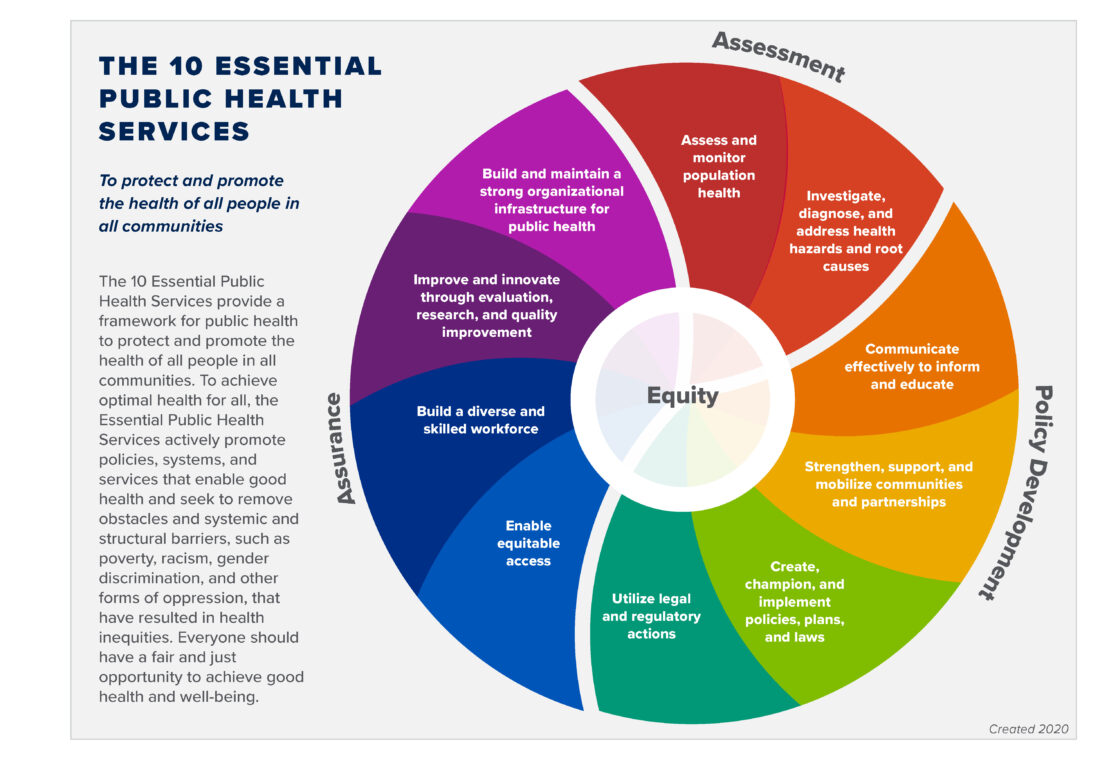
photo by: Centers for Disease Control and Prevention
This graphic details the “10 essential public health services” that the health department’s board lays out in its bylaws as their purpose and function to deliver.
Those 10 services are grouped into what Partridge referred to as three “buckets.” The first, assessment of trends, includes assessing and monitoring the population’s health, like the health department’s ongoing charting of coronavirus cases. Another bucket, policy development, includes “creating, championing and implementing policies, plans and laws” like the City of Lawrence’s recent tobacco sales license and enforcement process.
The third bucket, assurance, involves what Partridge described as a “hodgepodge” of services, like ensuring “proper fiscal management” and government oversight. Though none of the services in this bucket is explicitly outlined as “maintain a clinic at the local health department,” there is one area where Partridge said health department leadership thinks the clinic lands, under “enabling equitable access.”
The health department spends at least 55% of its money on clinic functions, Partridge said, and the clinic is currently thought of as the vehicle for enabling equitable access. But he also leaned into the notion that the more detailed verbiage describing this service — which includes “ensuring access to high-quality and cost-effective health care and social services” — could position the health department in more of a “connector” role rather than as a care provider.
“That’s ‘ensuring’ access, not ‘providing’ access,” Partridge said. “I think those words matter.”
Partridge said the health department saw a disconnect between what it’s currently practicing and the concept of that service and decided it needed to put greater effort into understanding what local data says about access to health care.
That also led to some thought about being open to current health department services going where they’re best suited in the community, Partridge said.
“In other words, this shouldn’t be about a turf protection kind of thing for us,” Partridge said. “Really, the higher motive, the higher purpose, is we want everyone in this community connected to care, and let’s as a system think about how that best happens and put our turf aside.”
…
The U.S. Department of Health and Human Services keeps a directory of regional Title X family planning service providers, which helps to illustrate who typically provides such services in Kansas.
According to the directory, which was last updated in October, there are 43 sub-recipients who receive Title X funding from the state of Kansas’ overall grantee, the Kansas Department of Health and Environment. That’s coupled with another 15 service sites where Title X services are facilitated using funds from a sub-recipient. In next-door Johnson County, for example, the Johnson County Health Department’s Olathe office is listed as the sub-recipient, and its Mission office is listed as a service site.
Either way, all but a handful of the sub-recipients and service sites listed in the directory are county health departments, including Douglas County’s.
Why, then, does Douglas County’s health department no longer want to offer those services? Partridge said his opinion is that sub-recipients and service sites tend to be county health departments based on “historical legacy.” Federally qualified health centers — like Heartland in Lawrence — are a more recent host, he said, and otherwise the list of grant-holders doesn’t tend to change a whole lot over time.
“… (When you look at) how does health care for the uninsured get funded in this country, it’s the federal government,” Partridge said. “The federal government, by and large, is the payor of uninsured — or underinsured — health care. Where are they putting their money? They’re putting their money in FQHCs. That’s (how) I see the federal funding strategy to provide health care — build up the FQHC network.”
Partridge said any concerns about the cost of Title X services changing if offered through another provider is “understandable,” but he also said that any holder of a Title X grant is required to provide those services on a sliding scale based on income — and at no cost if the patient qualifies. Whether it’s at Heartland or the health department, he said, that cost is always guided by the grant and the federal government.
Partridge added that he can’t in good conscience tell folks simply not to worry about any impending changes, but he’s confident that Title X services will continue to be provided seamlessly even if they end up under a different roof. In other words, the goal is that there will be no void in family planning services.
“We will not just say, ‘Well, so long, Title X. Good luck, community,'” Partridge said. “We’re going to do everything that we possibly can, because our mission, our purpose and function, is to make sure the gap in access to care does not exist. That’s the goal we’re shooting for, and it makes no sense to go the wrong direction, at least if we have options on the table to go a different way. As long as options to advance are here, we’ll use them.”
Other News
Eudora voters to decide sales tax election to fund increased fire protection in the city

Perry-Lecompton voters to weigh new joint recreation system funded by property tax levy

Theatre Lawrence’s ‘LIZZIE’ puts a Riot Grrrl edge on infamous ax murders

PHOTOS: 19th annual Lawrence Zombie Walk
Housing Stabilization Collaborative’s new system directs rental and utility aid to more vulnerable households, review finds