Transportation planners share details about proposed bus route changes that include Uber-like ‘microtransit’
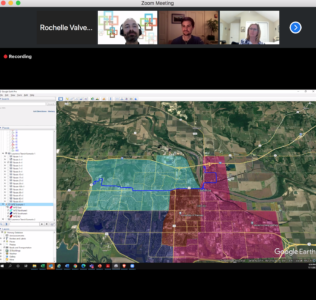
photo by: City of Lawrence
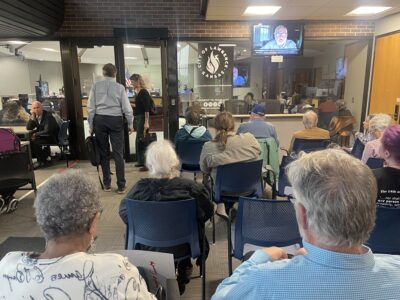
Boris Palchik, of Foursquare Integrated Transportation Planning, explains one option for an Uber-like microtransit service that would divide the city into several zones. To limit the length of trips, riders could only use microtransit to travel within any given zone. The other option would use distance-based pricing.
Residents heard more details Monday about a proposed redesign of the city’s bus routes that includes an Uber-like “microtransit” option.
Lawrence Transit has proposed two options for a long-awaited redesign of the city’s bus routes and held the first public meeting Monday to present the proposals and get input from residents. Transportation consultants explained that both proposals use traditional routes complemented by a microtransit service that uses a van or a smaller bus that riders can request on demand.
“It functions very much like Uber and Lyft, but it’s more of a transit type of product versus a single-ride where one person gets a ride, then the next person gets a ride,” said Boris Palchik, of Foursquare Integrated Transportation Planning. “With microtransit it’s a shared-ride type of service.”
The city and the University of Kansas coordinate their bus routes and have been working with consultants at Foursquare ITP to develop the options. Unlike Uber and Lyft, which have pricing that increases significantly based on time of day or demand, the city has said the microtransit service would offer affordable and predictable fares.
Palchik said that residents could use a smartphone app — or call a dispatcher if they don’t have a smartphone — to request a trip and then use the app to track the vehicle in real time. He said that unlike rideshare services, the trip could be slightly deviated to pick up others nearby who request service on a similar route. He said there would be multiple microtransit vehicles in service in a given area, and an algorithm would be used to assign trips and additional pickups in the most logical fashion and avoid extreme deviations.
Palchik said to make such a service work efficiently, the trips need to be kept relatively short, and the two options propose different means of accomplishing that. The first structure would divide the city into a handful of zones, and microtransit could only be used to travel within each zone, meaning riders would need to use the traditional bus for longer trips. The second option would use distance-based pricing.
The presentation also covered how both proposals would change routes as compared to current routes. Palchik said a goal of the route redesign was to improve connections between residential areas and popular destinations such as grocery stores, the hospital, downtown, South Iowa Street, schools and business parks.
“The aim is to make every route a strong standalone route,” Palchik said. “And the way the way that you make a route a strong standalone route is ensure it has a good mix of origins and destinations.”
A few regular bus riders participated in the meeting and asked questions about how certain routes would change or how specific destinations could be reached. Two riders commented that they appreciated the focus on providing better service to key destinations and that they saw the proposed changes as an improvement.
The route redesign is tied to the long-awaited city bus station project. After years of delay that included pushback from neighborhoods regarding other locations, the City Commission settled in 2019 on locating the bus station on KU property on the southeast corner of Bob Billings Parkway and Crestline Drive. Palchik said other route changes work to center the new bus station, where he said riders would be able to get to multiple destinations quickly.
To collect input about the proposed changes, Public Transit and Parking Manager Adam Weigel said that the city is conducting an online survey, tabling at various locations, and communicating directly with bus riders. An interactive map of the proposed route changes is available as part of the survey. Residents can take the survey until Nov. 19 at lawrenceks.org/listens/surveys. A second virtual presentation will take place from noon to 2 p.m. Friday. A link to register for Friday’s meeting is available on the project website, lawrencetransit.org/route-redesign.
Palchik said that the input received would be used to develop a third “hybrid” option that includes the most popular elements of both proposals.
Weigel said the final recommended proposal will be shared before the end of the year, and route changes will be implemented in August 2022 along with the opening of the bus station.
City Government

As club cancels ‘Beetlejuice’ screening at Oak Hill, city says there are no specific rules about events at cemeteries
Opinion: An $80 million Hail Mary that combines Costco and Lawrence’s love of trails
Lawrence Police Department receives KDOT’s top traffic safety award for second straight year
Lawrence City Commission approves extra layers of oversight for data centers, asks for patience on further regulations
Lawrence to participate in program that helps nonprofits rehabilitate abandoned properties as affordable housing