Sidewalk repair program will focus on Sunset Hill and Pinkney neighborhoods this year; what to know about the projects
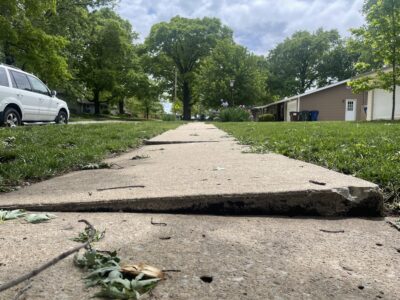
photo by: Sylas May/Journal-World
Uneven sidewalks in the Sunset Hill neighborhood are pictured on Tuesday, April 28, 2026.
Parts of two Lawrence neighborhoods are scheduled for sidewalk repairs in 2026 as part of the city’s ongoing effort to bring its infrastructure into compliance with ADA accessibility standards.
The city’s ADA Right of Way Transition Program will be targeting areas in the Sunset Hill and Pinkney neighborhoods, and ADA Compliance Administrator Evan Korynta recently briefed Lawrence’s Connected City Advisory Board on what the work would entail.
“We have neighborhoods that have been around for many, many, many years and have never really received a lot of the attention that probably they should have,” Korynta told the advisory board earlier this month.
State statute in Kansas says that property owners are responsible for maintaining sidewalks adjacent to their properties, but in Lawrence, the city has a “cost-partnering” program intended to lessen the burden for homeowners. Basically, the city will pay for a number of services related to construction and removal of the old sidewalks, and property owners only pay for the cost of correcting certain sidewalk defects or hazards.
In its capital improvement plan for 2026, the city has set aside $2.63 million for sidewalk repairs, Korynta said.
Here’s a closer look at the sidewalks that are affected this year and some reminders about how the city’s sidewalk repair program works.
What areas are being repaired this year?
The ADA sidewalk projects currently in the design phase for 2026 would cover about 3 miles worth of sidewalks in the Pinkney and Sunset Hill neighborhoods.
In the Pinkney neighborhood, the projects will be on Wisconsin, Michigan, Illinois, Mississippi and Fifth streets and on Second Terrace. In the Sunset Hill neighborhood, they will be just to the northwest of Sunset Hill Elementary on Ninth and Seventh streets, Lawrence Avenue and Schwarz Road.
Korynta told the board that property owners in these areas should have already received notifications about the project. He said it normally takes several months from the time property owners get the notification to the time construction starts, because it takes time to do the design work and other preparations.
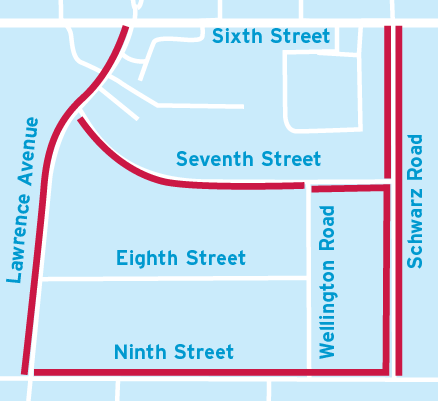
photo by: Sylas May/Journal-World
The red lines on the map show where sidewalks are scheduled to be repaired in Lawrence’s Sunset Hill Neighborhood in 2026. One street, Schwarz Road, will have repairs on both sides.
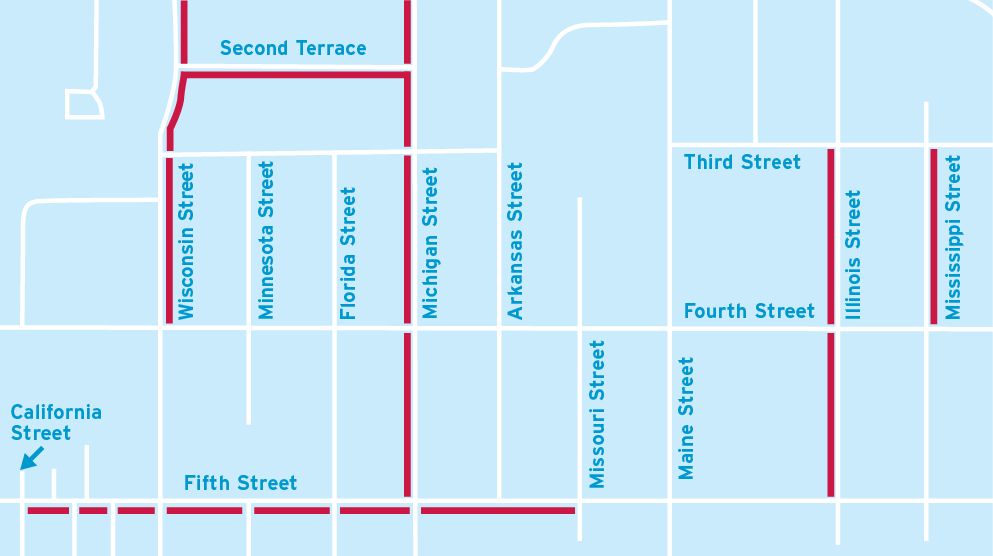
photo by: Sylas May/Journal-World
The red lines on the map show where sidewalks are scheduled to be repaired in Lawrence’s Pinkney Neighborhood in 2026.
How does the “cost-partnering” program work?
When the city inspects an area’s sidewalks, Korynta said, it produces a report on the hazards present, such as uneven sidewalk panels or deterioration. If the city determines that these hazards are caused by something it’s responsible for, such as street trees, it pays for the cost of the repairs associated with those hazards. For any other hazards, the property owner is responsible for that cost.
But there are many other costs that the city pays as part of its program, whether the city is responsible for the hazards or not. The city will cover property owners’ costs related to demolition and removal of old sidewalks, excavation, grading, retaining walls and design services, Korynta told the advisory board.
“The only thing that adjacent property owners pay for are their identified hazards,” he said.
Owners are free to use a private contractor or even do repairs themselves instead of partnering with the city, provided the repairs are done to the city’s standards. Korynta said he encourages people to weigh their options.
“I always tell them, do your homework,” he said. “If you want to get additional bids from private contractors, go ahead and do that. If you have the skills to do self-repair yourself – sometimes, properties are owned by contractors and they just say, ‘Oh, I’ll just do it myself.’ … Whatever gets the work done, as long as it meets city accessibility standards, we don’t have a problem with that.”
However, he said, most people who end up shopping around ultimately come back to the city’s program because of all of the extra work that the program covers.
“One thing that we’ve found is that when people go and get outside bids, they’re like, ‘Never mind, I’ll use the city,’ because they’re not being charged for all these other things, where a private contractor charges you for all these things,” Korynta said.
What if I have special circumstances?
The city’s program provides special financial assistance for two kinds of owner-occupied properties: those owned by low-income residents or those that are on corner lots.
The low-income assistance is available to households that earn less than 80% of the area Median Family Income based on guidelines set by the United States Housing and Urban Development. If you meet those criteria, the city will cover 100% of the cost of repairs.
Homeowners who live on a corner lot and have multiple sidewalks adjacent to their property get 50% off of materials, Korynta said.
Property owners must fill out an application to be considered for assistance. The applications can be found at lawrenceks.gov/wp-content//2025/12/ADA-ROW-Financial-Assistance-Application.pdf
What about bricks?
Last year’s ADA sidewalk repair projects both took place in East Lawrence, a part of town with lots of brick sidewalks. As the Journal-World reported, according to the city’s brick sidewalks policy, property owners in a certain area of the city can choose whether to replace their sidewalks in brick or concrete, but brick will cost the property owners more.
This area is called the “brick sidewalk permissive area,” and it includes streets in East Lawrence, downtown and parts of Old West Lawrence and Pinkney.
Unlike last year’s projects, this year’s are mostly outside of the brick permissive area. The only properties for this year’s projects that are within it are on Illinois and Mississippi streets. All of those properties currently have concrete sidewalks, Korynta said, but they will have the option of repairing their sidewalks with bricks.
If you have brick sidewalks and are outside of the brick permissive area, Korynta said, you can still repair your sidewalks with brick, but you won’t be eligible for the city’s cost-partnering program.
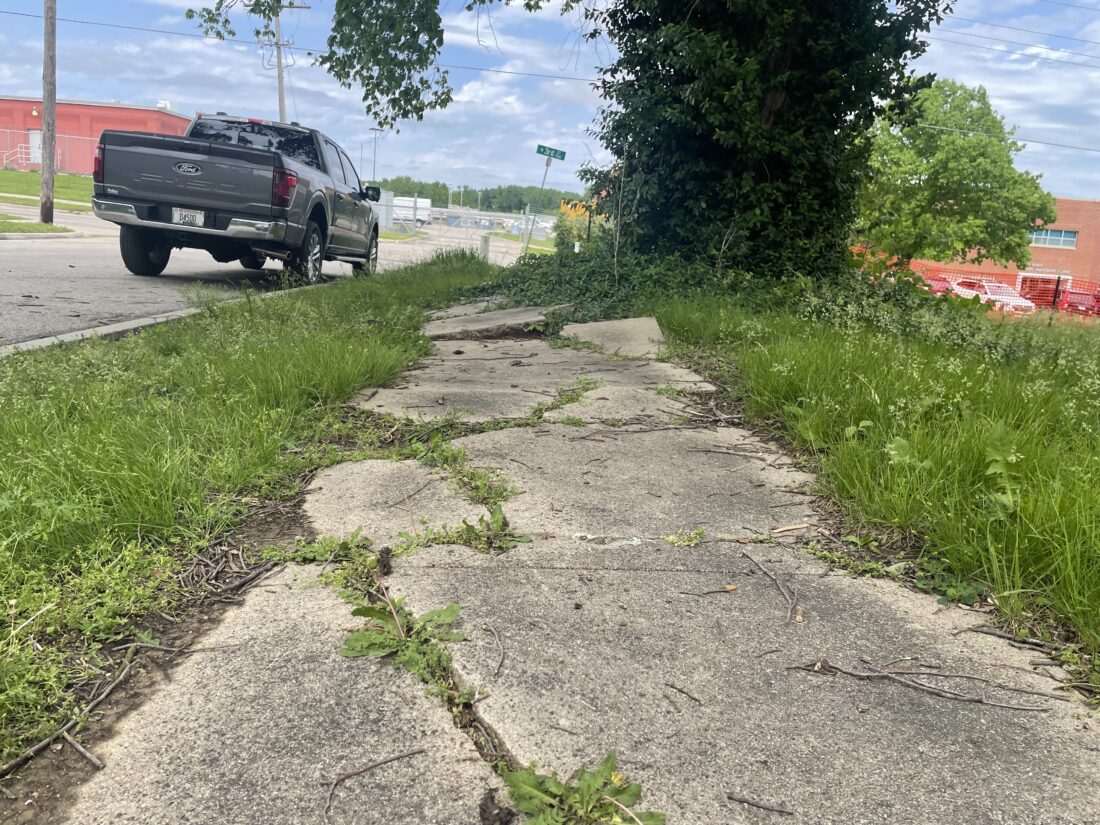
photo by: Sylas May/Journal-World
Damaged sidewalks in the Pinkney neighborhood are pictured on Tuesday, April 28, 2026.
City Government
Lawrence City Commission to weigh whether Costco should be included in STAR bond district
As they approve bikes plan, Lawrence city leaders ask about data collection, Kentucky and Tennessee streets
Lawrence city leaders want to toughen tobacco licensing rules ‘sooner than later’
Algerian government invites Mayor Brad Finkeldei, Lawrence delegation for a visit
Construction on Wakarusa Drive to resume; city manager says KDOT’s secretary has apologized for delay