Lawrence’s first director of equity and inclusion discusses first year on the job, efforts to address systemic issues
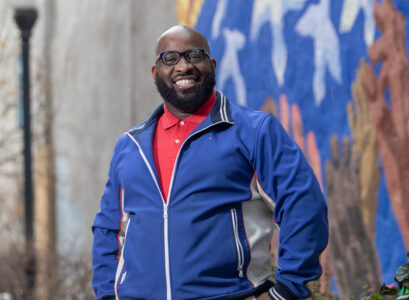
photo by: Mike Yoder
Farris Muhammad, the City of Lawrence's director of equity and inclusion, pictured recently in downtown Lawrence, is completing his first year on the job.
As the City of Lawrence’s first ever director of equity and inclusion, Farris Muhammad began by listening.
Muhammad, who recently completed his first year with the city, said that listening to the voices of those who are marginalized in the community was one way he sought to understand the landscape. He said when he asked people about their experiences and their history, a lot of them were candid, saying that Lawrence strives to be progressive, but there is a lot of work that still needs to be done.
“I’ve heard a lot of pain in voices, especially with the Black community and Indigenous community,” Muhammad said. “Whether that’s career opportunities, or promotional opportunities, or a sense of belonging, or what the avenue is to have their voices heard in a meaningful way.”
Muhammad said part of his job is to figure out the proper channels to make sure those concerns out in the community, as well as issues related to city staff, are being addressed at a systemic and structural level. As part of his position, Muhammad considers both internal and external equity and inclusion issues, meaning those related to how the city interacts with the community and issues related to the city’s nearly 900-member staff.
City Manager Craig Owens sought the City Commission’s approval to create the new position in March, and Muhammad began his role with the city in November 2020. Owens said one of the key initiatives Muhammad has been leading is the city’s implementation of a model from the Government Alliance on Race and Equity, which seeks to “normalize, organize and operationalize” dialogue and action steps related to equity.
“Farris has been an important addition to provide that leadership,” Owens said.
Muhammad earned a bachelor’s degree in business administration from Northwood University in Midland, Mich.; a master’s of business administration from Eastern Michigan University; and a doctorate in education administration and policy from the University of Georgia. He also holds a graduate certificate in Interdisciplinary Qualitative Research from the University of Georgia. His previous job experience includes being the director of the Multicultural Family Center with the city of Dubuque, Iowa, and the chief diversity and inclusion officer with the city of Peoria, Ill.
An equity lens
As far as what normalizing, organizing and operationalizing equity means practically, Muhammad said as part of the city’s commitment to equity in its strategic plan, equity will be a consideration in all five of the plan’s goal areas. The plan comprises goals related to arts and culture; strong and welcoming neighborhoods; safety and security; prosperity and economic security; and infrastructure and transportation.
“The commitment areas are really designed to say how do we do what we’re trying to do, what is it we’re trying to accomplish and how do we go about it?” Muhammad said. “And so when we’re talking about equity and inclusion, everything that we’re doing as a city needs to have an equity lens. So that’s lots and lots of moving pieces.”
For example, the city’s first goal area, “unmistakable identity,” relates to arts, culture and community events. Muhammad said that has meant coming up with strategies to encourage more diverse events; working to create public murals that reflect the city’s diversity; and reaching out to existing community groups, such as the one that hosts the city’s Juneteenth celebration, to either provide city support or help connect them to other funding or potential resources.
In all aspects, Muhammad said communication needed to go both ways. For instance, he said this year the city consulted with Indigenous community members regarding the city’s proclamation for Indigenous Peoples Day.
“I explained to the city it’s not for us to kind of put something together and just present it,” Muhammad said. “I subscribe to the ideology that do nothing for me without me, right? People who are most impacted by something should have a voice on the matter.”
When it comes how equity and inclusion plays into city services, he said he’s been working toward providing Spanish translations for utility department notices, human relations brochures and other city communications to the public.
Internally, he said he’s provided guidance to various departments regarding how equity plays into aspects of the city’s operations and helped examine issues related to equity when it comes to the city’s staff recruitment process. That includes being involved in recruitment for the city’s executive level positions and considering the city’s overall recruitment process, including where advertisements are posted, interview questions and evaluation forms.
As he came on board amid the coronavirus pandemic, Muhammad has also been involved in the community response to the pandemic. The city is part of the local COVID-19 response and recovery team, Unified Command, and one of Muhammad’s duties has been working with equity impact advisers on the team. Muhammad said the equity team considered issues such as the accessibility of the Douglas County Fairgrounds, where large-scale vaccine clinics were held, and helped to organize clinics at Holcom Park that were specifically geared toward people of color and also included translators.
Owens said through the experience of being on the Unified Command’s equity team, the city has become more aware of and more plugged in with work related to equity that is happening in different parts of the community. He said he thought that connection would continue to build and grow with the work of Muhammad and others around the community.
“The pandemic I think helped us activate and organize and coordinate the work that was already happening in the community and with other institutional partners,” Owens said. “And I think that was a purposeful recognition that was useful for pandemics that is going to transcend.”
Not a ‘one-person job’
The city is also preparing to hire another staff member for the city’s equity office, which currently consists solely of Muhammad. The city is currently hiring for the position of an organizational equity coordinator, who will help with the design and implementation of city’s equity and inclusion initiatives; equity and inclusion training; organizational development; and leadership training for city employees, according to the position description. Funding for the position was approved as part of the 2022 budget, and Muhammad said the hope is for that person to be hired and begin their position by March.
“This can’t be a one-person job, to address all these various structural issues and inequities that have been festering for a century or so,” Muhammad said. “You have to have the proper resources and the proper team to address these things.”
In the year to come, the city has other large considerations on the agenda. The Lawrence Police Department, under newly named Chief Rich Lockhart, will consider various changes to how the department operates based on recommendations from an outside study. The commission called for a review of the police department last year in the wake of national and local calls for police reform and protests against police killings of Black people and other people of color. The city is also in the process of reviewing its ordinances with an eye toward how they affect people with low incomes, and has recently created a new city division to address homelessness and housing issues.
City Government
Opinion: Environmentally conscious Lawrence is not focused on the biggest problem with electric vehicles
Locust Street apartments, Holcom housing development among this year’s applicants for $700K in Affordable Housing Trust Fund money
Business owners hurting from Wakarusa Drive closure say they’re getting no answers, no signs, no accountability
Planning Commission recommends adding more layers to approval process for data centers in Lawrence
Lawrence Loop trail may go along busy downtown street; city wants to steer clear of Riverfront for development reasons