

Library display explores history of City Moon, Lawrence’s homegrown satirical newspaper
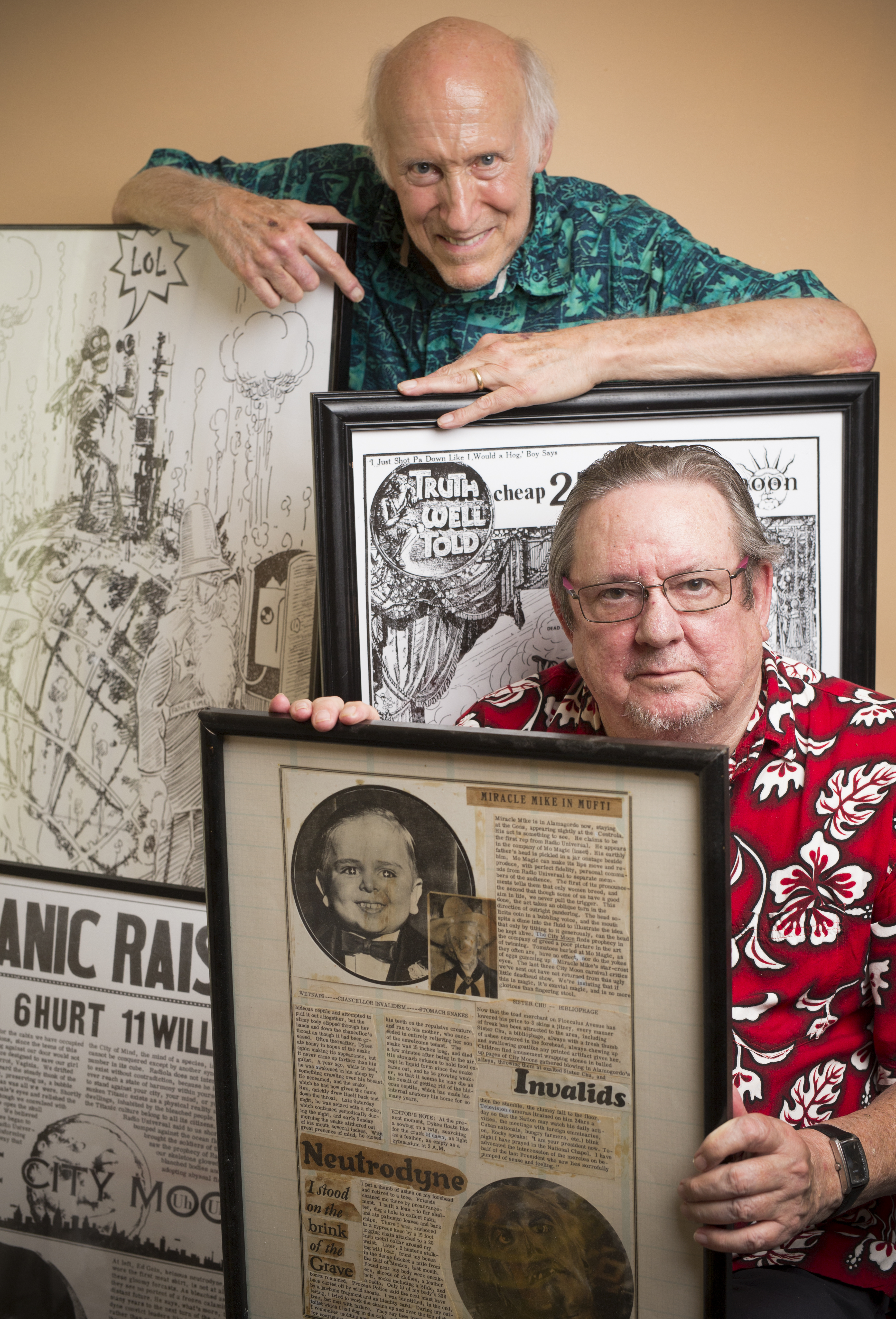
Writers and publishers David Ohle, front, and Roger Martin are pictured with framed copies of City Moon, a newspaper printed in Lawrence from 1973-1985 that combined satire and surrealism, among other things. A City Moon exhibit is currently on display at the Lawrence Public Library, 707 Vermont St. The two are pictured on Wednesday, July 19, 2017 at Ohle's studio.
David Ohle has plenty of favorites from his tenure at the now-defunct City Moon newspaper, though you won’t see those headlines at the Lawrence Public Library’s exhibit on the bizarre broadsheet.
“A lot of the good ones were selected out,” Ohle says of his best-loved stories from City Moon, which published 18 issues between 1973 and 1985.
One of Ohle’s personal favorites, an interview with the devil that ran under the headline “Hell fouled, could close; dead bad to Heaven,” didn’t make it into the library’s display of stories and images from City Moon’s 12-year run. Library staffers were careful in deeming which pieces were appropriate for younger visitors. Ohle and crew’s more twisted articles — and there were lots of them — didn’t make the cut.
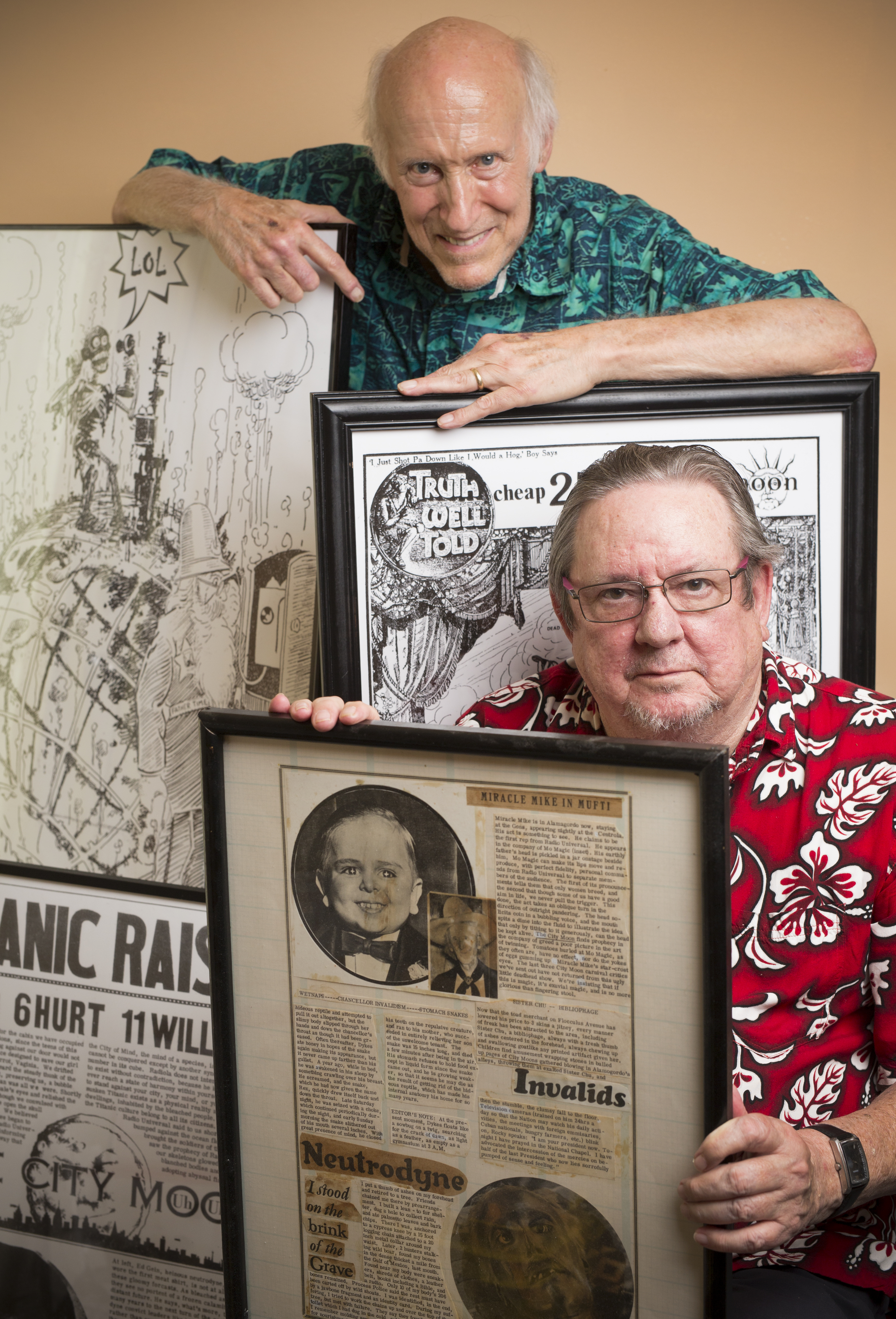
Writers and publishers David Ohle, front, and Roger Martin are pictured with framed copies of City Moon, a newspaper printed in Lawrence from 1973-1985 that combined satire and surrealism, among other things. A City Moon exhibit is currently on display at the Lawrence Public Library, 707 Vermont St. The two are pictured on Wednesday, July 19, 2017 at Ohle's studio.
Given the alternative newspaper’s history, that’s not necessarily a surprise. When Ohle, a now-retired instructor and lecturer at the University of Kansas, launched City Moon in 1973 with James Grauerholz and Wayne Propst, the idea wasn’t to offend.
“We were just having fun, playing around with words and language structures and photographs, cropping photographs in a funny way,” maintains Ohle, who says the project arose out of “disillusionment” with local news organizations.
Lawrence wasn’t hurting for underground newspapers in the early 1970s, Ohle says. There were several of them published locally. But Ohle, Grauerholz and Propst were looking for a little fun that didn’t involve politics, or more specifically the anti-war sentiment that seemed to permeate campus culture at the time. Unless, of course, it was “fake politics,” Ohle says.
City Moon is sometimes described as a predecessor of sorts to satirical online newspaper The Onion, but it’s not quite that easy to define, says Roger Martin, another Lawrence local and KU faculty member who joined City Moon as a writer and editor soon after its launch.
The newspaper presented a bizarre world with recurring characters such as the “Ape of Golf” and a sometimes-president named Oneba. Editors took delight in running headlines such as “TITANIC RAISED: 3 DEAD 6 HURT 11 WILL HANG” and “SUBMARINE GUTS PECULIAR BOY.”
“Essentially it’s stopping just short of being understandable. It’s stopping just short of being categorizable,” says Martin, who describes City Moon as closer in tone to burlesque and surrealism. “We were attempting to create something that was fun and silly and vaguely menacing and dark all at the same time.”
Much of the inspiration came from “real” newspapers dating back to the turn of the 20th century, when stories about horse-and-motorcar collisions, for example, were still commonplace. KU’s Watson Library was tossing out stacks of newspapers in the 1970s, Martin recalls, and he and his fellow editors took to “processing” the old stories into sillier, more compelling reads.
For a few years, City Moon operated out of three offices. One was in Austin, where Ohle taught English at the University of Texas from 1975 to 1984. The others were located in New York City, where Grauerholz became personal assistant to Beat Generation icon William S. Burroughs, and in Lawrence, where Martin taught in the KU English department and briefly worked as a reporter for the Journal-World.
City Moon exhibit
The City Moon exhibit at the Lawrence Public Library, 707 Vermont St., is planned to run through the end of July.
All 18 editions of City Moon can be found online through Calmari Press.
Because of Martin’s job at the university, the City Moon team had access to the KU presses, and the newspaper’s circulation was limited to the campus and surrounding town. At its peak, City Moon had a very small, very dedicated fan base, though the newspaper wasn’t without its critics.
“People who loved it, loved it, and people who didn’t ignored it pretty much, I think,” says Martin, now 70, who speculates most folks simply didn’t know what to make of the thing. “I don’t think anybody hated it particularly, although it was an offense to the chancellor, apparently.”
That would be former KU Chancellor Archie Dykes, who by all accounts was not a fan of the quirky broadsheet. In 1976, Dykes and then-Kansas Union director Frank Burge had the City Moon newspaper rack removed from the front of the student union — and relocated to the basement. The brouhaha was documented by a reporter from the Wichita Eagle, with Burge quoted as saying “scroungy newspaper racks are not the most beautiful things in the world,” according to literature from the Lawrence Public Library’s exhibit.
What attracted Chancellor Dykes’ attention, as Ohle remembers it, was the headline, “MAN SUCKS WETNAPS; BELLED BUZZARD SEEN; NECRONAUTS CRUISE.” Looking back, that brief period of notoriety was probably City Moon’s heyday, he says.
“I think we got better and better as we went along,” says Ohle, now 75. “It was big enough to offend the chancellor, so that was a high point.”
City Moon also received some attention outside Lawrence, with the conservative magazine The American Spectator deeming it the worst example of “sewer journalism” in the United States, arguing that only the sewers of liberal New York could create such smut. The now-defunct Crawdaddy magazine — a predecessor to music publications such as Rolling Stone — was a fan, though, and at one point ran several City Moon articles in a special section called the “Crawdoodah Gazette.”
But the newspaper was never a moneymaker for its publishers. Ohle, Martin and their fellow editors paid for most of the printing, with some help from various KU organizations and, in one year, a relatively modest grant through the National Endowment for the Arts.
“We hoped it would take off, and it never did. But that was part of the charm of it,” Martin says of City Moon. “We never tried to promote it or advance it or anything like that.”
Decades later, the newspaper’s former editors still aren’t big on self-promotion. Martin says he’s surprised to see “any interest at all” these days. Even with the arrival of the City Moon display at the Lawrence Public Library earlier this month, Ohle says he never receives any inquiries about the long-gone newspaper, and he doubts that will change much in the future.
The exhibit, he maintains, wasn’t his idea. The library was the interested party who approached him, he says. Self-deprecation aside, Ohle says he recently finished a 400-page novelization of City Moon that he’s since sent to a publisher and he’s waiting to hear back.
Interestingly enough, City Moon is now archived at the same university that once relegated its newspaper racks to the basement of the student union — a short walk away, at the Spencer Research Library. It’s also archived at Wichita State University, Northwestern University, Michigan State University and the University of Michigan, by Martin’s own count.
You can also access all 18 issues of City Moon online at Calamari Press, the company that published Ohle’s book “The Blast.” Ohle, who also penned the surreal novel “Motorman,” says he’s content with the newspaper’s relative obscurity.
He has several old copies lying around, and he still finds the stories funny — even if he’s frankly a bit “tired” of the whole thing. Both he and Martin shy away from the word “legacy” when it comes to describing City Moon’s colorful run and afterlife.
“I still like to look at it now and then. But as far as a legacy, there’s never been anything like it here in Lawrence,” Ohle says. “There have been a few people who copied it, but I think it’s a unique and singular thing.”
City Government
As they approve bikes plan, Lawrence city leaders ask about data collection, Kentucky and Tennessee streets
Lawrence city leaders want to toughen tobacco licensing rules ‘sooner than later’
Algerian government invites Mayor Brad Finkeldei, Lawrence delegation for a visit
Construction on Wakarusa Drive to resume; city manager says KDOT’s secretary has apologized for delay
Evacuation drill planned Tuesday at Lawrence City Hall
