

Ex-Kansas AG Phill Kline defends conduct in abortion cases
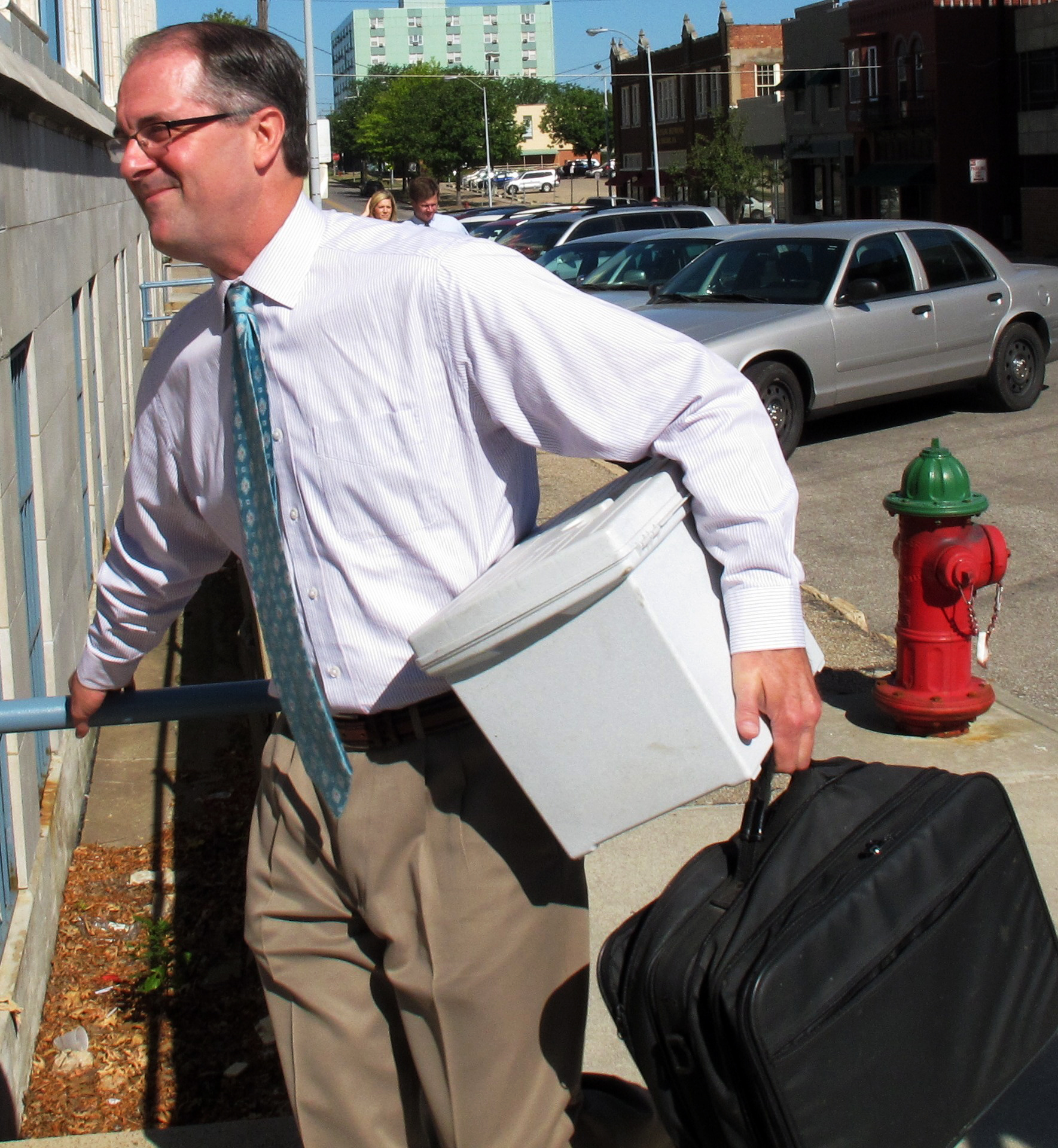
Former Kansas Attorney General Phill Kline heads into an ethics hearing, Tuesday, July 19, 2011, in Topeka. The state Board for Discipline of Attorneys is examining allegations of professional misconduct stemming from his past investigations of abortion providers, which he strongly disputes.
Topeka ? Former Kansas prosecutor Phill Kline told a state ethics panel Thursday that an allegation that he misled a Kansas City-area grand jury investigating an abortion clinic rests on “mass confusion” about what he and his subordinates told the group.
The allegation is part of a professional misconduct complaint against Kline. It stems from actions by Kline, an anti-abortion Republican, during investigations of abortion providers from 2003 to 2007 while he was attorney general, and in 2007 and 2008 when he was Johnson County district attorney.
Kline took the witness stand in his own defense Wednesday and Thursday during an ethics hearing before a three-member panel of the state Board for Discipline of Attorneys. Testimony finished Thursday; the panel planned to hear closing arguments from attorneys Friday and issue a decision later, probably taking at least several weeks.
The complaint accuses Kline and his staff of mishandling patients’ medical records and misleading other officials to further potential prosecutions of abortion providers, which he strongly disputes. The ethics panel will recommend to the Kansas Supreme Court whether he should face sanctions — although the court has criticized Kline in past decisions in abortion cases.
Among other things, the complaint alleges that Kline and his staff in the Johnson County district attorney’s office gave incomplete and misleading information to a grand jury that convened in late 2007 to investigate a Planned Parenthood clinic in the Kansas City suburb of Overland Park. The allegation came from the group’s presiding juror, who testified previously.
“This is one of the areas where there’s mass confusion,” Kline testified.
Kline was voted out of both the attorney general’s and district attorney’s offices and is now a visiting assistant law professor at Liberty University in Lynchburg, Va. The university was founded by evangelist Jerry Falwell.
In October 2007, Kline filed 107 criminal charges against the Planned Parenthood clinic, alleging it falsified documents and performed illegal abortions, which it strongly denies. A preliminary hearing to determine whether the case goes to trial is scheduled for Oct. 24-26.
But even as Kline filed those charges, anti-abortion groups used petitions signed by voters to force Johnson County to convene a grand jury to investigate the same clinic. However, the grand jury never issued an indictment.
Kline’s attorneys attempted to cast doubt on testimony from Stephanie Hensel, the grand jury’s presiding juror. At issue is what Kline and his staff told grand jurors as they considered investigating whether the Planned Parenthood clinic had reported cases of sexual abuse of children to the state, as required by Kansas law.
Hensel testified that Kline and his staff told the grand jury that any abortion involving a child under 16 had to be reported to the state as evidence of child abuse because the state’s age of consent for sex is 16. That would be in keeping with legal opinion Kline had issued as attorney general in 2003, but the issue inspired a federal lawsuit and legislators eventually rewrote the reporting law.
One of Kline’s former subordinates, who faced an ethics complaint himself, agreed to an informal admonishment last year, acknowledging not giving the grand jury enough information about the law but not intentionally misleading it.
But, questioned by one of his attorneys Thursday, Kline pointed to passages in transcripts of grand jury meetings to contradict Hensel’s version of events. He said grand jurors received “a clear and accurate recitation” of the law.
As for Hensel’s version of what the grand jury was told, Kline said, “I never said that. There was a presumption, but that’s not what was said.”
The disciplinary administrator’s office has portrayed Hensel as the grand jury’s spokeswoman.
Testimony has shown a strained relationship between the Johnson County district attorney’s office under Kline and the grand jury, which retained its own attorneys, not wanting to rely entirely on Kline’s staff.
One of the grand jury’s attorneys, retired Johnson County District Judge Larry McClain, testified that Kline’s office was “kind of demonizing” Planned Parenthood. He said he also told one of Kline’s subordinates, “Look, I just can’t trust you anymore.”
Kline and the subordinate testified that they didn’t recall any such comment from McClain. And, pointing to the lack of disparaging comments about Planned Parenthood in the grand jury transcripts, Kline said he and his staff remained professional throughout.
Kline’s attorneys describe the grand jury as beset by internal disagreements, and Kline testified Thursday that the panel was “fractured.” No grand jurors other than Hensel were identified publicly or testified in the ethics case.
Kline and his supporters also have questioned grand jury decisions, such as negotiating with Planned Parenthood attorneys to obtain records even after issuing a subpoena, which was never enforced.
During a break in testimony, Kline said actions by Hensel and the grand jury’s attorneys “killed” the panel’s investigation of the clinic. He and anti-abortion groups have made much of an agreement with Planned Parenthood’s attorneys to obtain records — drafted but ultimately not followed — that would have limited how the documents could be used, even by the district attorney.
“This procedure was not an investigation,” Kline said of the grand jury’s work. “I’ve never seen anything like it in my life.”
State Government
‘If it ain’t broke, don’t fix it’: Retired Judge Sally Pokorny tells residents why she opposes electing Supreme Court justices
KU professors would be limited in how they could present the idea of systemic racism in future classes
State legislators push back against federal energy regulators ending competitive bids
TOPEKA — Two Kansas legislators asked federal energy regulators to ensure competitive bidding occurs on ...
Senate confirms 1st of 3 Kansas nominees to U.S. District Court
Corporate income tax collections falling sharply in Kansas; Republican, Democratic leaders disagree on what it means
TOPEKA — Corporate income tax collections in Kansas have almost halved since last year, while other sources trend ...
Candidate’s campaign manager created website with documents used to attack rival
TOPEKA — Kansas U.S. Senate candidate Patrick Schmidt’s campaign manager left his digital footprint on ...