Deployments stress marriages
Divorce filings up near Fort Riley
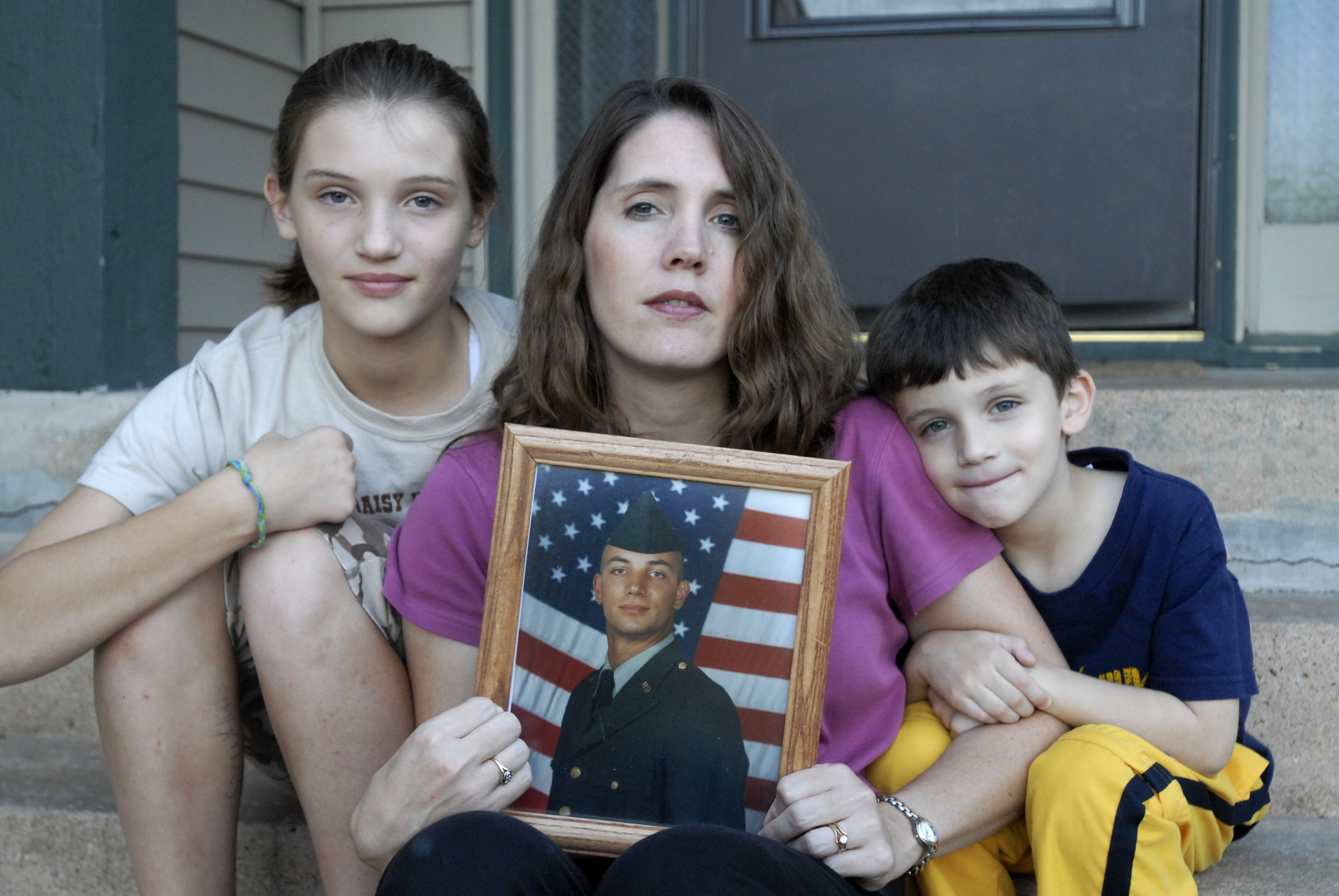
Larry Leuci, in framed photo, has been deployed to Iraq three times, leaving behind, from left, daughter Nicole, 12; wife, Dena; son, Chad, 5; and daughter April, 18, not pictured. The Leucis, pictured on Thursday, live in Manhattan, where Dena is raising their three children while her husband is off to war. The Leucis have learned how to cope with the deployments, but many soldiers' marriages end in divorce. Divorce filings in Riley and Geary counties have increased since 2003.
Manhattan ? In between his second and third deployments to Iraq, Larry Leuci’s bags sat unpacked and stacked in the middle of the bedroom floor.
Those bags wouldn’t let his wife, Dena, forget that since the war began, her husband has been gone far more than he has been home.
They were a nagging reminder that the process of deployment – the weeping goodbyes, carrying on daily conversations through instant messaging, figuring out how to juggle children, school and a job alone and then learning how to adjust when Dad comes home – was about to start all over again.
Early in September, Larry Leuci, a Black Hawk pilot with a medical evacuation unit based out of Fort Riley, returned to Iraq. He’ll be gone for 15 months.
The family he left behind went into adapt mode.
“You put this shell around your heart because you don’t have a choice. Because if you open your heart completely back up, you are going to be heartbroken again,” Dena Leuci said. “And you can’t. Not with little people depending on you.”
Four years into the war, as soldiers go back to Iraq for the third and fourth times, the wear and tear on marriages is starting to show, according to divorce attorneys, researchers and families.
“It does a lot of damage. How could it not?” Dena Leuci asked.
Increase in divorce filings
From Pete Robertson’s decades of experience as a divorce attorney just outside Fort Riley’s borders, he knows that any time soldiers are deployed, there is an uptick in divorce filings when they come home.
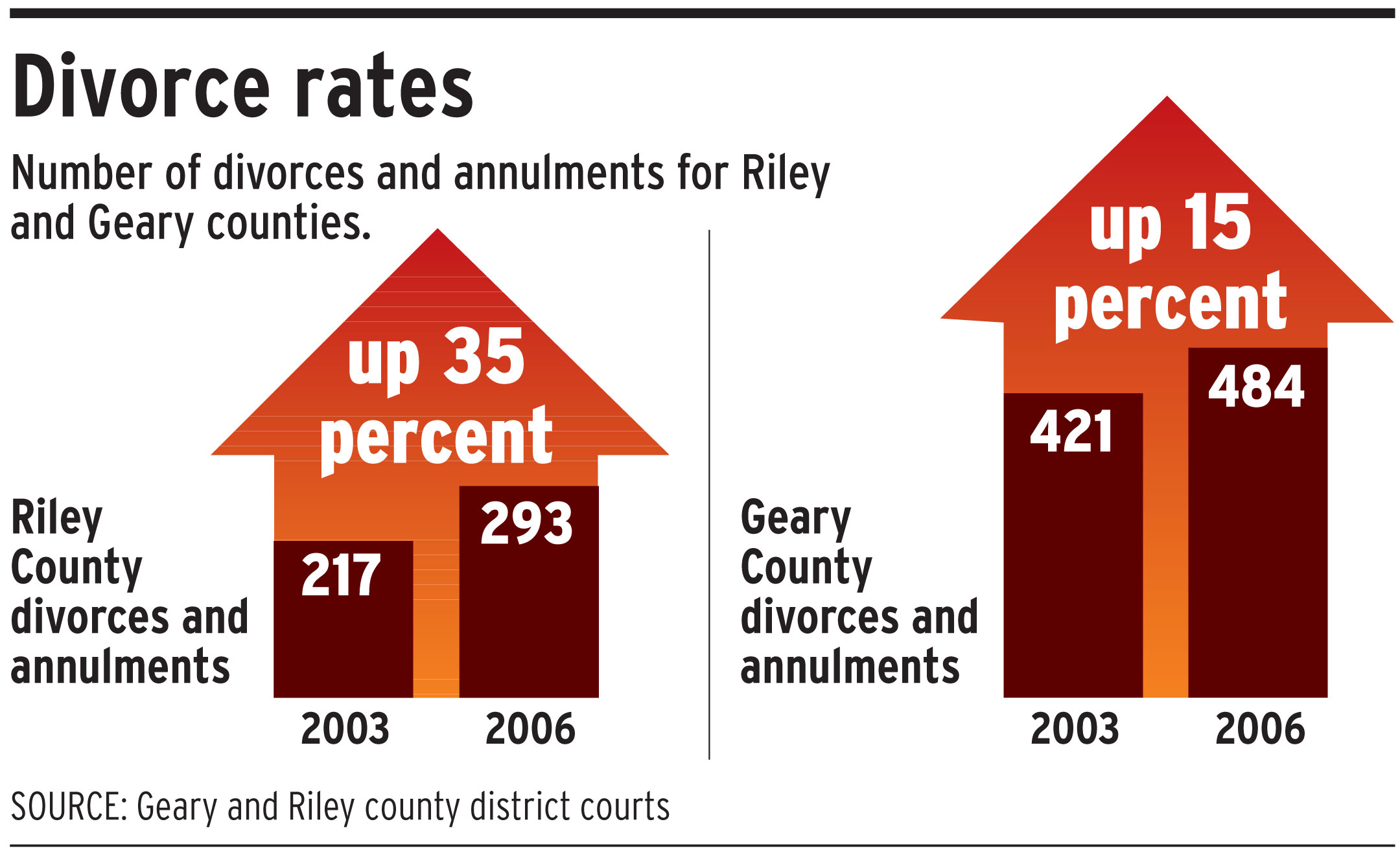
His theory held true for Riley and Geary counties, home to most of the families based out of Fort Riley. From 2003 to 2006, divorce filings in Riley County increased by 35 percent, and they increased in Geary County by 15 percent.
Manhattan and Junction City divorce attorney Linnea Alt, who has 60 percent or 70 percent of her clientele come from the Army base, has seen a bump in filings.
“Our workloads have increased,” she said. “I think the majority of divorce attorneys in the area are pretty swamped.”
K-State research
This spring, a study funded by the Department of Defense indicated that deployments could strengthen marriages. This contradicts what years of conventional wisdom held as true: With military deployment comes the breakup of marriages.
However, a study conducted by Walter Schumm, a Kansas State University professor with the School of Family Studies and Human Services, had a different take on how deployments affect marriages.
Before the second Gulf War, Schumm had studied soldiers who served on peacekeeping missions in Egypt. In that study, he found that soldiers had a divorce rate of about 21 percent in the two years after they came home.
Data gathered after Operation Desert Storm showed that some pockets of soldiers had divorce rates as high as 70 percent, Schumm said.
In spring 2006, just after an Army unit returned from Iraq, Schumm surveyed 337 soldiers at Fort Riley. He found that 12.5 percent of the soldiers reported having marriage troubles, 6.1 percent said they would probably divorce and 12.2 percent indicated that they would be divorcing.
In comparison, in civilian populations, 2 percent to 4 percent of married couples are divorced each year.
“That is pretty high because the 2 to 4 percent is over a whole year, and this is a snapshot in time,” Schumm said.
The young families
A good portion of those coming into Alt’s law office are young soldiers who married just before deployment.
“They get married right before they leave, don’t have a long-term relationship and come back and find they’re not compatible,” Alt said.
Schumm’s study found the younger enlisted soldiers had the highest rate of marriage instability, 43 percent.
Janet Crow, a K-State assistant professor of family studies and human services, knows the strain deployment can have on marriage. She remembers being a new mother when her husband was gone for several months in Germany.
“They are dealing with all the same stressors that young families deal with anyway, and you add on top of that the stress of military life in general and then deployment in particular,” Crow said. “And then in Geary County, you are going to have a lot of young spouses who may be 2,000 miles from Mom or Dad or Aunt Betty who would be there to support them.”
Col. Glen Bloomstrom, a chaplain stationed at Fort Leavenworth, said many young couples are still developing the much-needed “roots” of a relationship just as soldiers are deployed.
“Generally young people need a few years in order to develop their identity as a couple. It is a life-cycle stage,” Bloomstrom said.
Family time
For the Leucis, the odds of weathering the deployment are in their favor. They’ve been together for 15 years, have children and have already survived two deployments.
Last week, Dena, her 5-year-old son, Chad, 12-year-old daughter, Nicole, and her mother, Joyce Crumpton, settled down for dinner in their Manhattan kitchen. Along with Dad, 18-year-old April was missing at the table; the K-State student was at work.
The family prayed for Dad and sunshine before digging into pizza, Larry’s favorite.
In his absence, Larry has missed April’s prom, the death of family members, school plays and birthdays.
They keep in touch every day via phone calls, instant messages, e-mails and now the webcam. Dena jots down notes on what to tell Larry. He weighs in on daily decisions and even scolds the children when duty calls.
Still, it’s hard.
“It’s the day-to-day stuff that everyone takes for granted. Everything from the laughter to the tears to the arguing,” Dena said.
Like many couples, the hardest part for the Leucis wasn’t the time apart, but the return.
After the first deployment, Dena said she was shocked when after the first few days of celebration, “issues” surfaced.
The family adjusted as part of the discipline shifted from Mom to Dad. And Dad had to be reminded that unlike soldiers, family members should be asked, not told, what to do.
But most of all, everyone had changed.
There was a new boyfriend, a cat, a few more gray hairs and a dad who had spent a year in a war zone.
“He comes in, and it’s kind of like opening the chapters toward the end of a book and not having any clue as to what the beginning of the book was about because he missed a whole year,” Dena Leuci said.
Making it through
Whether it is survival of the fittest or better coping skills, Schumm’s study found that with more deployments comes a decrease in divorce rates.
The K-State professor theorized that the first deployment “weeds out” either the marriages or the soldiers.
The data he gathered showed that any deployment led to higher divorce rates than none at all. But the peak of those expecting to get divorced occurred between the second and third deployment. The rates dropped after the fourth.
“What is happening is people are figuring out how to deal with it, or they are getting divorced, or they are getting out of the Army,” Schumm said. “By the fourth time, they have figured something out, and it doesn’t appear to be bothering them quite so much.”
Help from the military
In the past decade, the military has taken note of the toll that deployments can take on families.
Fort Riley and Fort Leavenworth offer classes to build relationship skills and provide weekend retreats for couples. Before the soldiers return, families are given briefings to help adjust to the pending changes.
The Army is spending $15 million to $18 million on marriage and family development programs, Bloomstrom said.
“We really believe, theoretically, if we can help a young soldier to develop their marital skills, develop their friendships, develop their sense of attachment, they can concentrate on the mission and know that when they come back, their marriage is still going to be intact,” Bloomstrom said. “And that is a tall order.”
Dena Leuci is active in Fort Riley’s family readiness groups and helps coordinate outings with other families in the unit. The get-togethers help. So do prayers, constant communication, help from her mom and a constant reminder that her husband didn’t choose to go to Iraq and leave his family behind.
For the Leucis, this will be their last deployment. Dena said her husband will retire before going back to Iraq for a fourth time.
“It’s getting old,” she said, “it’s getting very, very old.”
City Government
Lawrence’s sustainability board interested in changes to weed control ordinance that would promote native plants

City of Lawrence plans to buy former Journal-World printing plant building for a City Hall annex

Conversations on Riverfront site’s future have already begun, but Lawrence city staff says there’s a long way to go
These officers play many roles on downtown patrol in Lawrence, and they don’t want to see it cut

Lawrence Transit’s sales tax is ‘critical,’ its director says, and an increase could be on the ballot in November