Urban intrigue
Denizens of the concrete jungle explore their natural habitat
Three weeks ago, long before I had heard of “elevator surfing,” “buildering” or “urban exploration,” I never pictured myself trespassing aboard a leaky rowboat in a flooded underground business park in southern Kansas City. I am on an excursion with a team of amateur enthusiasts whose mission is to find, explore and document the hidden and obscure landmarks of metropolitan history.
Our own guesses to the extent of the caverns come only from the echoes that surround us and the rumors that brought us here. It is pitch black other than the roving flashlight beams, musty and cool, and drops of condensation descend regularly from the ceiling. I grip the rickety oars and row on, scraping over submerged machines and building materials. Though my shoes are soaked from the water inside our dubious vessel, in my quest to unearth the local urban exploration community, my feet have just gotten wet.
What lies beneath
It is a little-known fact that there are vast mazes of tunnels, abandoned basements and crypts under many cities, and Lawrence is no exception. The KU steam tunnels themselves cover more than five miles. An even lesser-known fact is that there exists a secret enclave of curious devotees who navigate these metropolitan spaces; it has an active following in Lawrence and Kansas City.
Kelsey Lutz, a college-age student guided through the KU labyrinth by a fellow “stunneler” (i.e. steam tunneler) and Lawrence native known only by the handle “Spydr,” is an “urban explorer.” Despite the skepticism harbored toward reporters and other potential narcs by this particular facet of society’s underground, Lutz agrees to talk about her experiences beneath the surface of KU’s campus and her motivation for exploring it.
“It was awesome,” Lutz says. “It was almost like an alien world down there – all the changes in atmosphere just in going from one part of the tunnel to the next. One part can be really hot, and one part can be really cool. And you look up and there are drains from the outside and these vents, and it’s like, ‘Oops, I’m on the wrong side of the drain. I feel like a Ninja Turtle.'”
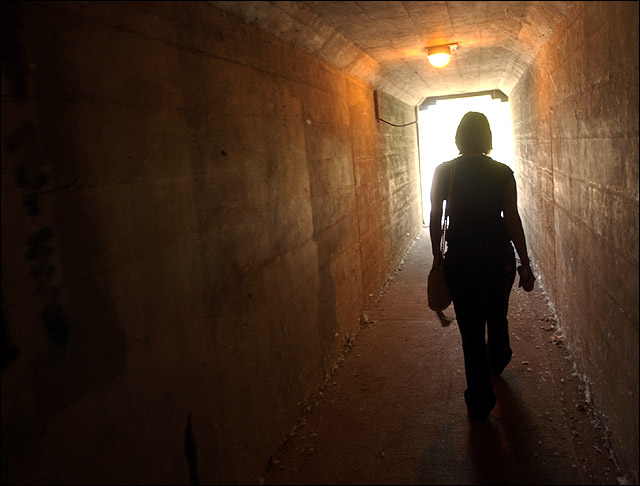
Kelsey Lutz, a member of a Kansas City urban exploration crew, risks injury and prosecution to scout abandoned and forbidden sites in Lawrence.
Lutz is fairly confident in exploring the tunnels. Neither she nor her “UrbEx” friends have ever been in serious trouble.
“Of all the people I know, no one’s ever gotten arrested for trespassing. I think the thing they’re most worried about is people’s safety. These are places that are unsafe to be in – the stairs are rotted out or there is asbestos everywhere. It’s a safety hazard,” she says.
Despite her awareness of the dangers of the antiquated insulation, Lutz does not use a respirator in KU’s asbestos-laden tunnels. But it is not omitted because of carelessness. She explains that the hazard of asbestos is primarily present when it is crushed and powderized, and can get in the lungs. As long as it is left alone, it presents less risk.
The most peril Lutz was ever near was on her first UrbEx mission with the group in Kansas City to a silo near Westport.
“In the grain elevator, parts of the building were just gone,” she says. “When there was a door, you had to be careful it didn’t just drop off – you’re up 300 feet in the air – and that you didn’t just walk out the door.”
What justifies the risks for Lutz is the artistic experience and the historical context … and the rush it gives her.
“I’m a photographer,” Lutz says. “You’re almost documenting history by the pictures you take and things you see – knowing sometimes buildings are on a demolition schedule and that they’re not going to be there and you’re probably going to be one of the last people that sees it. It’s also kind of eerie knowing you’re not supposed to be somewhere. It’s kind of an adrenaline thing; you never know what’s going to be around the next corner.”
The spirit of the underground
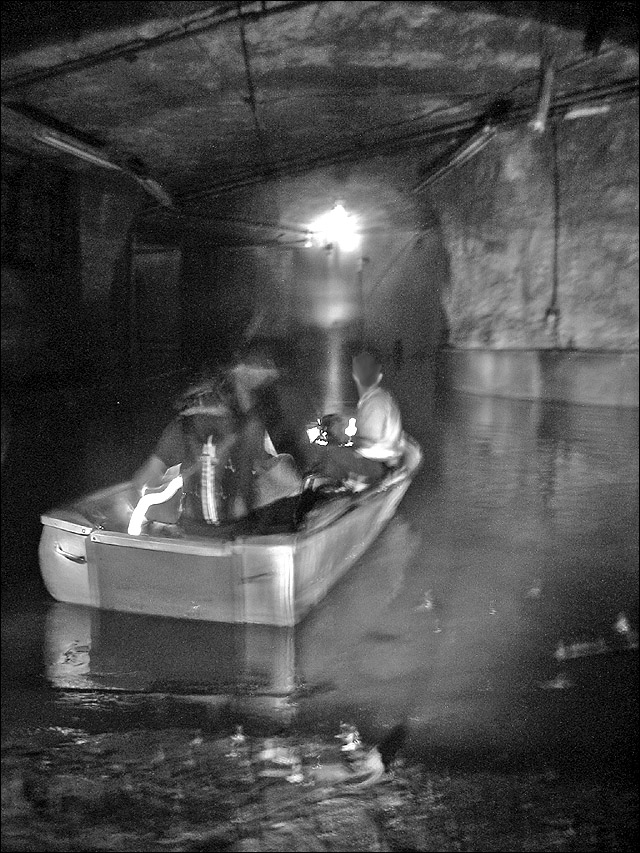
Urban Explorers float through an abandoned business park flooded during its construction in Kansas City.
Lutz had been my access to a hidden online network, so I decided to follow the web to its depth and find the heart of the local UrbEx community.
Eventually I came to a hub in the form of an UrbEx team organizer named Max (who asked his last name be omitted) who operates a large group under the handle “S1len7B0b,” i.e. SilentBob. He extended an invitation to meet the group at a rendezvous and get some first-hand experience with the obscure crew.
Surprisingly, the people who trickle into the rendezvous were quite normal-looking, devoid of goth, punk or the typical urban apparel worn by graffiti artists. It could easily be (and for several minutes becomes) a Harry Potter book release group. Everyone seems intelligent and enthusiastic, and they banter about all things UrbEx: flashlight candle-power, climbing harness discounts and an inflatable raft that they had purchased collectively (the purpose of which was unknown to me). They refer to members as much by online handles as real names, and share information they have learned from contacts about various sites around the city.
After we embark to the site du jour, S1len7B0b and another group member, Todd, aka “Gothstone,” (who also asked that his last name be omitted) are quick to debunk the misconception that shrouds the UrbEx community.
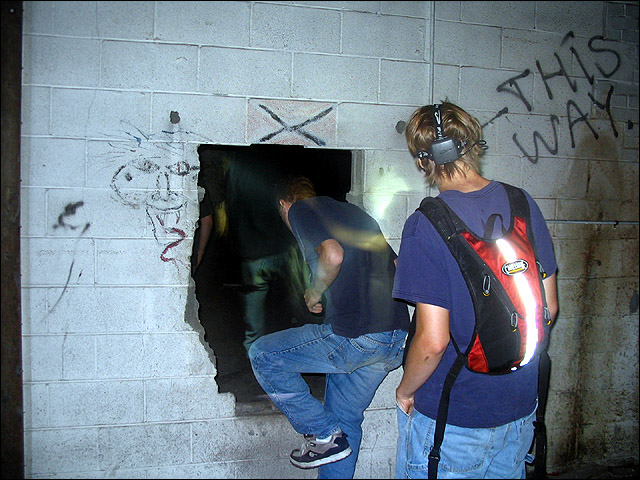
The Kansas City UrbEx team reaches an access point to an underground network that the members discovered by boat during a recent mission in southern Kansas City.
“It’s not that we’re doing it because it breaks some laws occasionally, or that we’re all about breaking and entering,” Gothstone says. “Realistically, a lot of people, if they knew exactly what we are doing, they could care less. But a lot of places jump to the conclusions that we are there to destroy, to tag or to steal. We’re just not interested in that.”
What the group is interested in, however, is the intrigue of the historic and the obscure. It was difficult for them to decide which is more appealing, the fun of the mission or the knowledge that they contribute to the global UrbEx network.
“Really, it’s a combination of both,” says Lydia, aka “LostLenore.” “Most of the locations we look into, especially the more historic ones, we do extensive research to find everything we possibly can about the history of the location and what it was used for – any interesting facts – so what we are able to share will have the most whole historical picture we can offer. That’s a really big thing for me.”
The sewer wild
Not that the KC UrbEx group doesn’t have purely recreational missions. Among the utilitarian things for which the raft they purchased is to be used, the group is specifically excited to whitewater raft Kansas City’s storm sewers during a heavy rainfall sometime soon. This sport, called “draining,” was started Down Under by some of the founders of urban exploration.
“In Australia, Cave Clan there has actually found different storm drains that they go tubing in,” S1len7B0b says. “They’ll wait for a big storm, and since they know the drains well enough to understand how they flood, they take inner tubes down them. They get going something like 30 or 40 miles per hour.”
When including endeavors like “elevator surfing” (riding on the tops of elevators to jump into maintenance ducts), “buildering” (climbing buildings with or without the aid of equipment), stunneling, “skunneling” (skateboarding inside tunnels and storm sewers) and draining, urban exploration quickly morphs into an extreme sport so diverse it has warranted its own vocabulary.
While to some, these pursuits may seem like an inordinate risk for a fun time, LostLenore puts it in perspective.
“In anything we do, there’s a danger factor because you don’t know – the building could have something structurally wrong with it that you’re unaware of,” she says. “So while one thing may sound sexier than another, when it comes down to how much you could potentially get hurt, anything can be dangerous.”
All in a day’s UrbEx
No extreme sports are slated for our rowboat today, however. When we finally reach our destination, that is just the beginning. A whole complex awaits the meticulous perusal of the team. It’s evident that others have been here before us. Graffiti decorates the area, and makeshift entrances have been smashed through the cinder block walls. For several hours the team will commit all it sees to memory and film. Every opening is a new opportunity, every tunnel a new prospect. And because they stick to their ethos and leave everything “in situ,” the Kansas City UrbEx could continue to go unnoticed.
Like LostLenore says, “Take nothing but pictures; leave nothing but footprints.”
City Government
When will Ninth Street reopen? When will Mass. Street construction begin? Here’s where road projects around Lawrence are at
As Lawrence and partners update school routes, they’ve seen less walking and biking to most schools
Traffic will be affected near Watson Park as city installs a new stormwater tunnel
The Granada announces two more watch parties in downtown Lawrence for U.S., Algeria matches
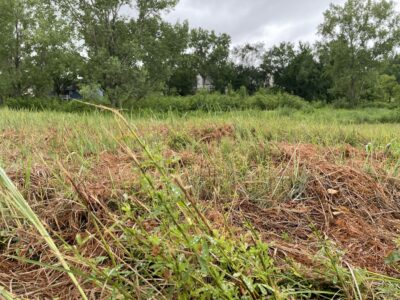
Mowing at Prairie Park’s remnant prairie is part of a strategy to control noxious weeds; city, restoration team say it’s the least damaging option