Hillcrest third-graders build ‘simple machines’ for contest
Federal testing standards taking time away from classroom creativity
The days might be numbered for inventions such as the Fantastic Frog Food Flinger, the R.G. Illuminator 9000 and the Automatic Toothbrush Feeler.
Those creations — powered by marbles, pulleys, levers, mousetraps, and kids’ ingenuity — went on display Monday at Hillcrest School’s annual Rube Goldberg competition. For the past decade, third-graders at the school have designed homemade contraptions that use an elaborate sequence of simple machines to perform a task.
“I called it ‘Rabbit Feeder,'” 8-year-old Karen McCormick told the contest’s judges, before she pulled a piece of yarn that caused a weight to roll down a chute, land on a lever and upset a paper cup filled with rabbit pellets.
“One lucky rabbit,” a judge said.
The annual contest teaches children about persistence, public speaking and physics.
But the teacher behind the lesson said she feared more stringent testing requirements brought about by the federal No Child Left Behind Act would force it out of existence in coming years.
“The requirements being raised so high, it’s hard to squeeze in time to do activities like this,” said third-grade teacher Kathy Farwell, who’s taught the lesson the past few years at Hillcrest.
Third-graders in the district are required to learn about the human skeleton, but “simple machines” — the lesson underlying the Rube Goldberg contest — is an optional science unit, Farwell said. With schools now required to make annual testing improvements in reading and math, there’s less time for helping students create a Happy Flower Feeder or a Tea Bag Drop.
“It really has created a far more bureaucratic educational system than I think we had before,” said Tom Christie, who oversees curriculum for the Lawrence school district.
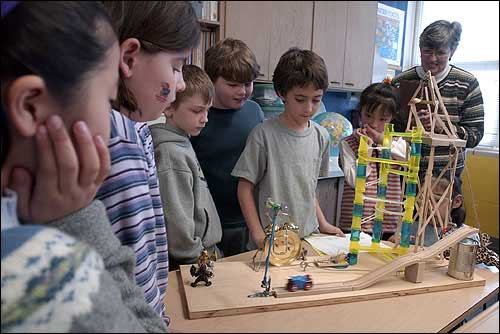
Hillcrest School third-graders, from left, Kelly Song, Anna Wright, David Fulbright, Wyatt Ohse, Anthony Groene and Danni Wang, and judge Kathy Davis gather to watch a Rube Goldberg machine. Created by Anthony, the machine used various mechanisms and ultimately turned off an alarm clock. The students' projects were judged on Monday.
But Christie pointed out that if the law remains in effect, schools soon will be testing students on science and social studies, not just reading and math. He was optimistic about the future of the Rube Goldberg contest because he said it’s possible to find ways to tie the lesson in with reading and math standards.
“My guess is that, no, that’s not something they would have to discontinue. I don’t know how much time they spent doing it,” he said. “I think that’s a good activity that reinforces what we’re trying to get students to learn.”
Farwell wasn’t as optimistic. Asked whether she believed the competition would happen two years from now, she said “No, not at this point.”
“The bottom line is that it’s just kind of frowned upon to do larger, more time-consuming projects that aren’t in the essential-skills piece,” she said.
Judges in Monday’s contest scored machines on criteria including their names, students’ verbal presentations, and how well they captured the spirit of Rube Goldberg, a 20th-century cartoonist who sketched machines that performed easy tasks through as many convoluted steps as possible.

 6News video: Students build ‘simple machines’ at Hillcrest
Inventions on display included Anna Wright’s “How to Crack an Egg,” which used a mousetrap to fling a doorstop into a hard-boiled egg; and Ella Gore’s “The Nutcracker,” which used levers, springs and wedges to tip a heavy metal ball onto a walnut. When one of the machines failed to work as planned, Farwell asked how many of the children thought that real-life inventors sometimes had problems.
They all raised their hands.
“It’s fun, and they’re learning,” said judge Carol Abrahamson, a retired teacher who started the contest in the early 1990s. “There’s more than just pushing a pencil and filling in bubbles.”
City Government
During new demolition moratorium, University Place hopes to strengthen protections for its older homes
Lawrence city manager finalists will visit in 2 weeks; hiring decision expected shortly after
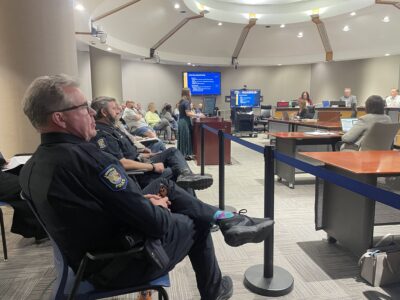
Police officers urge Lawrence City Commission not to cut their department to fund fire and medical expansion

Lawrence city leaders voice support for proposed Fire Medical funding formula, say it will lead to more stability

Per aspera: Outgoing Lawrence City Manager Craig Owens looks back on challenges good, bad and traumatic