Tires feel travel pressure
Tread maintenance can help drivers ensure safe arrivals
If you’re one of the millions of people across the nation planning to hit the road this Thanksgiving holiday, consider this:
Tire failures cause thousands of crashes and kill hundreds of people every year. And while some failures can be attributed to road hazards or manufacturer defects, safety experts say most can be blamed on simple neglect, such as not checking tire pressure or replacing worn or aged tires.
“The most important thing is to check air pressure,” said Steve Aldrich, assistant manager at Gregg Tire Co. “If you have improper tire pressure, it’s going to affect your gas mileage and it’s going to wear your tires unevenly.”
Or worse.
Driving on underinflated tires can create a build-up of excess heat that causes internal damage, including tread separation, in which the tire tread peels off at highway speeds. That can lead to loss of control and crashes.
Tire-related crashes
Tire failures were blamed for 325 crashes on Kansas roadways during 2002, according to the Kansas Department of Transportation, ranking them the 30th-leading cause of crashes in the state.
With the recent steep drop in temperature, Aldrich said, tire inflation is even more of an issue.
“You lose pressure in the course of a month just due to normal use, but air temperature also affects your tires,” he said. “For every 10 degrees the temperature drops you lose one pound of air pressure.”
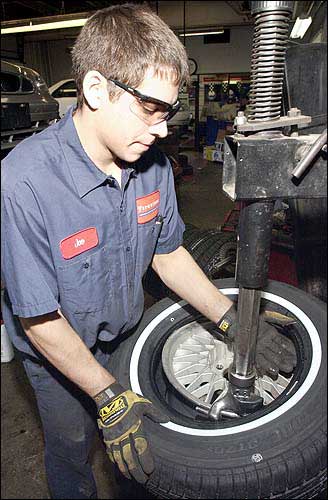
As the holidays approach, some automobile owners are preparing their cars for long-distance travel. Joe Hall works on a tire Monday at the Firestone Tire and Service Center, 2425 Iowa.
Checking the proper tire pressure is simple. The recommended pressure typically is found in the car owner’s manual. It may also be found on a permanent label attached to the vehicle door edge, door post or glove-box door.
Aldrich recommends checking tires at least once a month.
Check the tread
But don’t count on the pressure gauge built into the pump at the local gasoline station. According to a recent study by the National Highway Traffic Safety Administration, nearly 20 percent of such gauges over-report the pressure in a tire by at least four pounds per square inch. So ask the attendant for a gauge, or buy one to carry in the car.


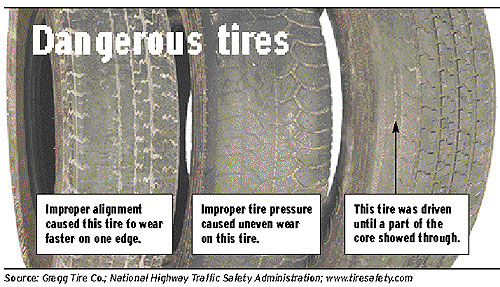
Taking care of tires also means monitoring the tread.
“Bald tires are like ice skates instead of snow shoes. They can be very dangerous in winter conditions,” said Lt. John Eichkorn of the Kansas Highway Patrol.
And many drivers are riding on them. Another study by the NHTSA found almost one in every 10 cars in the United States was being driven with at least one bald tire.
| ¢ Tires can lose one pound of pressure per square inch during a month of normal driving. Additionally, tires can lose 1 psi for every 10 degrees the temperature drops. So check tire pressure often.¢ Looks can be deceiving: Use a gauge to check pressure.¢ For maximum tire life, rotate tires every 5,000 miles.¢ Generally, tires with less than 1/16 of an inch of tread should be replaced. Also look for uneven wear on shoulders. |
Tires have built-in treadwear bars to let drivers know when it’s time to replace them. These indicators are raised sections between the tread grooves. When the tread is even with the treadwear bars, it’s time to get new tires.
The penny test
Aldrich also recommended the penny test as a simple way to test tread depth. Place a Lincoln penny head first into a tire’s tread. If Lincoln’s head is visible, the tread is shot and the tire needs to be replaced.
“It’s best to take your car to a shop if you’re really concerned because you can’t always see the inside of your tread. It’s also a good idea if you’re there to have them look for anything like cracks or nails that might cause a problem on the road,” Aldrich said.
| During the Thanksgiving weekend a year ago, seven people were killed on Kansas highways. That was up from four who died over the holiday in 2001; nine were killed in Thanksgiving crashes in 2000. |
Drivers should also check that their car’s fluids are topped off before hitting the road.
“Your antifreeze needs to be checked to make sure the protection level is good enough. It should be around negative 40. If it gets down to zero you could have problems with your car freezing up,” Aldrich said.
City Government
At listening session on Lawrence police’s draft camera policy, Chief Rich Lockhart looks for understanding
Sidewalk repair program will focus on Sunset Hill and Pinkney neighborhoods this year; what to know about the projects
Trails behind Sports Pavilion Lawrence closed after storm damage
Lawrence could be a landing spot for data centers as city code already allows them
If you have a galvanized water line, you could soon get a free replacement from the City of Lawrence