New Unified Command branch updating COVID response as pandemic enters recovery phase

photo by: Contributed and Journal-World File Photos
Lawrence-Douglas County Public Health Director Dan Partridge is pictured along with the department's home in the Community Health Facility, 200 Maine St.
With COVID cases declining, a new branch of Douglas County Unified Command is set to begin a pandemic recovery phase in the coming months, and that will include lessening the frequency of coronavirus data reporting and reworking Lawrence-Douglas County Public Health’s community transmission indicator tool, among other goals.
That transition comes as Douglas County reaches the end of a significant COVID spike, which prompted a monthslong mask mandate that expired on Wednesday. Members of the new branch include County Health Officer Dr. Jennifer Schrimsher, Health Department Director Dan Partridge and other public health representatives from both the health department and LMH Health, as well as representatives from the City of Lawrence, the county and emergency management.
Schrimsher and Partridge spoke with the Journal-World via Zoom Friday afternoon, and both said the move was intended to help guide the county’s next phase of COVID recovery.
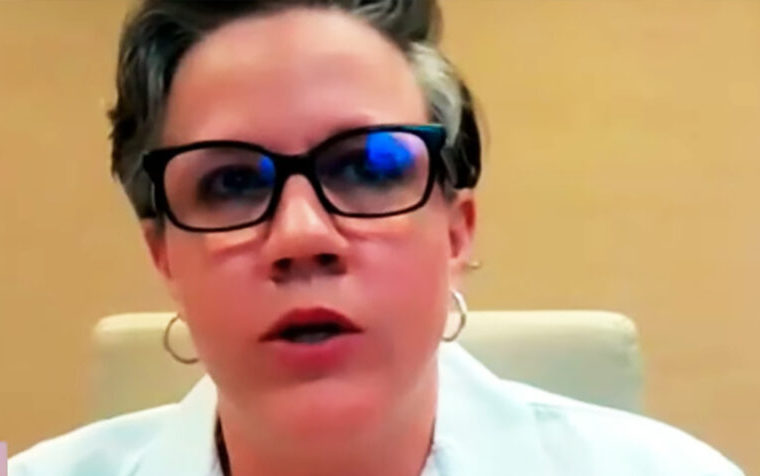
photo by: Journal-World screenshot
Douglas County Health Officer Dr. Jennifer Schrimsher
“With every emergency, there’s kind of a rhythm and a cycle to it,” Partridge said. “Response, recovery, rinse, repeat. The time was right to try to start transitioning from responding to COVID to moving into a recovery stage.”
Early on, the work will likely include reducing COVID data reporting by the health department from three days per week to one day per week. Partridge said those reports are also likely to include fewer metrics.
Those numbers will become less useful the more over-the-counter testing is used, Schrimsher said. People will still want to know if suddenly 30 people are hospitalized for COVID, she said, but there has to be a shift toward suggested mitigation measures during the current lull.
To that end, Partridge said, there will eventually be a move away from the green, yellow and red risk categories the health department currently employs for the community transmission indicator tool. In general, the tool lists broad recommendations people should follow depending on how many active COVID cases exist at one time and what the daily average has been based on a moving 14-day average.
Those categories may instead be renamed to something like low, medium and high, he said. That’s partially influenced by what Partridge said could sometimes be an “emotional” public response to the current tiers, since entering the “red” zone might sound more alarming.
It’s difficult to tell for now, though, as the new branch has met only a handful of times. That means there isn’t a firm timeline for changing that tool in particular, Partridge said, but it could roughly align with the end of the school year, three or four months from now.
The goal, Partridge said, would be to shift the community’s mindset away from waiting for a governing body to set the direction through a public health order, and instead provide information and guidance to help community members control their individual risks.
“Behind that is the concept that everyone needs to manage the risk,” Partridge said. “We each have an individual part to play in risk management, so we want to help you understand what the level of risk is.”
It’s intended to be implemented gradually, Schrimsher said, with the understanding that the community needs to think about how to responsibly move toward relative normalcy.
There is one caveat to all of this, Partridge said: We don’t know when the next COVID surge might be coming.
“It’s a back-and-forth, or at least it could be,” Partridge said. “We recognize — and part of what we want the community to recognize is — that there’s no guarantees about where COVID will take us next.”
It’s a familiar tune, Schrimsher said. The county’s been at this point before, until the delta variant set recovery back again. Right now, Schrimsher said we should see a period of relative quiet, but we should also be prepared to buckle down again if worse comes to worst.
It’s also difficult to tell how local recommendations might square with the Centers for Disease Control and Prevention’s latest mask guidelines in the immediate future. Those guidelines, broadly speaking, say people who live in counties where COVID is posing a low or medium threat to hospitals can stop wearing masks. Douglas County entered its lowest local risk status, the green category, on Friday, and the CDC also lists the county’s risk level as low.
Locally, Partridge said the goal is reaching some measure of overlap whenever there are new federal guidelines, but health officials here in Douglas County haven’t ever set guidance that aligns completely.
Instead, Schrimsher said, they’ve tried to better reflect what’s going on in Douglas County. Local guidance may continue to vary from federal guidance in the future, but the more statistics like hospitalizations improve, the more the need for hyper-local data will lessen and allow for the county to reflect CDC guidance instead, she said.
As the latest transition begins, Partridge said the health department has estimated that Douglas County has seen 7,824 fewer COVID cases, 183 fewer COVID hospitalizations and 195 fewer deaths due to COVID since the start of the pandemic as a result of the community’s participation in mitigation efforts, including past mask mandates.
Partridge said that’s a result of collective individual action from Douglas County residents, and the idea would be for future messaging to reflect that impact.
“For me, those numbers are important to help tell the story of ‘Why did we do this? Why did we wear a mask?'” Partridge said. “… Me included, we want to know if it was worth it. And when we feel like ‘Oh, it was worth it,’ that kind of helps you feel good about the work that went into it, and motivated to keep it up if you need it.”
But that isn’t to say their job is over. For example, Partridge said work still remains to encourage vaccination, especially booster doses and shots for young children. But he said he hoped to present a balance on that front — the work isn’t done, but here is the progress the community has made possible. It’s also an opportunity to show some appreciation for those efforts, he said.
Moving forward, the new branch plans to look toward some other elements of recovery that Partridge and Schrimsher said shouldn’t be overlooked. For Partridge, that’s recognizing there’s an “equity dimension” to the recovery process. Not everyone has had the same sort of access to health care or other resources, and that means it isn’t universal how quickly or easily one will recover from the effects of the pandemic.
Schrimsher, meanwhile, said she hoped there would be an emphasis on how the pandemic has affected mental health, a topic she stressed to the Journal-World recently.
For now, Schrimsher said she’s expecting we’ll see a restful period for a while, which hopefully will provide people with an opportunity to do things that feel more normal — perhaps go visit family that they haven’t seen in a while, or simply go out and do something fun. That doesn’t indicate the pandemic is over by any means, though.
“I think people are willing the pandemic to be over really hard,” Schrimsher said. “Willing it does not make it so. If we do things responsibly, we can continue to move forward, but the (pandemic) is not over.”
Other News

RJ Mitte, ‘Breaking Bad’ actor and disability rights champion, dies at 34
Clinton State Park and other state parks will increase overnight camping, vehicle permit fees starting next month
‘No day is like the other here’: Students from Lawrence’s German sister city discover football, new foods and new friends on exchange

GCSAA celebrates 100 years with new plaza and statue honoring its founder and first president

Go, See, Do: Library book sale, candidate forum and more