A new aviation program at Peaslee Tech helped this Lawrence High grad get her dreams off the ground
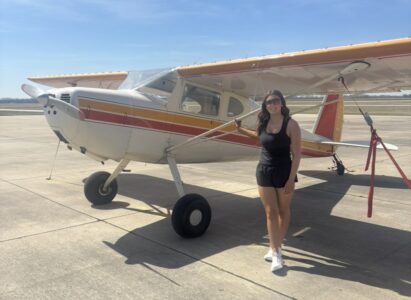
photo by: Contributed
Lawrence High School graduate Noelle Fisher is training to become a pilot.
Noelle Fisher’s flight plan through life hasn’t looked like a typical pilot’s story.
“Most people in the aviation world have family that does it,” said Fisher, who graduated from Lawrence High School last week. “Or they have some kind of moment where they’re like, ‘Oh, I want to do this!’
“But I’ve never really had that moment. I just always liked planes, and then I started to get serious about it my sophomore year of high school, realized that it was a career path I could follow and kind of just stuck with it.”
The problem was that she didn’t know where to start. But in her senior year, she got a new opportunity through Peaslee Tech: an Intro to Aviation course for high school students where she could connect with people in the industry and find out more about how to pursue it as a career.
Now, her dreams are cleared for takeoff.
Fisher is now working toward her private pilot’s license, and she will be going to college at Kansas State University’s Salina location, which offers a professional pilot degree program and has an airport adjacent to campus. Eventually she hopes to be flying airliners as a commercial pilot.
Fisher was in a class of six students in this first year of the Peaslee Tech program, which doesn’t just teach students about careers in piloting, but also about all the other professions that make air travel possible, like ground crews and maintenance staff.
“We got to do these cool things, but it was also teaching you about different careers in aviation, different paths you can follow, and then it kind of went in depth about each one of those,” Fisher said.
Students in the course get to “do a lot of cool stuff,” Peaslee Tech CEO Kevin Kelley told the Journal-World, and though they won’t earn a license to fly a plane in the course, they will earn some useful certifications, including a professional drone pilot license.
Kelley said this program was something the local aviation community had been asking Peaslee Tech for. He said Lawrence’s previous airport manager told him, “We have all these companies here (at Lawrence Regional Airport), and they need people to come to work here,” and that the Vinland Aerodrome in south-central Douglas County had been interested in a program, as well.
He wasn’t sure at first whether there was interest in local high schools.
“We thought, ‘We don’t know; who’s going to show up?'” Kelley said. “So, before we started this program, we piloted an aviation club in many of the local high schools that we work with. We sent the information to their counselors, and I was out there on a September morning, and 19 kids showed up and said, ‘yeah, we want to be in the aviation club.’ And because the club was a successful venture, we started a program.”
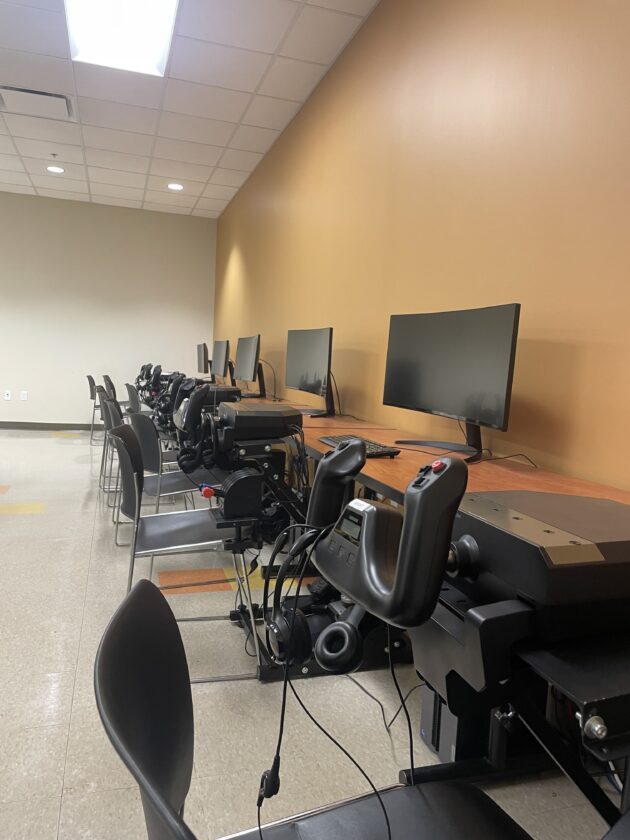
photo by: Sylas May/Journal-World
A row of flight simulators is pictured in a computer lab at Peaslee Tech on May 13, 2026.
Peaslee Tech has converted one of its computer labs into a simulation lab, where students can train on a row of Logitech flight simulators. And the students this year spent a lot of time at Lawrence Regional Airport and in Vinland to see the aviation industry up close.
Fisher said she already knew a lot coming into the course, and she saw it as a chance not just to learn more, but to build connections with people who could help her pursue her dreams.
“A lot of things are all about connections, especially in the aviation world, and I met some cool people,” Fisher said. “And that has been one of the big things that has helped me get my foot in the door and talk to people and get opportunities.”
When the students went down to Vinland to learn from Dave McFarlane, founder of aircraft parts manufacturer McFarlane Aviation, she fell in love with the small rural aerodrome, and it became her home base for learning to fly.
Her dad, she said, is “very much the type of dad who wants to be interested in whatever his kids are interested in.” One of his good friends is a pilot and has a stepson who is learning to fly, as well. So, her dad and his friend bought a small Cessna for the aspiring pilots to train on.
“Now it’s out there (at Vinland), because I loved it so much out there,” Fisher said.
The plane was an investment, she said, and once they have their licenses, it will ultimately end up making money for the families because they’ll be able to lease it out to other people.
It takes about 40 to 50 hours of flying to get your private pilot’s license, Fisher said, and she now has 30 hours of experience.
She was surprised to learn how expensive becoming a pilot was. It was “very shocking” at first, she said, to learn about the tens of thousands of dollars that it costs to learn to fly at a university like K-State Salina.
“You’re paying to rent the plane, you’re paying for ground school instruction, and you’re paying for your instructor per hour. And on top of that, you’re paying just the normal tuition costs for a university,” she said.
For what Fisher wants to do, it makes sense to go to college. Flying lessons on their own won’t teach you all of the professional skills that commercial pilots need, she said, and “airlines are looking at people with college degrees these days.” And she noted that flying airliners is a career that pays well.
But if you’re not planning to become a professional pilot, just earning a private license can look financially intimidating.
Fisher said your first private pilot rating can cost $20,000 or more, and according to the Aircraft Owners and Pilots Association, the biggest expense tends to be renting a plane, which might make up about three-quarters of that cost. Part of the reason Fisher’s dad and his friend bought their plane is that owning an aircraft just makes more financial sense than renting one, Fisher said.
The cost of learning to fly is “not what it should be,” she said. “There’s so many people that are interested in aviation, but the cost is a big thing that makes people think twice about it.”
It didn’t cost Fisher anything to take the Intro to Aviation course at Peaslee Tech, and she thinks a lot of high school students would appreciate a class like this if they knew it was there.
“I actually talked to my engineering teacher at Lawrence High and told her to kind of push the class to her students,” she said, “because I know that so many kids in that engineering class would be interested in it. People just don’t really know about it.”
Those who want more information can contact Peaslee Tech’s admissions director, Charlie Lauts, at charlie.lauts@peasleetech.org, and Fisher also encouraged students to talk to their school counselors about it.
“It gives kids the opportunity to do something and see if they’re actually interested in it before they figure out how to pay for something like that,” Fisher said. “Which is what it did for me.”
As she works toward earning her wings, she has a word of advice for other aspiring pilots: “Stick with it,” even when things get difficult or you feel like you’re not making progress.
“If it’s something that you love and you want to do, just keep going,” she said. “Because it will be worth it.”
Other News
Clinton State Park and other state parks will increase overnight camping, vehicle permit fees starting next month
‘No day is like the other here’: Students from Lawrence’s German sister city discover football, new foods and new friends on exchange
GCSAA celebrates 100 years with new plaza and statue honoring its founder and first president

Go, See, Do: Library book sale, candidate forum and more
Gas station at Lawrence’s new Costco will be open starting next Wednesday