Eyes on the sky: Solar eclipse viewing draws crowds in Lawrence

photo by: Austin Hornbostel/Journal-World
People gaze at the sky during the peak totality of the solar eclipse on Monday, April 8, 2024.
On Monday, folks in Lawrence — and all over the country — had a chance to watch an event that won’t happen again for another two decades, as a total solar eclipse crossed the U.S.
Many of those viewers in Lawrence may well have been congregated near the Lied Center on the University of Kansas campus, where hundreds turned out to an event organized by KU’s Society of Physics Students chapter.
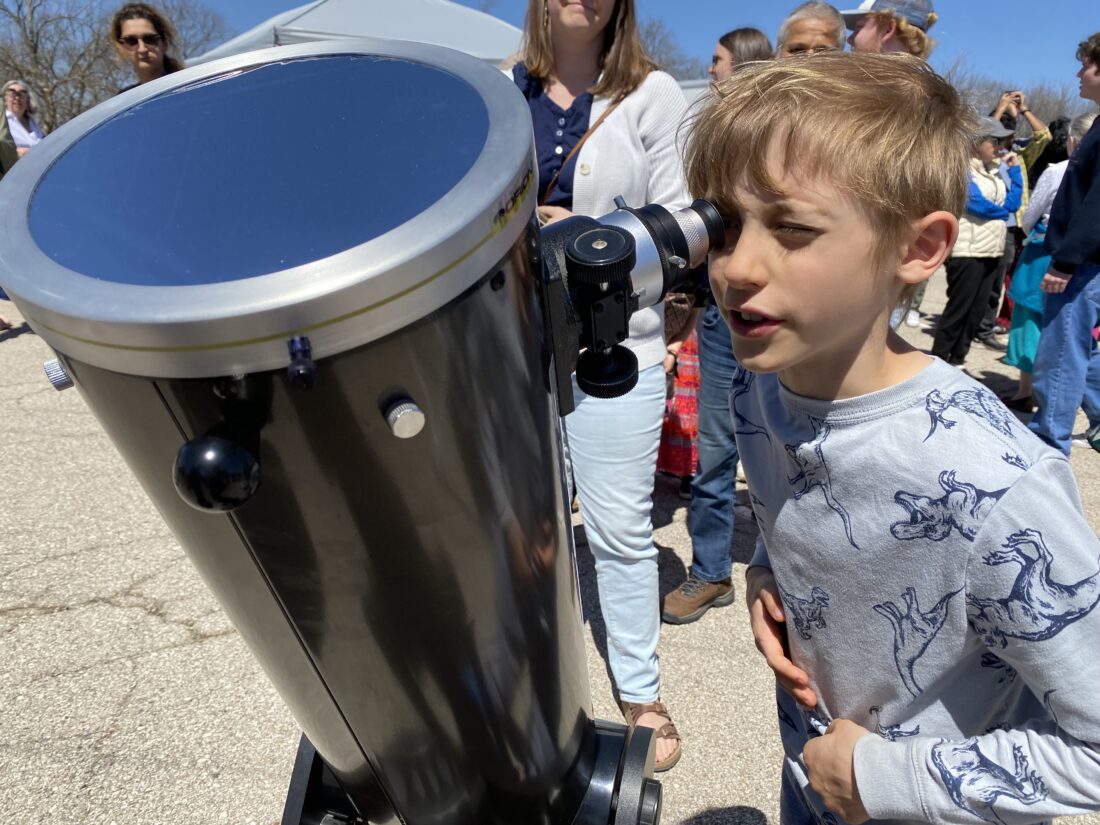
photo by: Austin Hornbostel/Journal-World
Theo Morgan, 8, peers through a telescope to get a view of the solar eclipse on Monday, April 8, 2024.
That viewing party had such a high turnout of people hoping to get a good look at the last total eclipse visible from the U.S. until 2044, in fact, that the supply of free eclipse glasses on hand had run out more than a half hour before 1:53 p.m. — the time when around 90% of the sun’s surface was obscured by the moon. That was during Lawrence’s “peak totality,” or when the largest area of the sun would be visibly obscured for viewers here.
“It’s great — I think this is one of the best turnouts we’ve had for any sort of public event we’ve done in a while,” Keaton Donaghue, president of KU’s Society of Physics Students chapter, told the Journal-World Monday. “…We’d ordered a thousand pairs of eclipse glasses, so obviously that means we’ve had a thousand people come to us to get glasses. That doesn’t mean everyone’s here, but we have a great crowd.”
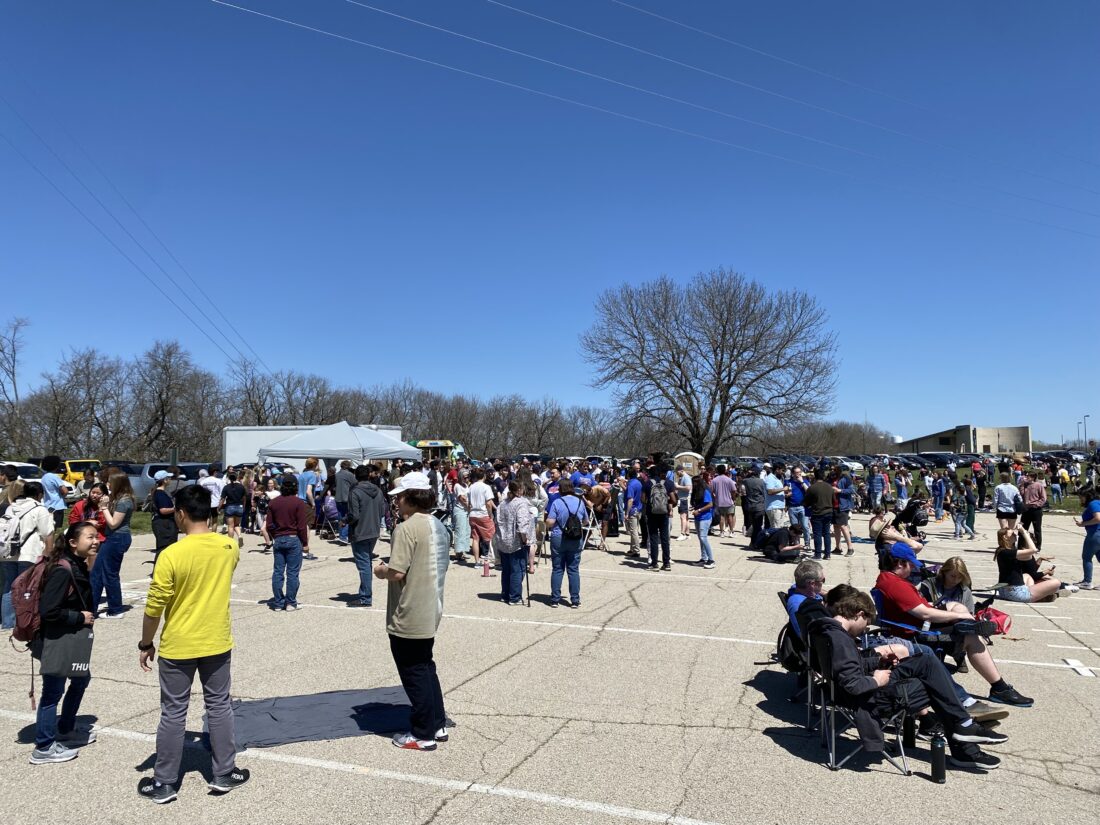
photo by: Austin Hornbostel/Journal-World
Hundreds came out to view the solar eclipse on the University of Kansas campus on Monday, April 8, 2024.
Donaghue said the last comparable event for the group may have been the solar eclipse of 2017, when Lawrence was located very near the eclipse’s path of totality and the sky darkened significantly by its peak at 1:09 p.m., enough to necessitate the use of streetlights and car headlights.
Getting a similar experience this time around would have required a road trip for folks who live in Lawrence. The eclipse’s path of totality swept across parts of Texas, Oklahoma, Arkansas, Missouri, Kentucky, Illinois, Ohio, Pennsylvania, New York, Vermont, New Hampshire and Maine, as well as central Mexico and southern Canada. Lawrence’s distance from that path meant that instead of skies that looked as if it was nighttime, the sun’s brightness was only diminished slightly.
Donaghue, an undergraduate student, wasn’t at KU for the last eclipse, but he said the sunny, clear weather on Monday made for a much better viewing experience by comparison. Though Lawrence was indeed closer to the path of totality in 2017, cloudy conditions intervened and kept many in Lawrence from getting a good view.
“Even though in 2017 we had totality here, I think this is a much better experience for the public,” Donaghue said. “It’s not cloudy, we’re going to get a great view, and I think the most proud thing I can say is the number of people that we’ve gathered here who are enthusiastic about the eclipse or astronomy is astounding.”
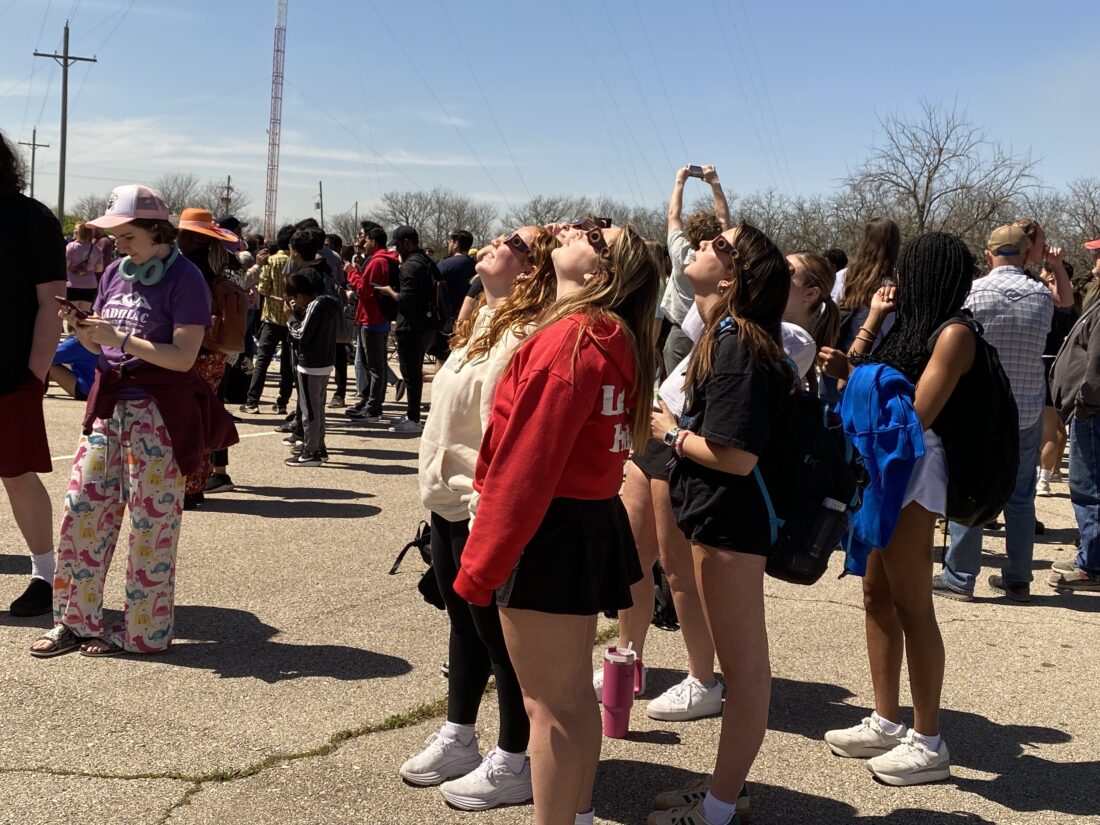
photo by: Austin Hornbostel/Journal-World
Plenty of eyes were turned to the sky as the solar eclipse reached its peak totality in Lawrence on Monday, April 8, 2024.
Along with sharing protective eyewear and providing telescopes that allowed for an even closer view of the eclipse, the Society of Physics Students also shared some knowledge with people who came to the event.
In the lead-up to peak totality, for example, Allison Kirkpatrick, the associate chair of KU’s Department of Physics & Astronomy, gave a talk about how an eclipse event in 1919 helped to establish Albert Einstein’s theory of general relativity — that the observed gravitational effect between masses results from their warping of space-time — as a valid theory and made the now-ubiquitous scientist famous. Kirkpatrick said the same measurements that scientists observed more than a century ago, concerning the position of the Hyades star cluster just as the eclipsing sun was crossing over it, are taken today to further validate the theory.
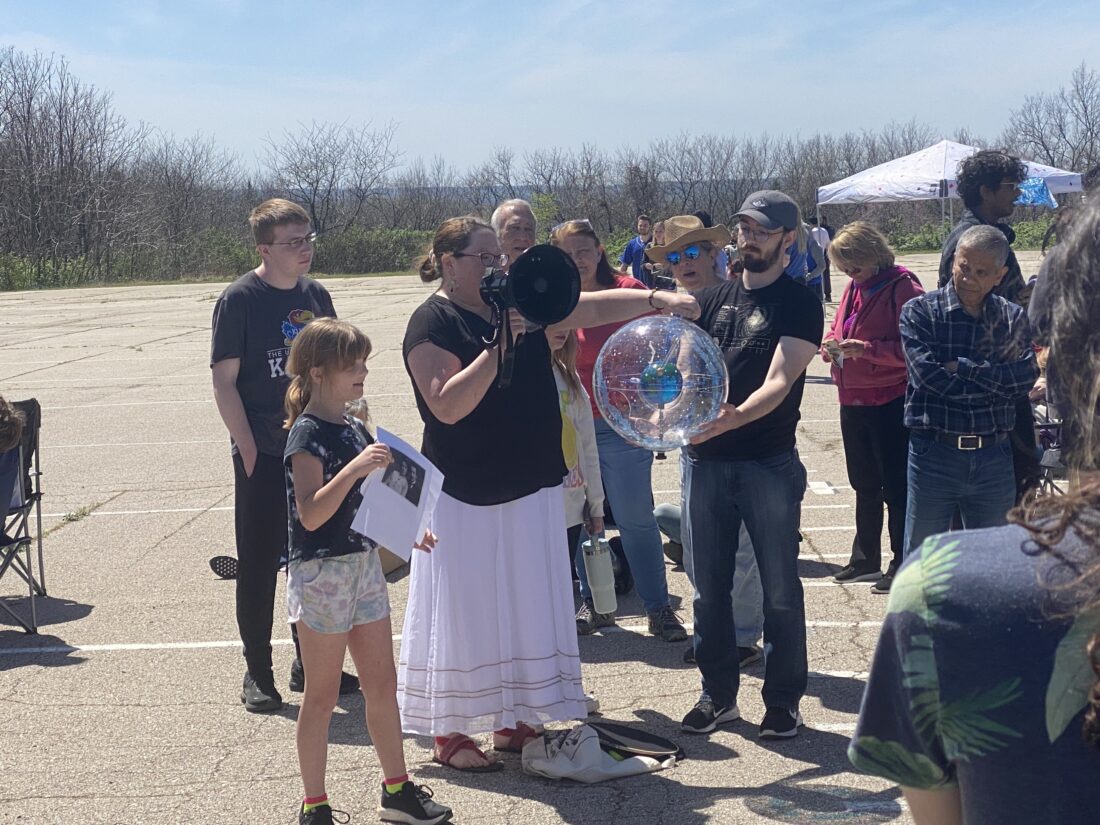
photo by: Austin Hornbostel/Journal-World
Allison Kirkpatrick, the associate chair of the University of Kansas Department of Physics & Astronomy, gives a talk about the 1919 eclipse that verified Albert Einstein’s theory of general relativity.
Kirkpatrick’s was one of several talks at the event. Donaghue said he’d be sharing one of his own later on in the day, and he and the other students who organized the event thought it made for a great opportunity to learn both from faculty like Kirkpatrick and from students.
“We want to share, also, the science,” Donaghue said. “It’s a great physical thing you can see. The best thing you can physically see as an astronomer is an eclipse or looking at the sun; it’s our nearest star.”
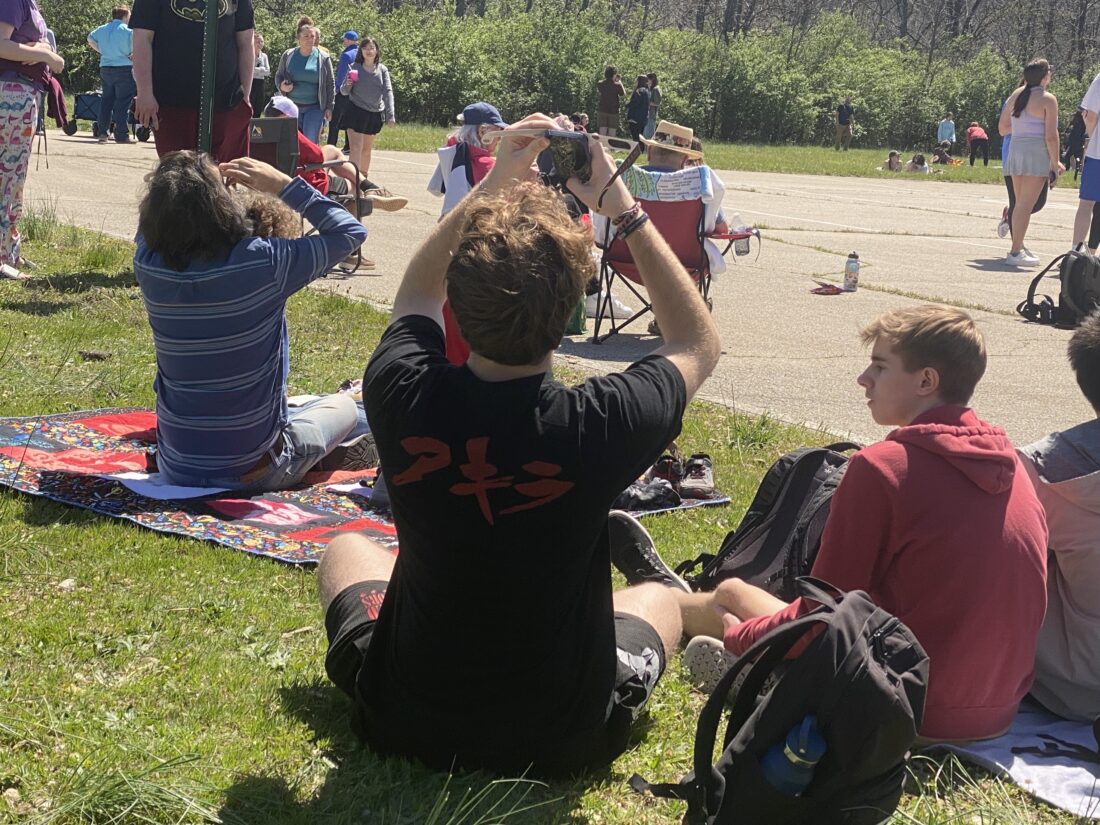
photo by: Austin Hornbostel/Journal-World
An attendee at the eclipse viewing event on the University of Kansas campus holds a phone camera up to a special pair of eclipse glasses.
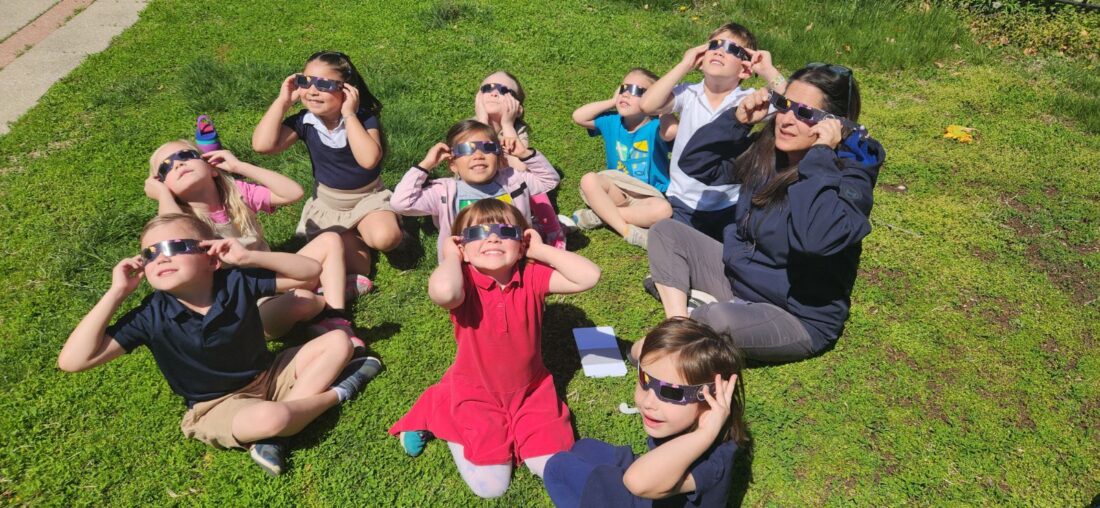
photo by: Submitted by Jacinta Hoyt
St. John preschool students watch the eclipse with their teacher, Amy Cast.
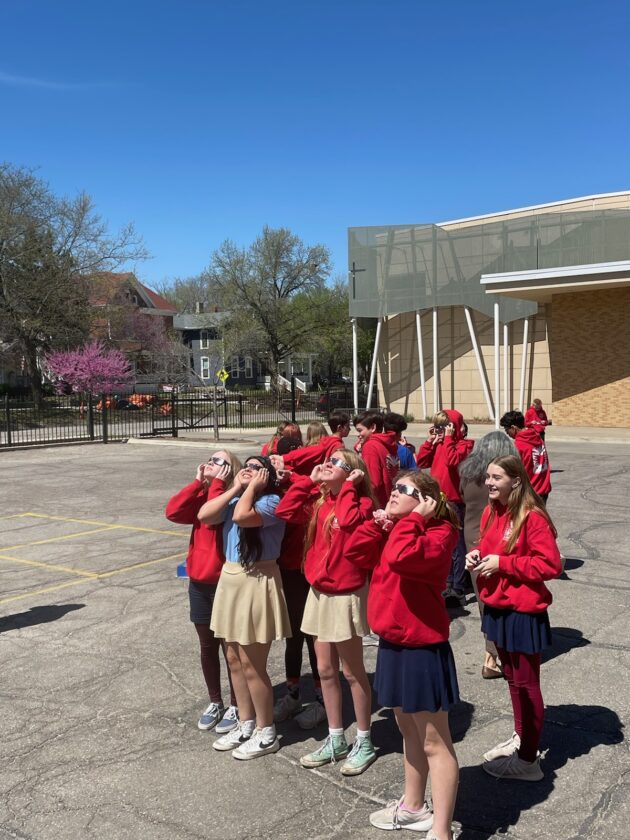
photo by: Submitted by Jacinta Hoyt
Students in LeeAnn Hartwick’s seventh grade math class at St. John School view the eclipse Monday, April 8, 2024.
Other News

Douglas County commissioners to discuss whether to increase the number of days fireworks can be sold in the county
Lawrence’s first bike lanes with physical barriers are installed on Ninth Street
Data center company plans up to $1,000 a year in tax, utility credits for De Soto households
Supernatural thriller filmed in Lawrence to have multiple showings at Liberty Hall
Eudora voters to decide sales tax election to fund increased fire protection in the city