

Kagan vows political independence
Washington ? The Senate Judiciary Committee wrapped up its public questioning of Supreme Court nominee Elena Kagan on Wednesday after she vowed to be politically independent and rebutted Republican attempts to portray her as pursuing a liberal agenda.
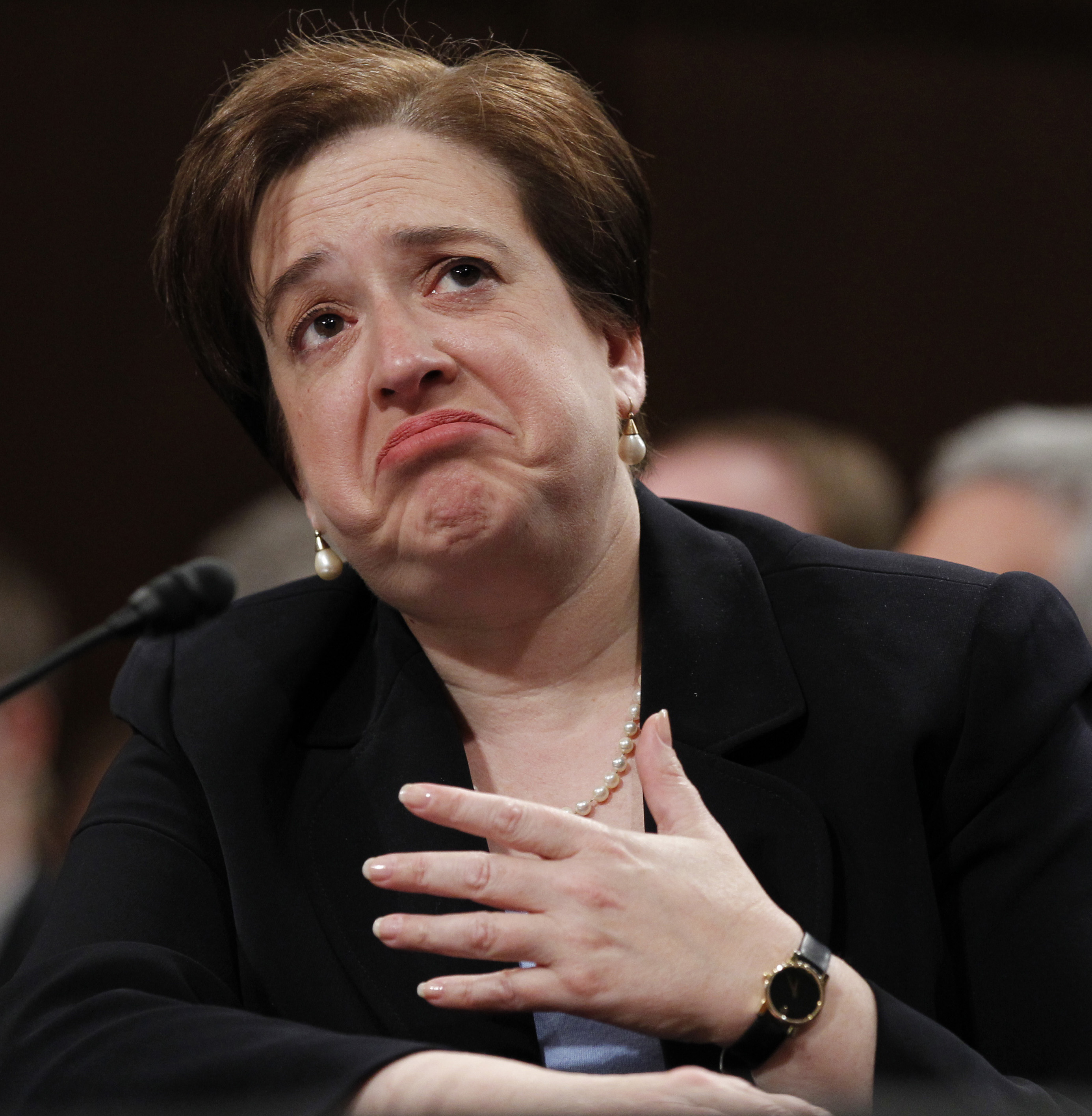
Supreme Court nominee Elena Kagan testifies Wednesday on Capitol Hill in Washington before the Senate Judiciary Committee hearing on her nomination.
Following a day of opening statements and two days of questioning, Kagan appeared headed for approval by the committee and eventual confirmation by the full Senate, lawmakers on both sides of the aisle agreed.
“You demonstrated an impressive, an encyclopedic knowledge of the law,” Sen. Patrick Leahy, D-Vt., the committee chairman, told Kagan before gaveling the session to an end. The committee is to hear from outside witnesses for and against Kagan’s nomination when it resumes its confirmation hearings. But it faces an obstacle because committees have been asked not to hold hearings today between 9 a.m. and 3 p.m. CDT while the body of the late Sen. Robert Byrd, D-W.Va., lies in repose in the Senate chamber, Leahy said.
In response to questions when the committee reconvened Wednesday morning, Kagan said that times were different in the middle of the last century when Thurgood Marshall, the liberal legal titan who would become one of her mentors, found in the courts society’s only refuge to chip away at Jim Crow segregation laws.
Today, a judge must be “on nobody’s team,” Kagan said. Trying to counter Republican efforts to portray her as an instrument of liberal politics, Democratic senators encouraged her to give avowals of neutrality.
“I mean, the worst kind of thing you can say of a judge is he or she is results-oriented,” said Kagan, the first nominee to the nation’s highest court in four decades who has never been a jurist. “It suggests that a judge is kind of picking sides irrespective of what the law requires. … The judge should be trying to figure out as best she can what the law does require, and not going in and saying, ‘You know, I don’t really care about the law, you know, this side should win.'”
Outside the hearing, committee Republicans and Democrats alike said they expect Kagan to be confirmed by the full Senate when it takes up the nomination, possibly by the end of July.
“Solicitor General Kagan will be confirmed,” Leahy told reporters.
Sen. John Cornyn, R-Texas, referred to her as “soon-to-be Justice Kagan,” and Sen. Jon Kyl, R-Ariz., said “we have no Republican position” on the confirmation vote. Sen. Tom Coburn, R-Okla., said Kagan’s characterization of herself as a “progressive” in Tuesday’s hearing “doesn’t disqualify her from the court.”
“We are not trying to get Republicans to vote one way or the other,” Kyl told reporters outside the hearing room. With only 41 GOP votes in the Senate, “a filibuster obviously would be highly improbable,” he added.
Under questioning from Democrats, who dominated Wednesday morning’s session because they hold the majority on the Senate Judiciary Committee, Kagan repeatedly bypassed opportunities to criticize the recent work of the court she hopes to join, with its frequent, closely decided rulings.
“Every justice has to do what he or she thinks is right on the law,” she replied when Sen. Sheldon Whitehouse, D-R.I., asked whether she was concerned by recent 5-4 rulings in which a bare majority was composed of justices who were appointees of Republican presidents.
“I’m sure everybody up there is acting in good faith,” Kagan said. “You wouldn’t want the judicial process to become in any way a bargaining process or a log-rolling process. You wouldn’t want people to trade with each other — you know, you’ll vote this way, and I’ll vote that way, and then we can … get some unanimous decisions.”
Kagan said she thought it was more productive for the court to decide cases on narrow legal grounds than to pursue larger majorities.
“One of the benefits of narrow decisions is that they enable consensus to a greater degree than broad, far-reaching decisions,” she said. “And that is generally a benefit for the judicial process and for the country as a whole to try to reach consensus on what it’s possible to reach consensus on, consistent with the law.”
State Government

‘If it ain’t broke, don’t fix it’: Retired Judge Sally Pokorny tells residents why she opposes electing Supreme Court justices
KU professors would be limited in how they could present the idea of systemic racism in future classes
State legislators push back against federal energy regulators ending competitive bids
TOPEKA — Two Kansas legislators asked federal energy regulators to ensure competitive bidding occurs on ...
Senate confirms 1st of 3 Kansas nominees to U.S. District Court
Corporate income tax collections falling sharply in Kansas; Republican, Democratic leaders disagree on what it means
TOPEKA — Corporate income tax collections in Kansas have almost halved since last year, while other sources trend ...
Candidate’s campaign manager created website with documents used to attack rival
TOPEKA — Kansas U.S. Senate candidate Patrick Schmidt’s campaign manager left his digital footprint on ...