Business in Lawrence offers clean break for Honduran family
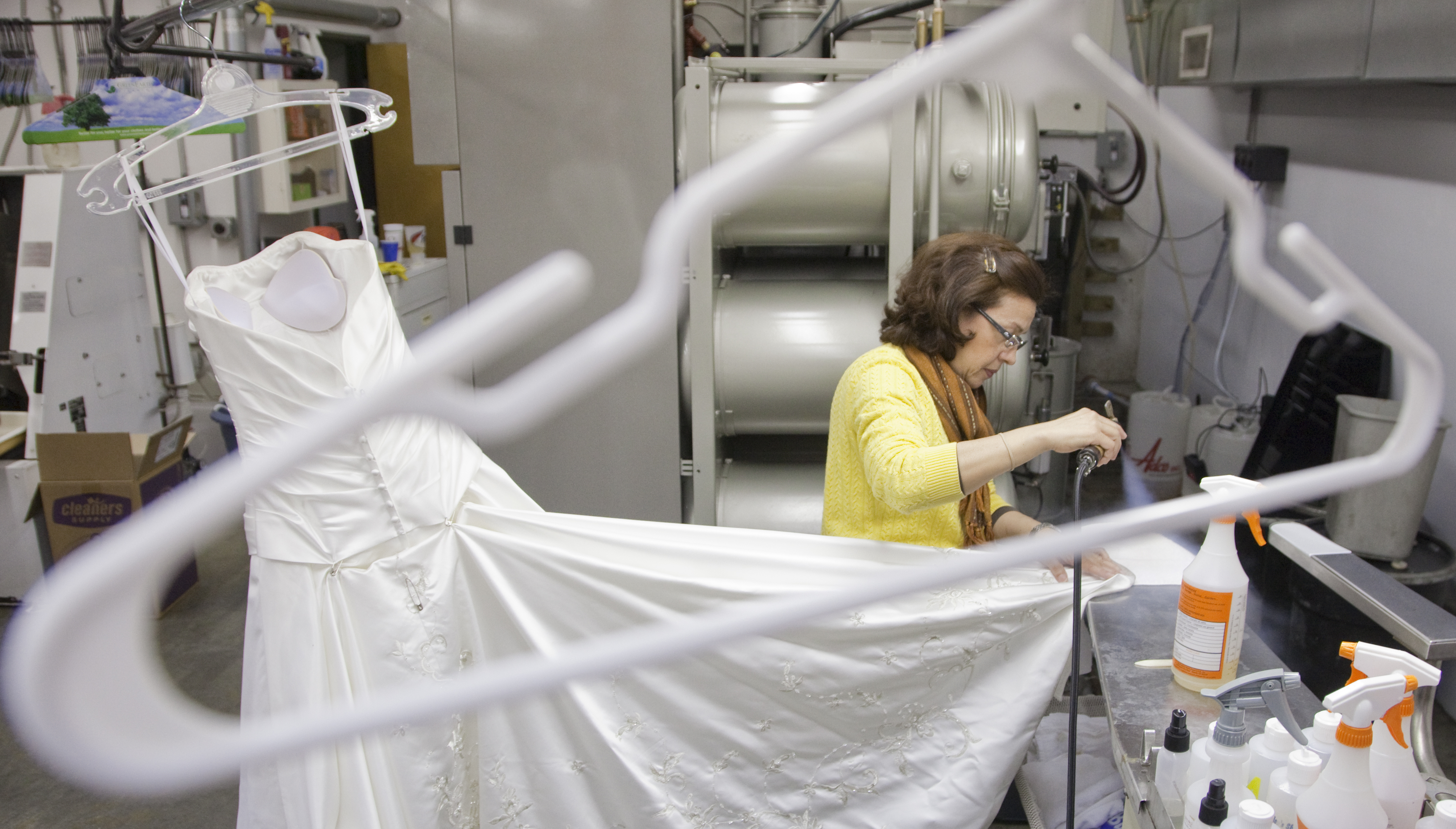
Santa Ocampo cleans a wedding dress at her business, Ecologic Dry Cleaners, 2540 Iowa. Ocampo’s family fled Honduras in 2008 because of violence there, and opened the business in April 2009.
April 2009 was not the month for new business startups.
Headlines warned that the world’s financial system was on the brink, uncertainty dominated markets of nearly every kind, and Americans did what they had not done in decades: they began saving instead of spending.
In short, it was a time to hide from risk, not add it.
But the Ocampo family ignored it all. In April, they started a small dry-cleaning shop — in a space where a dry-cleaning shop had just failed, no less — on South Iowa Street.
They moved all the way from Honduras to do it. The matriarch of the family, Santa Ocampo, left the successful civil engineering firm she owned to do so. Two of her sons, Eddie and Jorge, joined her in Lawrence.
They dove into the choppy waters of American business, when so many others were looking for a life preserver. The reason, they say, is simple: Risk is relative.
Honduras is a great place to learn that.
“If you guys think this is the worst,” Jorge Ocampo said of America’s financial downturn, “just wait. If you think it is hitting you hard here, just think of how hard it is hitting a Third World country like Honduras.”
•••
The fellow introduced himself by shooting Eddie Ocampo’s friend through the neck.
The mugger didn’t offer the courtesy of waving the gun in their faces, yelling demands for money, or anything else of the sort. Instead, just a bullet in the neck to get everybody’s attention.
That mugging was in 2004 in Honduras’ capital and the Ocampos’ hometown of Tegucigalpa. Eddie would be mugged three more times in the next four years, including one incident where the gun was pointed squarely at the back of his head.
“Not everybody in Honduras has been mugged,” Eddie said, “but it is fair to say everybody knows somebody who has been.”
Increasingly, that also is becoming the story with kidnappings. In fact, there are so many kidnappings in Honduras that they have started to be categorized like restaurants — sort of a full-service vs. fast-food thing.
Eddie and Jorge explain that some kidnappings are still traditional affairs that involve a ransom sometimes exceeding a million U.S. dollars. But others are what Hondurans call “express kidnappings.”
“They may just be asking for a couple hundred dollars and it usually lasts for an hour or two,” Jorge Ocampo said.
The clearest trend, though, has been that anybody is now fair game for a kidnapping.
“They have started doing them at random,” Eddie Ocampo said. “It doesn’t matter how much money the family has.”
Complicating matters is that the people doing the kidnapping can be those you least suspect. High unemployment — there are estimates that about 35 percent of the population is either unemployed or under-employed — can turn anyone into a kidnapper.
Eddie tells of his family’s friendship with the owner of a construction company in Honduras. One day the owner gets kidnapped. Come to find out, it was the contractor’s longtime electrician who masterminded the heist.
Such a scenario isn’t unique. After the Ocampos came to America in early 2009, a friend sent them a copy of a Honduran newspaper article. It was about the capture of the leader of one of the area’s larger kidnapping rings. The leader was the bookkeeper for Santa’s engineering company.
“In Honduras,” said Santa, whose English is still a work in progress, “you never feel safe.”
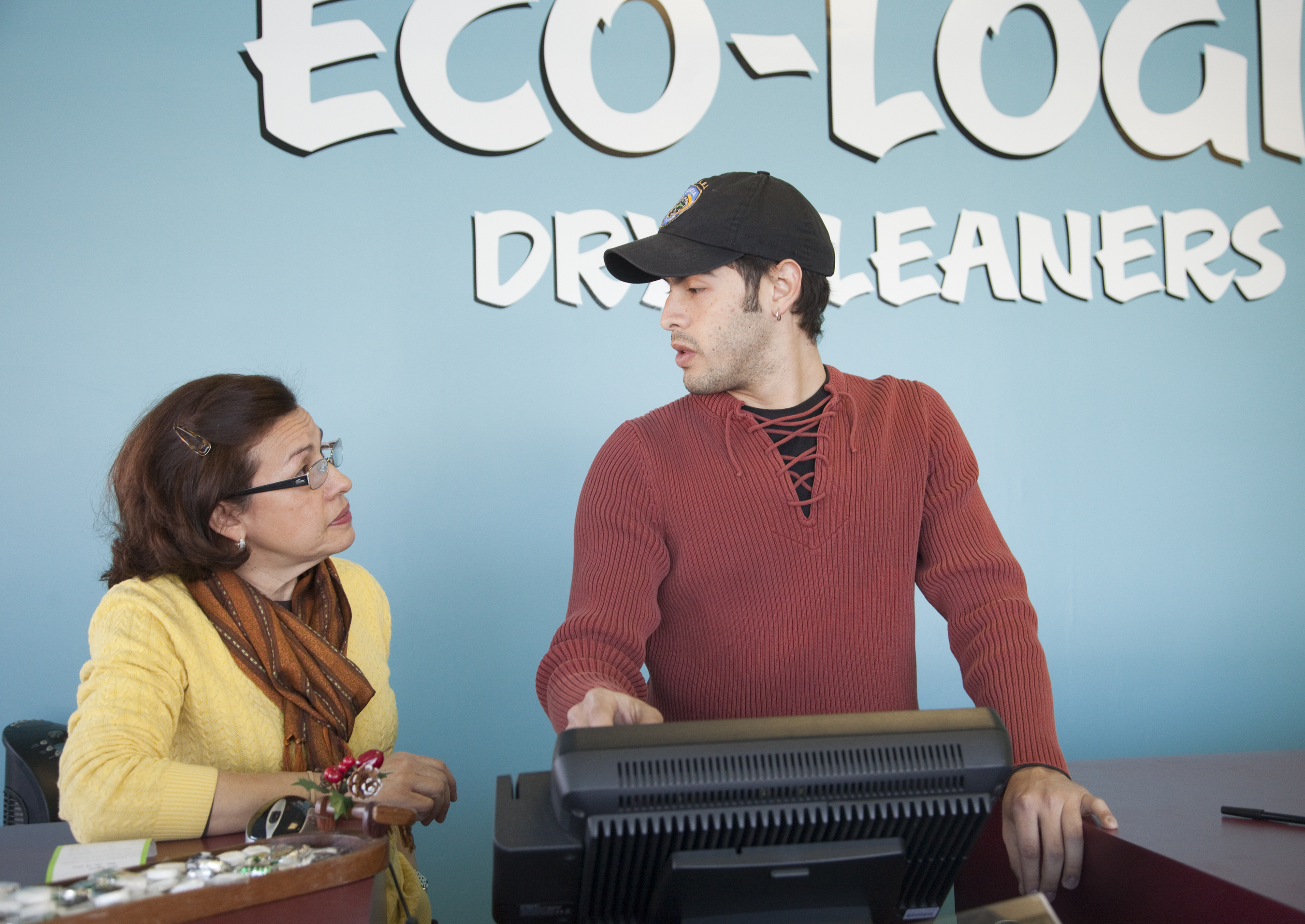
Santa Ocampo, left, and her son Eddie, discuss business at their Ecologic Dry Cleaners store at 2540 Iowa. The Ocampo family, including Eddie's brother Jorge, fled Honduras in 2008 because of violence and opened the business in April of 2009.
•••
When the Ocampos started their business in April, they bucked many trends, but embraced one — they went green.
Eco-Logic Dry Cleaners, 2540 Iowa, is billed as the only dry cleaner in Lawrence that uses a specially formulated, “environmentally friendly” dry cleaning process.
Kind of ironic given that the Ocampos come from a country that actually discouraged — with good reason — the environmentally friendly practice of carpooling. Having five to six people in a single car was too tempting of a target for muggers.
But in Lawrence, the Ocampos are counting on environmental awareness to be a key for their new business. Eco-Logic features a dry cleaning system that eliminates the use of petroleum-based chemicals and other solvents that can be toxic.
Many dry cleaners use a synthetic solvent known as perc, or perchloroethylene, which if disposed of improperly can be an air and water contaminant.
The Eco-Logic system uses colorless, odorless liquid silicon — or basically liquefied sand — in place of the petroleum based chemicals.
“We could drink it,” Jorge said.
“We’re not going to,” Eddie replies, as he shows how the solvent feels like a slightly gritty, light oil. “But we could.”
The family settled on getting into the dry cleaning business after Santa researched various investment opportunities and thought this would be a growing niche. The family landed in Lawrence on the advice of one of Santa’s sisters, who lives in Topeka. She told Santa that Lawrence was an environmentally conscious community
“It has been really different,” Santa said of leaving behind her native country and her established engineering business. “But we wanted to live in peace.”
•••
Eddie talks about how America is a land with so few walls. Maybe at some level he’s talking in symbolic terms, but mainly he’s talking about actual walls. In Honduras, nearly every house — no matter the income level — has a large concrete wall surrounding it.
“The smallest walls are about 10 feet tall and still have serpentine wire along the top,” said Eddie, who said he still loves Honduras but can’t live with the stress the country creates.
Their Honduran home had not only a wall, but an electrically charged fence, a video camera at the front door, and two Rottweilers “trained to kill.”
“But you can have as much as you want and still not be safe,” Eddie said.
Now Jorge and Eddie find themselves reminding their mother that it is OK for her to occasionally sit in her home with the front door open.
“My mom never imagined in her life that she could actually leave the front door of a house unlocked,” Jorge said.
It is new experiences like those that have helped the Ocampos keep their new business venture in perspective. Business at the store — like at many, these days — has been slow. But just like risk is measured differently in Honduras, so is return on investment.
“It is not just a new business,” Jorge said. “It is a new page, a new start.”
City Government
STAR Bond project is proposing $1.3B of development in Lawrence, including an arena geared toward ‘international cycling competitions’
Contamination in Lawrence’s recycling has risen to 17.5%, audit finds; that means city will continue paying more for processing
City of Lawrence seeking public feedback on its bike infrastructure plan

City to keep Community Building open through end of 2026; leaders want more data before deciding on 2027
City leaders approve incentive for 131-unit housing development near Wakarusa and Queens