

STAR Bond project is proposing $1.3B of development in Lawrence, including an arena geared toward ‘international cycling competitions’
Attractions aren't finalized, but could include bike racing track, board-game-themed park
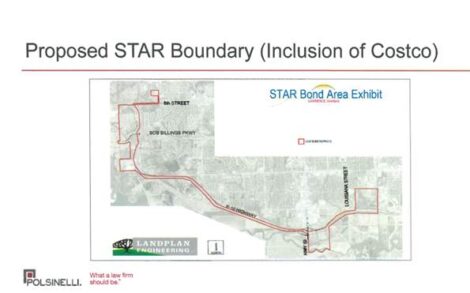
photo by: City of Lawrence
A map submitted to the City of Lawrence by K-10 Development Group LLC shows a proposed STAR Bond district that includes the Costco site.
With his STAR Bond project proposed for Lawrence’s southern and western edges, developer Phil Bundy thinks he’s found something that could be “a win all around.”
It’s a win for the city, the Wichita businessman said, because it would get new attractions, like an arena with a velodrome that could host major cycling races; new homes; and new property tax revenue. It’s a win for his group because it would allow them to develop in two parts of town they’ve been looking at for a while.
And he said he wanted to get started quickly on both parts of it – the southern part called The 1059, and the western part called Beacon Landing – if they can get the necessary approvals for the STAR Bonds.
“Our plan, provided that the City of Lawrence can approve things on a timely basis, is we’d like to start The 1059, and I think six months after that we’ll be right behind them out west,” Bundy told the Journal-World this week.
The project Bundy is proposing spans a large area to the south and west of town, and according to its incentive application filed with the city, it would take about $1.3 billion to construct, approximately $200 million of which would come from STAR Bonds.
As the Journal-World has reported, city leaders and community members have already had questions about The 1059 and Beacon Landing and the way their STAR Bond taxing district would work.
Some questions were about the timeline and whether the city would have to wait for one part of the project to conclude before the next one began. Others were about the new Costco store’s inclusion in the taxing district, which would capture much of the tax from sales at that store. And still others were about a $2 million contribution that the developers were considering giving to Haskell Indian Nations University for improvements on its campus.
STAR Bonds are a tool from the State of Kansas that can use sales tax revenue to finance entertainment- and tourism-related developments. They are more powerful than other types of development incentives because they can capture state sales taxes, and the state charges more sales tax than local governments do.
The sales tax collections affected in a STAR Bond project are from a specific geographic district. Here, the boundaries that the developers are proposing would wrap around the south and west sides of Lawrence, starting near the Haskell campus and The 1059 development in the south, then running west and north up K-10 to the Beacon Landing development west of the SLT. From there, the district would go east on Sixth Street and take in the site of the Costco store in the Mercato development.
Bundy’s group, K-10 Development Group LLC, has said that the single STAR Bond district was intended to be seen as a set of connected attractions linked by K-10. They shared more details with the Journal-World this week about what kinds of projects they envisioned and how they thought the city would benefit, even with Costco included in the district.
Big plans for cycling
Beacon Landing is the larger western portion of the development. The incentive application estimates it would cost just over $1 billion to construct, and about 12% of that, or $122 million, would be financed with STAR Bond proceeds.
The main attraction the group envisions there is called the Free State Arena, a multipurpose event venue that would have 3,000 permanent seats and 2,000 more convertible seats. Brian Clothier, special projects manager for K-10 Development Group LLC, said this space would be “large enough with convertible pieces to be turned into virtually anything we want,” including an ice rink, a concert venue, a soccer pitch or a convention space.
But the biggest draw of the arena, he said, would be an indoor velodrome track for bicycle racing. He said the group had already been in talks with national and international organizations about bringing in big racing events.
“We have been working with the Olympic Committee and USA Cycling, and it’s kind of one of those things that if we build it, they will come,” Clothier said. “… So the cycling community in Lawrence is very excited about this, and so are we.”
“We’ve already talked to a lot of the cycling community,” Bundy added. “… We think there will be international cycling competitions in Lawrence, Kansas.”
Behind the arena would be what Clothier described as an outdoor entertainment space “kind of like the Power and Light District” in Kansas City. It would have a stage for outdoor concerts and would aim for “a sports-bar-type atmosphere outside.”
Also in this part of the development would be “Wildflower Meadow Park,” a space of 51 acres of restored prairie with walking trails and a “butterfly alley” to attract pollinators. And on the south end of Beacon Landing, near Clinton Lake, would be an RV park, which the developers hoped would be used by visiting cyclists, people attending University of Kansas sporting events and “people that just want to stop and see all the other attractions we’re bringing to town.”
The 1059, meanwhile, would cost $300 million, the application says, with about 26%, or $77.8 million, financed with STAR Bond proceeds.
The developers are proposing an indoor multisport facility for the Sporting Kaw Valley youth soccer club that could host tournaments in soccer, lacrosse and other sports; an outdoor barefoot walking trail; and a “Hasbro LIFESIZED” attraction that would feature immersive experiences based on board games. As an example of the Hasbro attraction, the project’s website links to a “Monopoly Lifesized” attraction in the United Kingdom. That site describes an escape-room-like experience where people navigate a giant game board and compete against each other in puzzles and “challenge rooms.”
While the application includes all of these “anticipated uses” and cost estimates for them, it also says the plans are “subject to future market conditions and community demand.” The group said that the arena’s design was still being finalized, and for that reason it didn’t have renderings of the development to share. And Clothier told the Journal-World last week that the programming for the Hasbro attraction was still in development.
Moving housing out west
As for the housing component, the developers plan for most of the housing to be in the western Beacon Landing, not in the southern 1059. That’s a change from what they’d planned in a previous version of the southern development called New Boston Crossing.
At one time, the developers won city approvals for a New Boston Crossing plan that would have included single-family and duplex housing. However, Bundy said the group decided it would be better to move the bulk of the housing out west.
“We made the decision that probably the most effective way to do this for us and the city of Lawrence was to … move most of the housing out to the west side of town and turn the south part into an entertainment district,” Bundy said.
He said that even though the approvals were there for the previous concept, the developers had gotten “kickback” from some Lawrence residents “that didn’t want housing down there because we were going to have to move so much dirt, it was floodplain.”
The group took those opinions into consideration in the new concept, Bundy said, and tried to minimize the amount of dirt work and the impact on the Wakarusa River and the wetlands to the south.
“Before, we were going to move 150,000 yards of dirt,” he said. “Now, we’re going to move about half of that. We’re not going to take near as much property out of the floodplain. … The previous plan that was approved was going to encroach on 14 acres of wetlands, now we’re at half an acre …”
“We’ve listened to the people of the city of Lawrence who were worried about the environmental impacts of when we had New Boston,” he continued. “And we made it, in our minds, very much more palatable for the environmental people.”
A different question about housing came from Vice Mayor Mike Courtney last week. He was concerned about the language of the STAR Bond application, which labeled The 1059 “Phase 1” and Beacon Landing “Phase 2.” It said that The 1059 “will take approximately five years to complete” and that Beacon Landing would “commence approximately six months after The 1059 is fully constructed.”
Courtney thought that meant The 1059 would have to be finished first before development on Beacon Landing could begin. He worried this might create “a situation where none of the west gets built.”
Bundy and his group said that interpretation wasn’t accurate. They said the language of the application amounted to a “legalism” and would be cleaned up, and that their intention was to start work on Beacon Landing within six months of starting on The 1059.
“It’s just not at all the way we wanted that to be written by our attorney,” Bundy said. “We kind of missed it, to be honest with you.”
Haskell contribution
The Journal-World also asked the developers about the $2 million contribution proposed for Haskell and what might be done with it. Bundy said that “Haskell has asked us, and we’re going to comply, that they’re going to be the lead on anything” in regard to details on their projects. But he did discuss how the idea came about.
He said that Lawrence Mayor Brad Finkeldei had encouraged the developers to meet with the Haskell Foundation’s board about their plans when the board members were in town for commencement.
“Mayor Finkeldei requested, ‘Hey, just to keep harmony, guys, would you be against going to make a presentation for the Haskell board about what you’re doing, their concerns, because it’s close to their property and their wetlands,'” Bundy recalled. “So we did.”
At that meeting, Bundy said the developers “made great inroads” with Haskell about the projects and how they would affect the wetlands. And “it kind of came to us, you know, if we included Haskell … within our STAR Bond district, we could possibly help Haskell with some of the things they want to do to their wetlands.”
Some people in Lawrence have asked if there was more to the idea than that. At the City Commission’s meeting on June 9, multiple commenters said they suspected the developers were offering the contribution in exchange for Haskell not opposing The 1059 project.
Bundy said that the developers just saw the opportunity to help Haskell and decided to pursue it.
“It wasn’t a plan,” Bundy said. “It was just we went and met with them and realized, ‘we think we can help them, and we think it’d be good for them and good for the city of Lawrence and good for us.'”
Haskell Acting President Alex Red Corn previously told the Journal-World that the university had been in communication with the developers about a contribution that could be used to improve the Haskell powwow grounds, the stadium and the Haskell Cultural Center, as well as to create new boardwalk access to the wetlands. But he also said that the university had not yet committed to anything.
The Costco question
City commissioners also had questions about Costco’s inclusion in the proposed STAR Bond district, and how it would impact the city’s revenue.
Costco, which received its building permit last month, is expected to cause a boost in the city’s sales taxes and to bring in shoppers from other communities, and Courtney said last week that “our execution phase depends on” the store’s success. But if it were in the STAR Bond district, the district would capture much of the tax revenue the city was expecting. The STAR bond proposal essentially would earmark tax revenues generated by Costco for this new development proposal, limiting the city’s ability to use the new Costco revenues for other projects.
Bundy’s group said that while the project wouldn’t be impossible without Costco in the district, it would be much harder.
“Costco will provide the initial sales tax revenue to sell the bonds and get this thing kicked off quicker,” he said. “I’m not going to say it’s not going to happen without Costco, but it would sure be a lot better for everyone involved if Costco is involved.”
The developers said that being in the district wouldn’t hurt Costco at all – it would just change where the sales taxes it generated went. And they wanted to assure the public that the STAR Bond financing couldn’t be used to do whatever the developers wanted.
“That money can only go for infrastructure and for attractions,” Clothier said. “It’s not coming to our pockets for us to just carry off into the sunset.”
The developers said they believed having Costco in the district would benefit the city more than leaving it out and collecting all of the sales tax revenue. Part of that is because they say their new developments could also generate revenue for the city. But another part is a $6 million contribution to the city that would be paid for with the STAR Bond proceeds.
The STAR Bonds, of course, are paid off with the tax revenue the district generates, so part of that contribution would come from sales taxes generated by Costco. If the district didn’t include Costco, the city would be receiving the tax revenue from Costco more directly, but it would arrive in a stream over time, not in a lump sum.
The developers are portraying this $6 million contribution as a kind of advance on that money. In exchange for the loss of the Costco revenue over time, they would give the city $6 million of the STAR Bond proceeds up front to spend on infrastructure.
“Our assessment is that our project will probably be more beneficial than if the city did not have Costco in the project,” Clothier said. “Because we’re basically going to give them money up front.”
Much of the utility and street infrastructure in new developments is already supposed to be funded by developers – things like smaller residential streets, sidewalks and individual water lines. But the $6 million contribution would be used to pay for infrastructure projects in the district beyond what the developers would ordinarily be responsible for.
The developers also said that not all of the new retail and business uses associated with The 1059 and Beacon Landing would be within the STAR Bond district’s boundaries, so some of them would generate sales tax for the city.
“There are a lot of benefits for the city by having Costco in this district,” Clothier said. “And after the bonds are paid off, the city has jobs, the city has attractions bringing people in, we have a lot of retail that’s going to generate property tax, sales tax …”
“All that stuff is beneficial after this is over, and even during the payback period (of the bonds), our economic analysis says that our plan of giving this money up front to the city is net present value beneficial to Lawrence.”
It will likely be several months before the City Commission does anything with the STAR Bond request. The city’s economic development director said that because of the application’s complexity, the city’s review of it might take 3 to 6 months.
City Government
As they approve bikes plan, Lawrence city leaders ask about data collection, Kentucky and Tennessee streets
Lawrence city leaders want to toughen tobacco licensing rules ‘sooner than later’
Algerian government invites Mayor Brad Finkeldei, Lawrence delegation for a visit
Construction on Wakarusa Drive to resume; city manager says KDOT’s secretary has apologized for delay
Evacuation drill planned Tuesday at Lawrence City Hall
