Breaking news

NWS issues winter weather advisory in Douglas County for early Monday posted 6 hours, 11 minutes ago

Archive for Tuesday, August 31, 2010

Animal lab forum has elements of ‘biosci-fi’
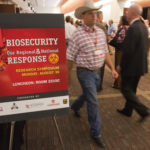
Attendees mill about during a break Monday at the Biosecurity Research Symposium in Kansas City, Mo.

Attendees mill about during a break Monday at the Biosecurity Research Symposium in Kansas City, Mo.

August 31, 2010

Advertisement

Their names seemed to be pulled out of a science-fiction novel: Rift Valley Fever, exotic blue tongue, Chinese porcine reproductive and respiratory syndrome.

But on Monday at the Biosecurity Research Symposium in Kansas City, Mo., animal researchers warned that those viruses were a very real threat to national security.

They could arrive by animal or terrorist, cost the livestock industry billions of dollars and put human lives at risk.

And, one day soon, many of those diseases could come to Kansas as researchers study ways to prevent, diagnose and protect against them.

That research will take place in high-security labs at Kansas State University’s Biosecurity Research Institute, which is now working with the U.S. Department of Agriculture to gain approval to study some of those diseases.

That lab’s work will prepare for the arrival of the National Bio and Agro-Defense Facility, a $650 million project that will be operational in Manhattan in the next decade.

Right now the country doesn’t have a facility that can study the most dangerous biological agents on animals. That will change with NBAF.

The work done in these laboratories protects the country, said Larry Barrett, who is the director of Plum Island Animal Disease Center, the aging facility in Long Island, N.Y., that NBAF will replace.

“People think we are the threat. But the threat is the 50 million people coming into the country that could be bringing other diseases in,” he said.

Barrett spoke to a crowd that included university researchers, livestock industry representatives and a few people from law enforcement and emergency services.

While getting a snapshot of the potential damage that future outbreaks could cause, the audience also had a peek into how researchers handled some of the country’s scariest encounters with biosecurity threats.

Tracey McNamara was a senior pathologist at the Bronx Zoo when she made a link between large numbers of crows and exotic birds dying at the zoo and New Yorkers becoming sick from mosquito bites.

A possible connection was first shot down by public health officials across the country. After further testing, both humans and birds were found to have the West Nile virus.

“The West Nile virus showed me we have glaring gaps in zoonotic (disease) defense,” McNamara said. “We have no idea where the next zoonotic threat comes from, and it could be a lot closer than you think.”

Jerry and Nancy Jaax, husband and wife, talked about their efforts to contain a new strain of the ebola virus found among a group of 500 monkeys in Reston, Va., in 1989. That biosecurity threat was depicted in the 1994 bestseller “The Hot Zone.”

Today the couple work at Kansas State. Jerry Jaax is an associate vice president of research and compliance and a university veterinarian. Nancy Jaax is an adjunct professor of diagnostic medicine and pathology.

Jerry Jaax was part of the team — wearing the suits like those seen in the movie “Outbreak” — that went into the facility that housed the monkeys.

“It wasn’t scary. It was the coolest thing you could be involved in,” he said of the work, which included spending a whole day chasing a monkey.

Nancy Jaax was one of the scientists working to identify what virus had made the monkeys sick. It turned out to be a modified version of the Zaire ebola virus. Unlike the Zaire ebola virus, the one found in Virginia, which came to be known as Reston ebola virus, wasn’t found to be fatal in humans. However, it could be transmitted through the air.

“You can’t even imagine that type of roller coaster ... everything just goes to the bottom,” Jaax said of the moment they realized the virus was linked to ebola. “You question who had it, who looked at it.”

Comments

LJWorld.com doesn’t necessarily condone the comments here, nor does it review every post. Read our full policy. Also, read about banned accounts and harassing comments.

  1. Catsap (anonymous) says…

    Here are some facts ksu Media Services has kept behind the N B A F Curtain of Transparency:

    Colonels Jerry & Nancy K. Jaax & David Franz, former Commander of the US Army Medical Research Institute for Infectious Diseases (usamriid), enabled & armed the 2001 anthrax mailer. The FBI found several plausible scenarios for how the usamrrid employee of 19 years, Dr. Bruce Ivins, could have removed Anthrax due to lax security & safety protocols at usamriid. In 2003, the Army gave Ivins its highest civilian honor.

    http://www.justice.gov/opa/pr/2010/Fe...

    http://www.fbi.gov/anthrax/amerithrax...

    http://www.dcmilitary.com/dcmilitary_......

    Col. Dr. David Franz the inside man:

    Col. Franz is a member of DHS committee which advised the NBAF site-selection official, Jay Cohen, on where to place NBAF.

    http://www.dhs.gov/xnews/releases/pre...

    Col. Franz sits on a NIH committee responsible for "dual use" research, as in my employee dual used usamriid anthrax to kill 5 people in 2001 AND win an award in 2003.

    http://oba.od.nih.gov/biosecurity/bio...

    Col. Franz joined up with Midwest Research Institute, KC, MO, in 2003. He actually runs MRI's lab in Fredrick, MD, a contractor for usamriid (infamous DoD "revolving door" job).

    http://www.mriresearch.org/news/Press...

    Col. Franz is a member of the KS Bioscience Authority, which authorized tax $ for NBAF.

    http://www.kansasbioauthority.org/abo...

    BEFORE this lab brings bioterrorism home to roost at KSU, we Kansans should be given an open look at the Pig in the Poke that N B A F truly is. The Army Veterinary Corps is authorized only 7 officers at the rank of Col. How is it that 3 of them signed on with KSU (1999-2003)?

    Midwest Research Institute, a usamriid contractor, & employer of Col Franz, surely had an inside agreement, or it wouldn't have sent 8 employees to nistac @ ksu prior to N B A F site selection. Look forr MRI to be the contractor for a Govt Owned, Contractor Operated N B A F.

    Since the 2001 anthrax mailings, usamriid has become a Top Secret - Sensitive Compartmented Information Facility; Plum Island has had usamriid Colonels as Directors. DHS has stated N B A F will have only a TS-SCIF room, for FBI interrogations. Which employees will need to be interrogated?

    Ask yourself, if the usamriid Colonels can't tell an award-winning scientist from a successful bioterrorist, how will the N B A F be safely operated in the heartland of agriculture aka Kansas?

    PS: When I made these comments in the presence of Tom Thornton, Kansas Bioscience Authority President and Chief Executive Officer, he got up and left the room . . . . .

    1. Catsap (anonymous) replies

      Jerry & Nancy K. used to have a lucrative PR career hawking & autographing copies of "The Hot Zone." Now, they get our tax $ to bring us potential bioterrorists:

      Gerald Jaax Kansas State University Associate Vice President $133,289.00*
      Nancy Jaax Kansas State University Program Director $55,237.00*

      *2007, BEFORE they secured N B A F for KSU.

      Read more: http://www.kansas.com/803?appSession=...

      I'm surprised that KU doesn't have a University Veterinarian. All the KSU squirrels I've talked to say "Jerry's AOK, he checks our nuts daily."

  2. AlfVenison (Alf Venison) says…

    Also remember that Plum Island is where the FBI was going to send Hannibal Lecter.

  3. olddognewtrix (anonymous) says…

    It is assumed that the NBAF facility will come to pass. There is one small technicality that the overly optimistic overlook--the $650 Million to build it has not yet been appropriated. Does Kansas think Lynn Jenkins can get that thru the House after all her posturing about wasteful govt spending and being opposed to all earmarks.

    1. Catsap (anonymous) replies

      KS' congressional delegation earmarks, 2008-2010

      National Agriculture Biosecurity Center - ks

      amount: $276,000.
      Year Enacted: 2008
      Code: sts-vd-o-vs-4
      Status: Complete
      Description: The National Agricultural Biosecurity Center (NABC) at Kansas State University was established to protect the U.S. agricultural infrastructure and economy from endemic and emerging biological threats. This funding will be used to implement international linkages for food animal and food crop disease surveillance and to expand animal health diagnostic screening capabilities.

      amount: $259,000
      Year: 2009
      Code: sts-vd-o-vs-4
      Status: Tracking

      amount: $500,000
      Year: 2010
      Code: sts-vd-o-vs-4
      Status: Tracking

      1. Catsap (anonymous) replies

        http://www.kansasbioauthority.org/abo...

        You will note the infamous Prince Memorandum of Understanding Bob, aka KSU AD Bob Krause, represented Jon Wefald at many KBA meetings. Lets see those MOUs, Bob.

        Bob's wife, Dr. Marty Vanier, was picked to succeed Col. Franz as Director of Operations for KSU's National Agricultural Biosecurity Center (NABC)

        http://nabc.ksu.edu/content/static/co...

    2. Catsap (anonymous) replies

      April 4, 2002: Former usamriid Commander on Anthrax Attacks: ‘A Lot of Good Has Come from It’
      Dr. David Franz, a former commander of usamriid, the US Army’s top biological laboratory, says of the 2001 anthrax attacks: “I think a lot of good has come from it. From a biological or a medical standpoint, we’ve now five people who have died, but we’ve put about $6 billion in our budget into defending against bioterrorism.” Plentiful evidence suggests that the anthrax came from usamriid, but investigators say they have no suspects at all. They also say they have come up “against some closely held military secrets” which are slowing down the investigation. “Federal investigators tell ABC News that military and intelligence agencies have withheld a full listing of all facilities and all employees dealing with top-secret anthrax programs where important leads could be found.” [abc news, 4/4/2002]

      http://www.historycommons.org/context...

  4. psycho_theclown (anonymous) says…

    My dog was just telling me the other day that aliens have been using animals for testing, not just humans. She said that the aliens figure that the animals aren't going to tell anyone.

    Personally, I think we need to send some animals into deep space so that when the aliens find them, they'll think we're a planet of dogs that are really smart.

  5. beatnik (anonymous) says…

    i'm glad i don't have a cat to worry about