

The New Deal revisited
Kansas had its share of improvement projects
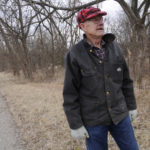
Ross Wulfkuhle, 93, Lawrence, stands near the location of a former WPA well that was the source of water for several families west of Lawrence in the Kanwaka Township. The site is near the intersection of the Kansas Highway 10 bypass and North 1500 Road. Wulfkuhle also worked on some WPA road projects in the township in the late 1930s.
For Ross Wulfkuhle, the New Deal meant drilling wells to help ease the Dust Bowl-era drought, providing much-needed water to livestock.
A program authorized by President Franklin D. Roosevelt bought up hogs from the family farm and slaughtered them so the market wouldn’t drop.
The New Deal also provided Wulfkuhle’s father with a job crushing rock procured from stone fence rows. No longer would cars become stranded on township roads after rain transformed dirt-packed roads into a muddy mess.
“It was a blessing,” said the 93-year-old man who has lived just about all his life in rural Douglas County.
New Deal
The merits of the New Deal — and its ability to pull the country out of the Great Depression — are still being debated today. Its principles and programs continue to underline the fundamental difference in today’s two major political parties.
Regardless of whether it’s viewed as creating a social safety network or a welfare state, it is undeniable that the New Deal brought millions of dollars to Kansas and funded projects that many of us benefit from today.
“Kansas was wise enough to know what the New Deal was and it didn’t sit it out,” Dr. Ted Kennedy said. “They wanted their share of it. And they were pretty good at getting it.”
Kennedy, a retired dentist who has lived in Lawrence for most of his 96 years, said the builder of his home learned stone masonry from working on the Civilian Conservation Corps’ project to build Lone Star Lake. The corps worked on the dam from 1934 to 1941.
In hopes of counteracting the Great Depression, the New Deal sparked a host of “alphabet agencies” that oversaw relief programs for everyone from farmers to writers. For the most part in Kansas, New Deal money streamed first through the Kansas Emergency Relief Committee and then the Works Progress Administration.
Much of the funding went toward infrastructure projects — fixing city streets and country roads and building bridges, farm ponds, airports, schools and parks.
It’s a concept that has been linked to President Barack Obama’s massive stimulus package.
“He’s patterning it very consciously off of what happened in the ’30s. Even the philosophy is the same,” said Matt Veatch, who is the state archivist for the Kansas State Historical Society. “He is trying to pump money into the economy and is trying to get something with that money.”
Area projects
Veatch researched the early days of the New Deal, at a time the Kansas Emergency Relief Committee was the one doling out the money.
Detailed reports from 1932 to 1935 show that $450,000 went toward Douglas County for work relief. Most of it was spent on roads, streets, farm ponds and cemeteries. Some was spent paving sidewalks and building retaining walls on Kansas University’s campus.
In 1934, the federal agency known as the Public Works Administration put $30,000 toward the $80,000 cost of building New York School. It replaced a two-story brick building that was originally constructed in 1870 and remodeled over the years. The new school, with its neo-colonial architecture and what at the time was considered to be one of the most fire- and storm-proof schools in the state, is still in use today.
In 1936, the PWA employed more than 70 men to build the Union Pacific underpass on Second Street in North Lawrence. In the same year, a project was approved to replace lamp poles, cables, curbs, gutters and sidewalks along Massachusetts Street in downtown Lawrence.
A combination of PWA, state and local funding went toward rebuilding the Kansas River bridge in Eudora — a project that cost more than $100,000.
Lawrence’s public library, then in the Carnegie Building at Ninth and Vermont streets, underwent a $35,000 expansion. Part of the funding came from the PWA. The work doubled the amount of book-stack space, put in a new heating system and replaced the roof.
The library moved out of that building in 1972. It is not currently in public use and the City Commission has postponed reopening it because of the $1 million needed to renovate it.
Up on the hill, New Deal dollars went toward restoring dioramas in the museum at Dyche Hall. Part of the work included the remains of Comanche, the famous horse who survived the Battle of Little Big Horn.
The National Youth Administration worked with Pinckney neighbors to construct a shelter house, toilets and retaining wall in Clinton Park, which sits just off Fifth Street, behind Pinckney School.
“This just wasn’t shovel-turning, make-work kinds of projects,” Lawrence historian Katie Armitage said. “This had a very lasting effect on public facilities.”
There were also smaller programs, such as a canning kitchen set up in the basement of Woodlawn School in North Lawrence. In May 1939, Douglas County received more than 12 tons of food for relief clients. Included were 5 tons of oranges, 5.5 tons of flour, nearly 1 ton of wheat cereal and a half-ton of beans. The same month saw the county purchasing $353.80 worth of materials for the WPA sewing project.
Still controversial
Elsewhere in Kansas, the WPA was behind numerous projects — including construction of Wyandotte High School, Lake Wabaunsee, Coronado Heights Park a few miles northwest of Lindsborg and the 17-foot-tall “Mennonite Settler” statue in Newton.
With the New Deal, nursery schools, hot lunch programs for children and sewing and canning classes sprang up across the state.
When Roosevelt ended the WPA program in 1942, the Lawrence Journal-World noted it could affect construction of the Military Science building at KU and mean loss of jobs for employees with the city’s recreation projects and the Kansas Geological Survey office.
Economists and historians continue to disagree on whether too much or too little was spent on the New Deal, and whether it pulled the U.S. out of the Great Depression or the credit goes to the production needed in the days leading up to World War II.
But if you asked Wulfkuhle, he would tell you the projects provided a job and relief to people in need during a time where little money was made and there wasn’t much to eat.
“It was a really sad affair and really rough going,” Wulfkuhle said.
“Some people had jobs, but a lot of the people were unemployed. And that is where the WPA came in,” he said.
State Government
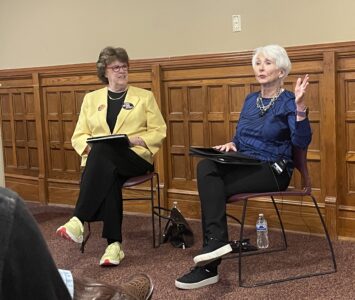
‘If it ain’t broke, don’t fix it’: Retired Judge Sally Pokorny tells residents why she opposes electing Supreme Court justices
KU professors would be limited in how they could present the idea of systemic racism in future classes
State legislators push back against federal energy regulators ending competitive bids
TOPEKA — Two Kansas legislators asked federal energy regulators to ensure competitive bidding occurs on ...
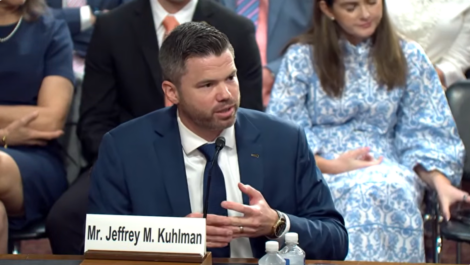
Senate confirms 1st of 3 Kansas nominees to U.S. District Court
Corporate income tax collections falling sharply in Kansas; Republican, Democratic leaders disagree on what it means
TOPEKA — Corporate income tax collections in Kansas have almost halved since last year, while other sources trend ...
Candidate’s campaign manager created website with documents used to attack rival
TOPEKA — Kansas U.S. Senate candidate Patrick Schmidt’s campaign manager left his digital footprint on ...