

New Army manual helps soldiers learn civil command
Visit Fort Leavenworth’s Web site
When Brig. Gen. Robert Abrams was deployed to Iraq in 2004 as a colonel, he had concerns about whether soldiers could go from conducting combat operations to assisting a civilian population in rapid succession.
But they did it, and they did it “at the snap of a finger,” thanks to training they had received, Abrams said.
“It’s an incredible capability. That’s our ultimate capability,” he said.
A new manual released this week now outlines how the Army will train soldiers to switch from combat to civil stability operations — or do them at the same time.
Called full spectrum operations, it’s something the Army has been doing in Afghanistan and Iraq for years. Now, the training for conducting the operations is on paper as doctrine.
“It’s designed to help develop an expeditionary Army,” said Lt. Gen. James Thurman, the Army’s deputy chief of staff.
Thurman took part in a video news conference on Wednesday from Washington, D.C., and answered questions from the Pentagon’s press pool and news reporters at Fort Leavenworth. Participating at Leavenworth were Abrams, commander of the fort’s Combined Arms Center-Training, where the manual was written, and Brig. Gen. Richard Longo, director of training for plans and operations.
“The manual codifies much of the training we’ve been doing,” Abrams said.
The recent wars have shown that the Army needs to be able to conduct conventional warfare with tanks and infantry but also be able to conduct counterinsurgency operations against small enemy units, often operating among the civilian population. But soldiers also need to know how to stabilize an area’s civilian population, as well as its government, the generals said.
“It’s not equipment that wins wars, it’s people,” Thurman said.
Whether attacking an enemy in a counterinsurgency or a conventional war, commanders must secure their force’s flanks and make maneuver and fire and control decisions, Abrams said. A small band of insurgents, however, are often found in a small but densely populated urban area, and innocent civilians must be protected, he said.
“The tasks and task steps are the same, whether I do it against an insurgency or against a conventional threat,” Abrams said. “The conditions under which I have to execute those tasks are vastly different.”
The new manual, called FM 7-0, doesn’t go into specific details about how to train, but outlines how to plan, prepare and assess training.
“It puts commanders back in the driver’s seat of planning their training,” Thurman said.
A Web-based Army training network is being developed that will address the “how” of the training. The manual was planned in coordination with the Marine Corps, Thurman said. The Army also works closely with other military services, he said.
“We don’t operate by ourselves,” Thurman said.
The manual is a follow-up to other manuals released this year, including FM 3-0, which changed the way the Army operates in offensive, defensive and stability operations.
The new manual can be downloaded by the public without charge at www.leavenworth.army.mil.
State Government
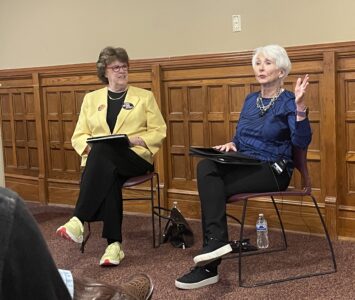
‘If it ain’t broke, don’t fix it’: Retired Judge Sally Pokorny tells residents why she opposes electing Supreme Court justices

KU professors would be limited in how they could present the idea of systemic racism in future classes
State legislators push back against federal energy regulators ending competitive bids
TOPEKA — Two Kansas legislators asked federal energy regulators to ensure competitive bidding occurs on ...
Senate confirms 1st of 3 Kansas nominees to U.S. District Court
Corporate income tax collections falling sharply in Kansas; Republican, Democratic leaders disagree on what it means
TOPEKA — Corporate income tax collections in Kansas have almost halved since last year, while other sources trend ...
Candidate’s campaign manager created website with documents used to attack rival
TOPEKA — Kansas U.S. Senate candidate Patrick Schmidt’s campaign manager left his digital footprint on ...