Solar project to highlight alternative power
Southwest Junior High School will soon plug into the sun to teach students about alternative energy.
Sometime in April, solar panels that generate small amounts of electricity will be installed in a visible location at the school as part of a Solar 4R Schools national renewable energy demonstration project.
“We will actually be producing renewable energy,” said Sarah Hill-Nelson, a Lawrence resident involved in the project.
A key part of the project is a Web-based interactive kiosk that will show students how much electricity is being generated and how the solar panels are reducing greenhouse gases.
“It’s a technological wonder,” said Trish Bransky, Southwest’s principal.
No cost to district
The $18,000 to $22,000 project is being funded partly by a $7,000 grant from the Douglas County Community Foundation’s Elizabeth Schultz Environmental Fund.
The rest of the funding will come through proceeds from a Lawrence-based “green tag product” set up by the Bonneville Environmental Foundation, a nonprofit foundation based in Portland, Ore.
Businesses, organizations or individuals buy “green tags” from BEF for alternative forms of electric energy, which reduces the amount of conventional energy needed to meet demand.
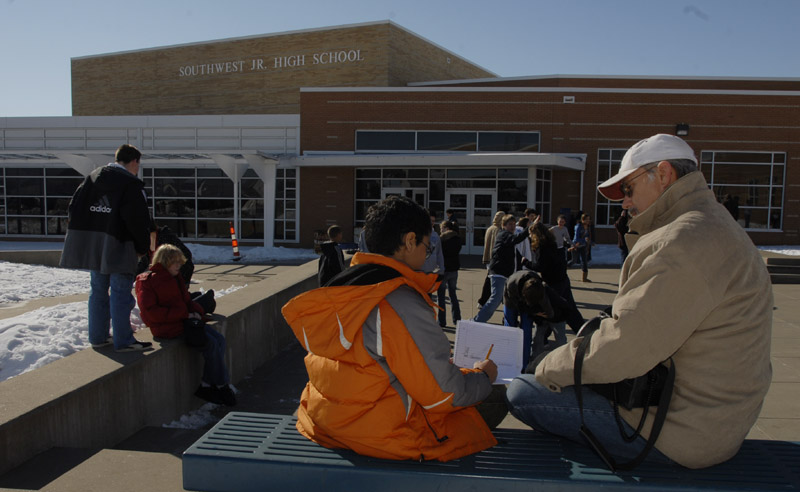
Southwest Junior High student Sudhanshu Manda, 12, left, visits with lab supervisor David Frye recently during recess. The school is planning to install solar panels as part of a national enterprise by Solar 4R Schools.
BEF has taken some of its proceeds from the sale of green tags around the country to fund about 35 Solar 4R Schools projects.
BEF set up a green tag product in Lawrence last year called Zephyr Energy.
Hill-Nelson, a representative of BEF, said Zephyr Energy consists of 50 percent hydroelectric power from the Bowersock Mills and Power Co., which her family operates along the Kansas River.
The remaining 50 percent comes from wind energy generated by the Gray County Montezuma Wind Farm in southwest Kansas.
The city of Lawrence and 13 firms and organizations have purchased Zephyr Energy green tags, Hill-Nelson said.
The solar project at Southwest would be the first reinvestment in the city of Lawrence of the proceeds from the local green tags, she said.
Highly visible
“One of the things that BEF always tries to do is make the solar panels very visible,” Hill-Nelson said.
The idea is to bring panels into the students’ daily consciousness, she said.
Bransky and Hill-Nelson will work with architects Gould Evans Associates to find the best location for the panels and the kiosk that will monitor the power generated and used.
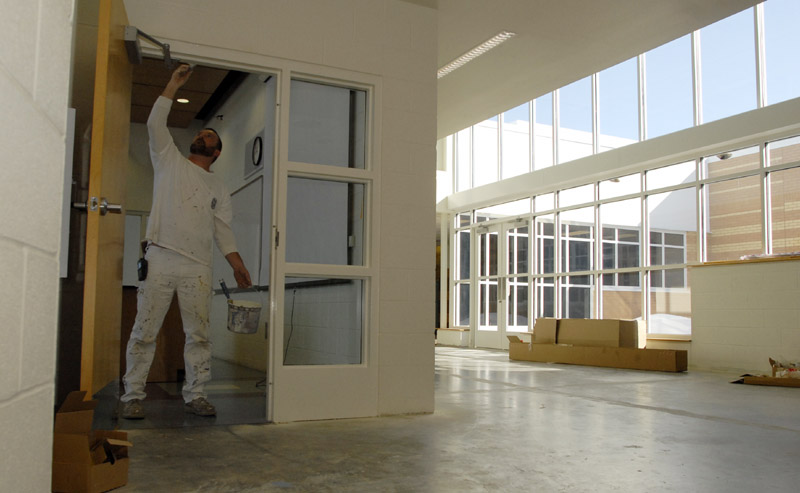
Randy Remer, a painter for A.T. Switzer Co. in Kansas City, Mo., works on the new addition at Southwest Junior High Schol. A planned solar collector may be installed in the area to the right, but the final placement for the solar array has to be designed by an engineering staff.
Students will be able to tell how much power the system is producing at different times of the day and on cloudy days, she said.
Two light bulbs
The solar system to be installed at Southwest would produce only 1.2 kilowatts of power – which isn’t much, said Aron Cromwell, a regional expert on solar electricity who operates Cromwell Environmental in Kansas City, Mo.
Cromwell, who will install the system, said it will generate an average of about 5 kilowatt hours of power a day. That’s enough to run two 100-watt bulbs for 24 hours a day, he said.
“The project is not intended to power the school by any stretch of the imagination,” Cromwell said. “The intention is more educational.”
Michele Hirschhorn, business development and communications for BEF, said the beauty of the system is the real-time data it gives students.
“It allows them to see not only what their school is generating but what other schools across the country are generating,” Hirschhorn said.
Generating enthusiasm
Bransky got the go-ahead for the project last week from Lawrence’s school board.
The project will allow the school to be able to teach about alternative energy production to seventh-grade earth science and eighth-grade physical science.
And the data generated can be used in math classes to make charts and graphs comparing similar Solar 4R Schools projects around the country, she said.
Bransky said there were other curriculum applications as well. For example, communications students can talk to adults about the project during parent-teacher conference nights.
“BEF found the education was as much for the adults in the community as much as for the students,” Hill-Nelson said. “The adults learn as much or more than the students do. A lot of Americans don’t know how the power grid works – they just flip on the switch. It’s an education for everyone.”
City Government
Opinion: Don’t give up on trying to use Costco to take tens of millions of dollars from the state of Kansas
Abandoned housing pilot program, data center rules, funding clawback for Bert Nash project on City Commission’s agenda
KU professors, middle school band director, radio personality among this year’s Phoenix Award honorees: ‘It’s a cool mix’
Housing Stabilization Collaborative’s request for city trust fund aid won’t be considered because it was filed late
On sister city visit, delegates from Hiratsuka, Japan, see Lawrence’s friendship firsthand