

Lawrence City Commission interested in moving public comments to the start of its meetings once a month
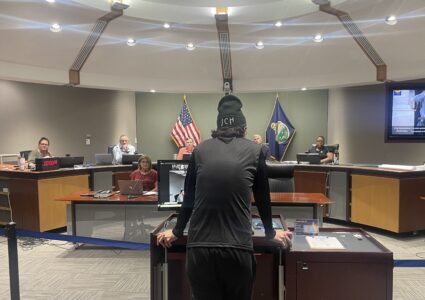
photo by: Sylas May/Journal-World
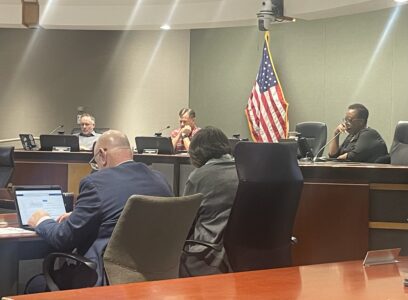
Patrick Ross addresses the Lawrence City Commission during public comments on Tuesday, April 21, 2026.
Once a month, the Lawrence City Commission is hoping to put public comments first – literally, as the first thing on its meeting agenda.
At its meeting on Tuesday, the commission asked staff to bring back a new meeting structure that would move the general public comment period, currently at the very end, to a 45-minute block at the very start on the second Tuesday of every month.
It would be a bit of a throwback for the commission, which heard public comments near the beginning of its meetings until it changed the meeting order in 2024.
“I support this. I like what we’re trying to do, to bring it back,” Vice Mayor Mike Courtney said. He said this would make it easier for people who can’t stay up late, such as parents of young children, to make their voices heard.
The commission on Tuesday was originally considering a different idea that Mayor Brad Finkeldei proposed, which would have split public comment at each meeting into two chunks.
First, there would have been a “scheduled” period near the start of the meeting, which people could sign up for via email on a first-come, first-served basis; up to five would have been allowed to speak in that block of time. Then, at the very end of the meeting, anyone who hadn’t signed up could speak at the later public comment period like usual.
Finkeldei said he was “trying to find a balance” between having comments earlier and delaying the rest of the meeting. Back before general public comments were moved to the end, he said, the commission had nights with lots of comments where the meeting’s regular agenda didn’t start until 7 or 8 p.m.
“Important agenda items weren’t being discussed until late at night, which is one of the reasons to try to find that right balance,” he said.
Finkeldei’s proposal would also have added a civility pledge that the mayor would read at the start of each open public comment period. “Obviously the speaker doesn’t have to accept it, but it’s something to try to remind folks,” he said.
Several members of the public, some of whom speak frequently at commission meetings, had suggestions or critiques.
Chris Flowers said he was against the idea of a civility pledge, and Patrick Ross was concerned about whether the homeless, who might not be able to sign up via email, would get to participate in the early period.
And Michael Eravi, who has delivered expletive-laden public comments at local government meetings before and once addressed a Black mayor using the N-word, spoke aloud George Carlin’s “seven dirty words” on Tuesday and threatened legal action if the commission adopted Finkeldei’s proposal. “This will be challenged if you choose to do this,” Eravi said.
City Attorney Toni Wheeler said there were no legal issues with the ideas that Finkeldei proposed. “The proposals that have been put forth are the proposals that have been tried by other cities, and we’re not aware of any prohibition,” she said.
In fact, the commissioners and City Clerk Sherri Riedemann said, cities have a variety of ways of handling public comment periods.
Commissioner Kristine Polian, who has worked with other municipal governments, said she was used to having pre-registration periods for comments. And Finkeldei said he’d heard of cities having people sign up in person immediately before the meeting.
“If there was a perfect way to do this, everyone would do it the same way,” he said.
Ultimately, the commissioners decided they wanted to go a different route. They were interested in something like what commenter John Ims proposed – a dedicated public comment format that would be held at a regular interval every few meetings.
The once-monthly period they’re interested in would be held on the second Tuesday of each month, from 5 p.m. to 5:45 p.m., and that meeting would not have a general public comment period at the end. At the other two monthly meetings, general public comments would be handled the same way they are now, coming at the very end of the agenda.
The commission would also move a couple of other items on the agenda around. The city manager’s report, which is currently near the end, and comments from the commissioners would move ahead to right before the regular agenda.
But commissioners also might impose a “shot clock” on themselves – the same three-minute time limit that public commenters must abide by – to keep the meetings moving along.
Some on the commission were interested in creating even more opportunities for dialogue with the community. Polian and Commissioner Amber Sellers both suggested regular events where the public could speak with commissioners in person outside of the normal meeting environment.
Ultimately, Polian said, making it easier to comment was about building trust with the community.
“And I think you gain that when you allow them to speak openly to us,” she said.
The commission will still have to approve any meeting changes in a formal vote. Finkeldei estimated that this could happen by the beginning of June.
And, “obviously, if we decide it’s not working, we can change it again,” he said.
City Government
As they approve bikes plan, Lawrence city leaders ask about data collection, Kentucky and Tennessee streets
Lawrence city leaders want to toughen tobacco licensing rules ‘sooner than later’
Algerian government invites Mayor Brad Finkeldei, Lawrence delegation for a visit
Construction on Wakarusa Drive to resume; city manager says KDOT’s secretary has apologized for delay
Evacuation drill planned Tuesday at Lawrence City Hall
