

Museum exhibit to revisit an era of lower gas prices
Owners lend muscle cars to display at Salina's Rolling Hills Wildlife Adventure
Salina ? Back in 1968, when the Dodge Charger first rolled off the line, Ron Barragree was impressed with its looks.
“I just like the body style. It was new that year, and different,” Barragree said. “It really looked good.”
So when a buyer traded in a forest-green, pearl metallic model in September 1969, Barragree snatched it up.
He’s had it ever since.
“I’ve had lots of cars over the years, and that’s the only one I ever kept,” he said. “It’s just one I really liked.”
Now, others will get an opportunity to appreciate Barragree’s Charger. The car will be displayed with fewer than a dozen other muscle cars in the Earl Bane Gallery at the wildlife museum at Rolling Hills Wildlife Adventure. The exhibit will be up through April 15, according to Kathy Tolbert, director.
Tolbert said she asked Roger Morrison, a Salina businessman and car enthusiast, to put together the exhibit to attract people who might not have visited the museum before.
“Our car show in the zoo is our biggest day of the year,” Tolbert said. “There’s a lot of interest in great cars. We’re hoping it will attract different people to the museum.”
Tolbert said the exhibit will include information about the cars that was provided by the owners.
Morrison said it wasn’t difficult to find owners willing to show their prized cars. Plenty of people love muscle cars, which were manufactured from the mid-1960s to the early 1970s.
“That was a time when the manufacturers developed new and more powerful engines,” Morrison said.
“There was a demand, in the 1960s, to build showroom traffic, to have these cars that were sort of over-the-top from the perspective of engine, graphics and names.”
The paints used on the cars even had colorful names, like plum crazy, sub lime and grabber orange.
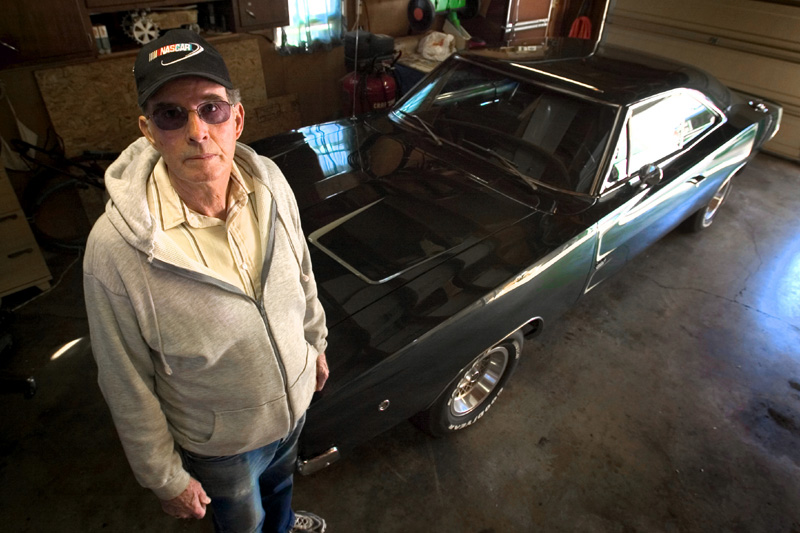
Ron Barragree is lending his 1968 Dodge Charger to he Earl Bane Gallery at the wildlife museum at Rolling Hills Wildlife Adventure for an upcoming muscle car show. He has owned the automobile since it was nine months old.
The cars had a short life, killed off in the 1970s by federal regulations regarding smog control, as well as high insurance rates and gasoline shortages.
“It’s really a sort of a snapshot of American culture in the late 1960s and early 1970s,” Morrison said. “Most manufacturers had one, and they were generally lower-priced models.”
With the baby boomers who were in high school in the 1970s now reaching their 50s – and possibly wanting to buy back their boyhood – muscle cars recently have surged in popularity, Morrison said.
“Those were the icons, the ones the kids read about, dreamed about, when they were youngsters,” Morrison said. “That’s the demographic that are buying them now.”
Barragree’s love of his Charger never waned.
He said his wife tired of driving the car in 1984, so he bought another car but kept the Charger.
“It was in good shape,” he said. “It has never been wrecked or anything, and it’s always been kept in a garage.”
The car, still going strong at 117,000 miles, has been painted twice. Barragree replaced the dash, the seat foam, covers and carpet to match the original.
He also overhauled the engine and transmission, put in new brakes and bearings and did other work. The car came stock with a 383-cubic-inch V-8 that turned out 335 horsepower, he said.
He has taken the car to shows in Kansas, Nebraska, Oklahoma, Colorado and Missouri during the past 20 years.
“I’ve got several hundred trophies, so I guess it does all right,” Barragree said.
The car doesn’t just sit in the garage, though. He drives it at least every week or so.
“You can get in and start it up and turn on the radio, and it just takes you back in time 40 years,” Barragree said. “It’s a getaway machine.”
State Government
‘If it ain’t broke, don’t fix it’: Retired Judge Sally Pokorny tells residents why she opposes electing Supreme Court justices

KU professors would be limited in how they could present the idea of systemic racism in future classes
State legislators push back against federal energy regulators ending competitive bids
TOPEKA — Two Kansas legislators asked federal energy regulators to ensure competitive bidding occurs on ...
Senate confirms 1st of 3 Kansas nominees to U.S. District Court
Corporate income tax collections falling sharply in Kansas; Republican, Democratic leaders disagree on what it means
TOPEKA — Corporate income tax collections in Kansas have almost halved since last year, while other sources trend ...
Candidate’s campaign manager created website with documents used to attack rival
TOPEKA — Kansas U.S. Senate candidate Patrick Schmidt’s campaign manager left his digital footprint on ...