

Veterans learn how to get employment in civilian world
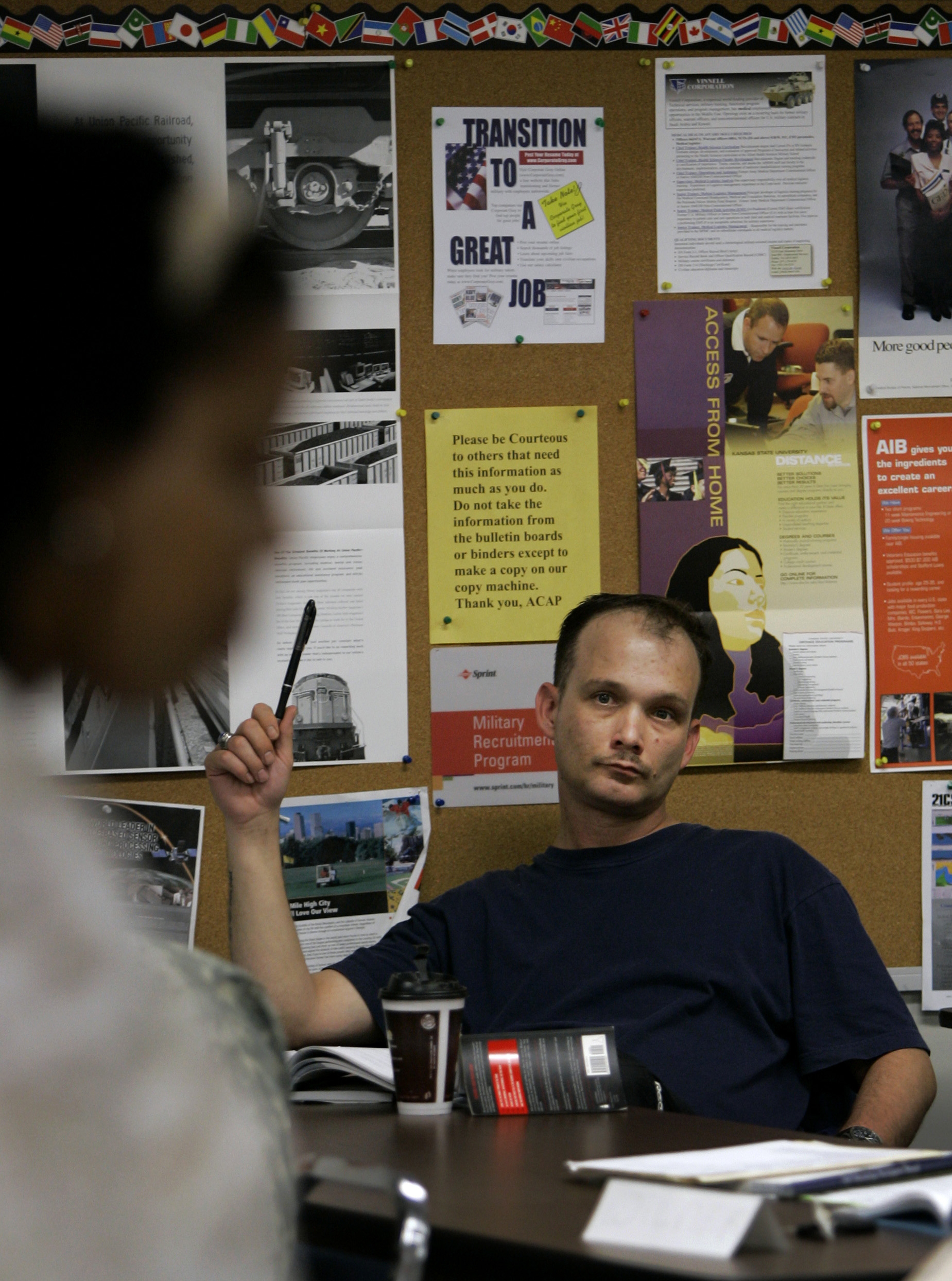
Army Sgt. Brian Brooks listens to a lecture during a class to train solders leaving the military to enter the civilian work force, in September at Fort Riley. For the nearly 250,000 who leave the military annually, selling themselves to employers isn't something they have had to worry about for years.
Fort Riley ? Brian Brooks sat against the wall listening intently to instructions for his next mission. After 20 years of working for team Army, the next task was all his.
Brooks is trading his uniform and procurement job for civilian clothes and work schedules. Since 1987, he has reported each day for duty, knowing there was a job waiting for him. Now, there’s no guarantee.
“For some of us, it’s a different world. It will make you a little nervous,” said Brooks, 38, who’s retiring after 20 years.
The disconnect between life in the active-duty military and the civilian job market is not unusual. For the nearly 250,000 who leave the military annually, selling themselves to employers isn’t something they have had to worry about for years – if ever.
More and more mid-grade officers and enlisted soldiers are leaving the military as multiple deployments to war takes their toll on them and their families. Despite increased incentives, including huge bonuses from the Army, many are opting to test the civilian job market, even if they aren’t sure how.
‘Lost in translation’
For the Department of Defense, having thousands of unemployed veterans is costly. In 2006, the agency paid $518 million in unemployment benefits and $365 million through the first three quarters of 2007.
Veterans say it’s difficult to go from a culture where the emphasis is on “we,” as in the squad or platoon, to “me,” as in a qualified applicant.
“It’s lost in the translation, this inability of the veteran to communicate all of their skills to an employer in a way that is meaningful,” said Tom Aiello, vice president of military.com, a division of Monster Worldwide.
A recent survey by military.com found that 76 percent of veterans felt unable to effectively translate their military skills in civilian terms and 72 percent felt unprepared to negotiate a salary. The survey heard from 287 recruiters and hiring managers from firms across the country, as well as responses from 4,442 veterans.
Soldiers’ preparation
“Because their resumes and experiences differ from traditional candidates, it can be challenging for hiring managers to immediately appreciate the value they bring,” Aiello said.
Brooks was responsible for getting resources to train teams sent to Iraq and Afghanistan to work as advisers. It meant working with approved suppliers and contractors for clothing, weapons, food and anything else soldiers or trainers needed to complete the mission. In the civilian market, Brooks could expect to do similar tasks in factories, warehouses or retail stores.
There is some help for veterans. A 1994 federal law requires the Department of Defense to help prepare service members for civilian employment. At Fort Riley, soldiers use the Army Career and Alumni Program to build resumes, search want ads and prepare for interviews.
Many don’t realize they are qualified to hold civilian jobs until they start putting their skills on paper, said program manager Glennwood McLaurin, a former air defense artillery soldier.
“I wondered, ‘How am I going to find a job shooting down airplanes?’ But I had other skills,” he said.
Overcoming perceptions
Some say venturing into the job market is like jumping off a 10-story building: About eight floors down, they wonder how the landing will be.
Veterans may apply for unemployment benefits the same way a worker at a steel plant may if they lose their job, depending on each state’s rules. But those benefits last only so long, meaning veterans often are taking jobs they are overqualified for because of difficulty getting their foot in the door.
Veterans have to overcome perceptions from employers who see a former artillery or infantry officer trained to kill or blow things up but don’t see that they also have talents in motivating others, leading them through a task or managing personnel with complex personalities.
For some young soldiers, the Defense Department’s mandatory training course on civilian life may end up persuading them to stay in the military. McLaurin said he sometimes advises people to re-enlist and get additional training.
“I’m not shy about telling the soldiers that they don’t have the skills to get that job,” he said.
State Government
‘If it ain’t broke, don’t fix it’: Retired Judge Sally Pokorny tells residents why she opposes electing Supreme Court justices
KU professors would be limited in how they could present the idea of systemic racism in future classes
State legislators push back against federal energy regulators ending competitive bids
TOPEKA — Two Kansas legislators asked federal energy regulators to ensure competitive bidding occurs on ...
Senate confirms 1st of 3 Kansas nominees to U.S. District Court
Corporate income tax collections falling sharply in Kansas; Republican, Democratic leaders disagree on what it means
TOPEKA — Corporate income tax collections in Kansas have almost halved since last year, while other sources trend ...
Candidate’s campaign manager created website with documents used to attack rival
TOPEKA — Kansas U.S. Senate candidate Patrick Schmidt’s campaign manager left his digital footprint on ...