

School funding plan no shoo-in
Attorney says $500M not enough for court
After years of bitter debate on school finance, a bipartisan, three-year, no-new-taxes, $500 million funding increase emerged Thursday and won Gov. Kathleen Sebelius’ blessing.
Despite the aura of Republican-Democrat cooperation, many public school advocates urged caution, saying the devil was in the details.
And the biggest question was whether the proposal would be accepted by the Kansas Supreme Court, which has declared the state’s school finance system unconstitutional.
Alan Rupe, the lead attorney for school districts that successfully sued the state over school funding, said a $500 million increase over three years was inadequate.
“The need is $500 million today, not spread over three years,” Rupe said.
If the proposal becomes law, Rupe said he would challenge it.
“Before the governor’s signature is dry, we will be back in court,” he promised.
Bipartisan plan
The measure brought by House Republicans and Democrats represented the first major school funding plan during the 2006 legislative session.
Last year, the Kansas Supreme Court declared the school finance system unconstitutional because it underfunded all students, especially those in low-wealth districts.
After a contentious special legislative session, the court accepted a $290 million increase as a down payment pending completion of an education cost study that was completed last month by the Legislative Division of Post Audit.
The study said schools needed $400 million to $470 million in the next year, and school funding had to be distributed differently, with additional money dedicated to districts that have high percentages of students from low-income families.
But on Thursday, several legislators said schools couldn’t handle that much additional funding so quickly.
By phasing in the dollars over three years, the districts “will have the ability to effectively absorb the new money that is coming in,” said Rep. Marti Crow, D-Leavenworth.
But Rupe said that was just an excuse.
He said the phase-in was simply a way to build a finance plan through growing state revenues without having to adopt a tax increase during an election year.
“It’s a political decision to avoid a tax increase and put election-year politics ahead of the Kansas Constitution and ahead of Kansas kids,” Rupe said.
Lawrence legislators who have voted for tax increases in the past for schools said political considerations probably had a lot to do with the proposal.
“There isn’t any interest in raising taxes in the Legislature this year,” said Rep. Paul Davis, a Democrat.
“This is how no one has to go into an election year proposing a tax increase,” said Rep. Tom Sloan, R-Lawrence.
‘A first step’
House education leaders said the proposal represented a good-faith effort to meet the court’s requirements by pumping in additional funds for at-risk students, including a new funding measure that focuses on districts with high percentages of low-income students.
But Rep. Valdenia Winn, D-Kansas City, whose district would benefit from the new formula, said it didn’t go far enough.
“It’s lowballing for the first year,” Winn said. “It’s a first step.”
The first year of the plan would increase school funding $175 million, less than half of the minimum called for by the cost study.
“It still falls far short in the first year,” said Kathy Cook, head of Kansas Families United for Public Education.
Sebelius, Kline agree
Hearings on the proposal are set for next week, when a Senate plan also is expected to be unveiled.
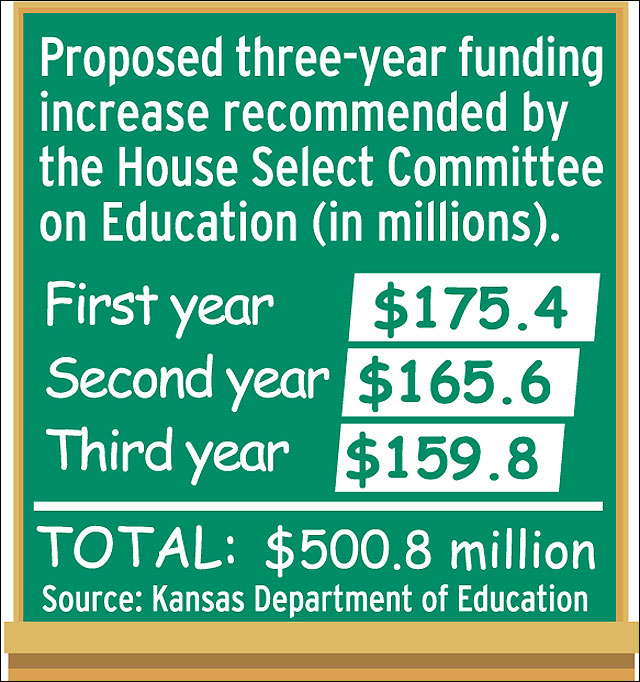
Proposed three-year funding increase
Sebelius issued a statement in support of the emerging school plans.
“I’m pleased we’ve reached a consensus on how we use the recommendations of the Legislative Post Audit study as a roadmap,” she said.
Kline also praised the proposal. “It demonstrates a good-faith effort in compliance, and the Supreme Court will honor that. At least that’s my hope,” he said.
But Rupe said the measure fell short and predicted the state Supreme Court would reject it, which could result in another special legislative session.
“The Legislature and the governor may be singing off the same page, but the Supreme Court looks at the page from the constitution and that is the governing document here,” he said.
State Government

Over 100,000 Kansans yet to receive state tax refunds; Department of Revenue says staffing issues contribute to delays
‘If it ain’t broke, don’t fix it’: Retired Judge Sally Pokorny tells residents why she opposes electing Supreme Court justices
KU professors would be limited in how they could present the idea of systemic racism in future classes
State legislators push back against federal energy regulators ending competitive bids
TOPEKA — Two Kansas legislators asked federal energy regulators to ensure competitive bidding occurs on ...
Senate confirms 1st of 3 Kansas nominees to U.S. District Court
Corporate income tax collections falling sharply in Kansas; Republican, Democratic leaders disagree on what it means
TOPEKA — Corporate income tax collections in Kansas have almost halved since last year, while other sources trend ...