

Volunteers restore old home, rebuild interest in town’s history
TROY ? A couple of intriguing myths are tied to the oldest house in Troy.
Few people contest that Abraham Lincoln visited an attorney at the house on Dec. 1, 1859 – but some say he stayed the night. A hatch in the kitchen floor opens to a flight of stairs leading down to a storage area under the house – but it doesn’t open up to the underground railroad.
Pete Duncan, president of the Doniphan County Historical Society, could get some mileage out of these myths, but he lets the house stand on its own merit.
“This is part of our heritage and our history,” Duncan said. “It’s important to keep it alive and keep it from being torn down.”
Every Saturday for the past 11 years, he and a small group of preservationists gather at the house on the town square at Liberty and Walnut streets to piece it back together. They’re also putting up a 24-by-40-foot museum in the backyard, complete with matching cedar roof.
Work on the home began in 1995 with a foundation overhaul. Over the years it has received a new cedar-shingled roof, new siding and the plaster walls have been completely rehabilitated. The upstairs quarters are a work in progress.
Every now and then the house turns up a gold nugget. Like the day a few years back when Duncan found a letter that had slipped through the upstairs floorboard. It was dated 1856 and was addressed to Sidney Tennant, the attorney who is said to have met Lincoln in his office at the home. The letter is stored in a vault and will probably end up on display in the museum.
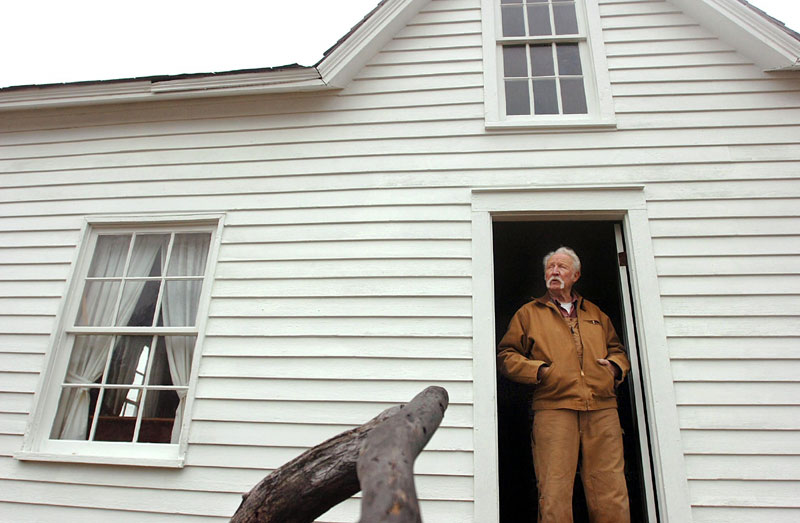
Pete Duncan, shown Dec. 11, has made it his mission to save the history of the oldest home in Troy. Abraham Lincoln is said to have visited the house at Liberty and Walnut streets, and Duncan was instrumental in restoring it.
Bricks from a collapsed schoolhouse in Doniphan were used to replace the chimney of what is often called the Rogers House. The initials of the schoolchildren are still clearly etched in the soft brick.
To keep the museum and the house historically consistent, the museum’s bricks are from a fallen house, built in 1871.
The home and museum could be complete in about a year, Duncan said. Funding is the major roadblock. Oftentimes Duncan and his Saturday regulars dip into their own pockets for supplies.
“We just do it because it needs to be done,” Duncan said modestly.
At 150 years old, the home has passed through surprisingly few hands. Formally named the Nelson Rogers residence, the home was built in 1856 by Rogers, Troy’s first blacksmith and postmaster. Locals refer to it as the Baker house, as it was last owned by Fred and Mary Baker, who donated it to the county in the 1970s. Baker’s father, Christian Jenkinson, bought the home in 1899 from the widow of Tennant.
State Government
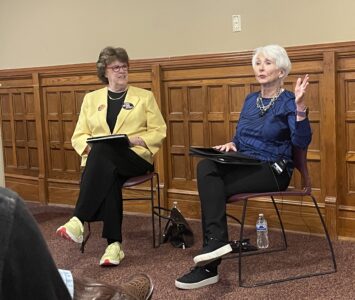
‘If it ain’t broke, don’t fix it’: Retired Judge Sally Pokorny tells residents why she opposes electing Supreme Court justices
KU professors would be limited in how they could present the idea of systemic racism in future classes
State legislators push back against federal energy regulators ending competitive bids
TOPEKA — Two Kansas legislators asked federal energy regulators to ensure competitive bidding occurs on ...
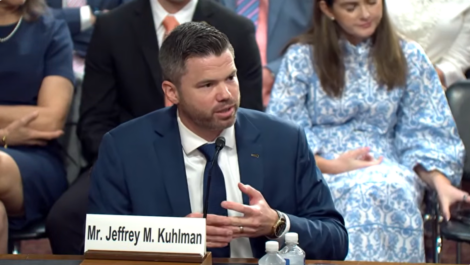
Senate confirms 1st of 3 Kansas nominees to U.S. District Court
Corporate income tax collections falling sharply in Kansas; Republican, Democratic leaders disagree on what it means
TOPEKA — Corporate income tax collections in Kansas have almost halved since last year, while other sources trend ...
Candidate’s campaign manager created website with documents used to attack rival
TOPEKA — Kansas U.S. Senate candidate Patrick Schmidt’s campaign manager left his digital footprint on ...