

Toymaker’s need for speed draws tourists to rural town
Speed ? Nestled in farm fields just south of a bend of a rural two-lane highway, this town is among Kansas’ smallest, with only 35 residents, a dozen houses and no downtown businesses.
Mattel Inc. is the world’s largest toy manufacturer, boasting 25,000 employees and nearly $5.2 billion in revenues last year.
The two had something in common on Sunday. Mattel sponsored an event designed to celebrate American car culture – and its Hot Wheels cars, which two generations of children have sent hurtling along plastic tracks out of their bedrooms, down stairs and through living rooms.
Mattel and Phillips County boosters predicted that events Sunday would attract 5,000 people, many of them adults who are avid collectors. Company officials were sold on the idea of an event in Speed just by the town’s name, and their collectors’ Web site headlines information about it with, “Feel the Need for Speed.”
The idea initially struck Brett Lambert as, well, crazy. But the avid Hot Wheels collector planned to drive more than 250 miles from his suburban Kansas City home to western Kansas to participate.
“I’m going as much for the hobby as for the curiosity of what this event is about,” said Lambert, a 40-year-old store security manager from Overland Park. “If it just rains, we could have the Hot Wheels Woodstock right here in Kansas.”
Most of Sunday’s events took place in a 45-acre farm field just north of Speed, next to a water tower. Festivities included a parade, car and motorcycle shows and a beauty pageant.
Organizers planned to attempt to set a world record for moving a Hot Wheels car along a track. They intended to link 2,100 pieces of orange track – more than a mile in all – on a slight incline and hope to move a car at least 1,650 feet. The attempt was to take place at 5 a.m., so that the day’s heat wouldn’t affect the track and slow the car.
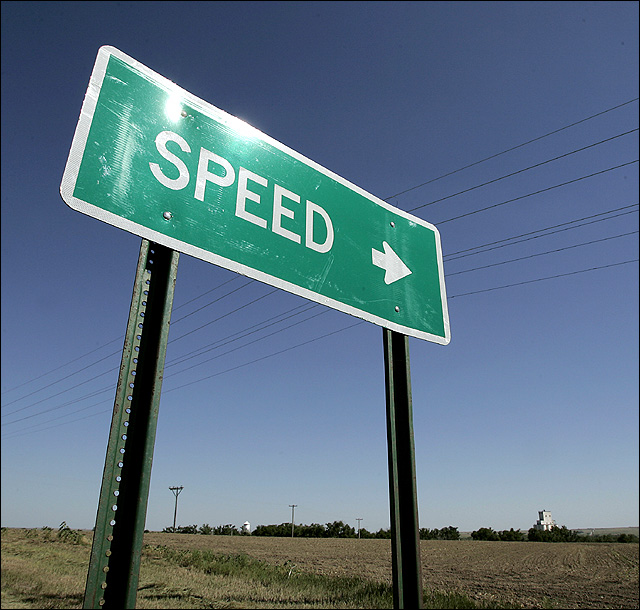
A roadside sign points the way to the small community of Speed. Mattel Inc., the maker of Hot Wheels toy cars, put on a celebration of car culture Sunday in the community of 35 people, largely because of the town's name.
Heart of America
Geoff Walker, the Mattel vice president who oversees the Hot Wheels line, said the company wanted to have its event in middle America to “get back to the roots of what America’s all about.”
The town’s name helped.
“It was the first place we looked – and the last,” Walker said. “The brand essence is speed, power and performance.”
But when Mattel contacted Speed Mayor Denise Lyon in May, she initially thought someone was pulling a practical joke.
“I really couldn’t believe it,” she said. “It was just out of this world that you would think anybody would want to do this.”
But Lyon and other Speed residents became excited about the possible attention – and sales tax revenues – such an event might generate.
The Phillipsburg Area Chamber of Commerce, with offices about 10 miles to the northeast, mobilized 300 or so volunteers, signed up vendors and helped make arrangements for as many as 70 portable toilets.
“We figure this national attention is going to help us, not just from that day, but from then on,” said Jackie Swatzell, the chamber’s director. “In the long run, it will promote our area and all of the state of Kansas, to showcase what we have to offer.”
Of course, for collectors like Lambert, the Hot Wheels name is the lure. Mattel, based in El Segundo, Calif., began selling the miniature cars in 1968, surfing the wave of California’s car culture.
In its 2005 annual report, Mattel said its Girls’ and Boys’ Brand domestic sales declined about 10 percent, with that segment covering both its Hot Wheels and Barbie products. But internationally, it said, Hot Wheels products saw sales growth.
In recent decades, it has not been unusual for toy lines to stay hot for only a few years, said Gary Cross, a history professor at Penn State University who has written books on toys and culture. Hot Wheels and other toy cars replaced the electric trains that wowed kids before World War II.
“What happened to trains in the 1960s?” Cross said. “All over the country, train depots closed down. I never took a train until I went to Europe.”
Yet Hot Wheels are still selling in retail chains like Toys R Us and Wal-Mart. Walker said Mattel now sells some 300 million cars a year and has 300 different models available each year.
Perpetual youth
Of course, toys appeal to adult collectors who played with them as children. There are Hot Wheels clubs across the nation, and Lambert is co-president of the Mo-Kan club in the Kansas City area. One Web site, ToyCarCollector.com, operated by a Vancouver, Wash., collector, offers more than 170 Hot Wheels at $10 or less, but lists a 1968 ice blue Custom Cougar at $2,500.
“There seems to be this perpetual longing among people, particularly as they get older, to recapture their youth in a very specific way,” Cross said.
Swatzell remembers playing with Hot Wheels as a little girl, and said her two children – now teenagers – did, too.
Lambert owns about 5,000 Hot Wheels cars, and he has taken his son, now 13, to shows and events since the boy was 6 months old. His son has his own collection now.
He said the chance to get together with other enthusiasts makes the Speed event “a neat thing.”
“If it turns out well and they want to do it again, there’s definitely a fan base to support it,” Lambert said.
State Government
‘If it ain’t broke, don’t fix it’: Retired Judge Sally Pokorny tells residents why she opposes electing Supreme Court justices

KU professors would be limited in how they could present the idea of systemic racism in future classes
State legislators push back against federal energy regulators ending competitive bids
TOPEKA — Two Kansas legislators asked federal energy regulators to ensure competitive bidding occurs on ...
Senate confirms 1st of 3 Kansas nominees to U.S. District Court
Corporate income tax collections falling sharply in Kansas; Republican, Democratic leaders disagree on what it means
TOPEKA — Corporate income tax collections in Kansas have almost halved since last year, while other sources trend ...
Candidate’s campaign manager created website with documents used to attack rival
TOPEKA — Kansas U.S. Senate candidate Patrick Schmidt’s campaign manager left his digital footprint on ...