

Judicial officials: Independence under attack
Kansas City, Mo. ? Judicial officials meeting here Wednesday said efforts in Missouri, Kansas and elsewhere to limit the power of courts and change how judges are selected are fueled in part by a poor public understanding of what the courts do.
Platte County Circuit Court Judge Gary Witt, speaking at the annual three-day meeting of the Missouri Bar, said judges, lawyers and even the business community need to do a better job defending the role the courts have in balancing the powers of the governor and legislators.
He said religious conservatives have tapped public confusion and anger about decisions ranging from abortion to the death penalty to inject politics into the courts and characterized it as a campaign to eliminate so-called “activist judges.”
“There is a mystique to the courts among the general public and where there is mystique, there is room for mistrust,” Witt said.
Witt and other presenters pointed to Kansas, where lawmakers this summer contemplated constitutional amendments that would have stripped the courts of power over finance issues and forced state Supreme Court judges to go before the Senate for confirmation. They were angry after the court mandated a $142 million increase in public school funding.
Similar calls to change how judges are selected have begun cropping up in Missouri, as well as Arizona, South Dakota, Colorado and Montana, said Georgetown University law professor Roy Schotland through videoconference.
In many cases, Schotland said, critics want to force their state’s highest judges who now get on the bench in nonpartisan appointments to go through regular partisan and nonpartisan elections, which he and others say could jeopardize the judges’ independence.
“Public respect for the courts is dependent on the belief that judges aren’t just another bunch of pols,” he said.
Witt, who serves as a liaison between the courts and the Missouri General Assembly, said more lawmakers he talks to seem to understand the court’s role and also seem more willing to approve budget increases, noting that state judges in Missouri haven’t had a pay raise since 2000 and rank ninth in salary of the 11 surrounding states.
But the group said more public education was required to get that understanding out to the people lawmakers listen to most – voters.
Officials announced a new nonprofit group called The Missouri Law Institute that plans to push that message with the help of the legal community and businesses.
Wayne Withers, general counsel for St. Louis-based Emerson Electric Co., said while businesses have contributed to some of the ugly judicial campaigns in other states, he’s been a big advocate for the status quo of the courts in Jefferson City.
“Corporations do not expect to win every decision,” Withers said. “What they do expect is that the courts won’t be swayed by public opinion or concerned with special interest groups, but rather will apply the facts of the law to the cases in which we are involved.”
State Government
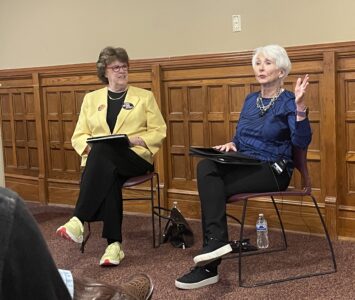
‘If it ain’t broke, don’t fix it’: Retired Judge Sally Pokorny tells residents why she opposes electing Supreme Court justices
KU professors would be limited in how they could present the idea of systemic racism in future classes
State legislators push back against federal energy regulators ending competitive bids
TOPEKA — Two Kansas legislators asked federal energy regulators to ensure competitive bidding occurs on ...
Senate confirms 1st of 3 Kansas nominees to U.S. District Court
Corporate income tax collections falling sharply in Kansas; Republican, Democratic leaders disagree on what it means
TOPEKA — Corporate income tax collections in Kansas have almost halved since last year, while other sources trend ...
Candidate’s campaign manager created website with documents used to attack rival
TOPEKA — Kansas U.S. Senate candidate Patrick Schmidt’s campaign manager left his digital footprint on ...