

Biographer says terrorist label too harsh for John Brown
History hasn’t been kind to John Brown. By most accounts, the militant abolitionist with pre-Civil War ties to Lawrence was either a madman or a terrorist.
Or, some would argue, both.
But David Reynolds, author of the new and critically acclaimed biography “John Brown, Abolitionist: The Man Who Killed Slavery, Sparked the Civil War and Seeded Civil Rights,” said there was little evidence that Brown was truly mentally ill or any more murderous than, say, Gen. William Tecumseh Sherman and his infamous march through Georgia.
“There’s a lot of hypocrisy going on here,” Reynolds said during a telephone interview from his office at City University of New York.
How is it, Reynolds asked, that Sherman and his men — who killed and pillaged for no other reason than, in the Union general’s words, “to make Georgia hollow” — get a pass while Brown is tagged a terrorist for overseeing the deaths of five pro-slavery settlers near Lane?
If Brown had fought for freedom in Adolf Hitler’s Germany, Pol Pot’s Cambodia or Saddam Hussein’s Iraq, he would not be labeled a terrorist, Reynolds said.
“It’s important to understand the context of the times (Brown) was living in,” Reynolds said. “At the time, there were 4 million blacks living in a state of slavery.”
Brown, he said, considered slavery “a state of war against an entire race of people.”
Brown was arrested, tried, found guilty of treason and hanged for his failed Oct. 16, 1859, raid on the federal arsenal at Harpers Ferry, Va., now in West Virginia.
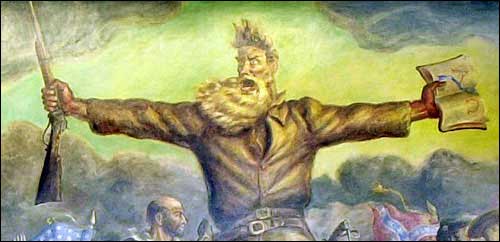
A new biography casts a kinder light on abolitionist John Brown, who stopped in Lawrence several times during the 1850s. For a look at those events, see page 5A. This image of Brown, by noted artist John Steuart Curry, hangs in the Kansas Statehouse in Topeka.
Reynolds’ 500-page biography has caused a stir both locally and nationally, and has been reviewed by The New York Times Book Review and several other publications.
Lawrence historian Katie Armitage said she was still fuming over an erroneous line in the Times’ review that put the Pottawatomie Creek Massacre in Missouri rather that Kansas.
“I was shocked The New York Times let that get in. That was no small mistake,” Armitage said.
Reynolds, who also wrote the much-lauded “Walt Whitman’s America: A Cultural Biography,” said he spent six years researching and writing the Brown biography.
His research did not include visits to Kansas; instead, he relied on microfilmed copies of the Kansas State Historical Society’s papers on Brown.
The West Virginia State Archives, Reynolds said, has a “huge collection” of Brown’s letters and writings on its Web site.

 Despite a few factual flaws, book offers good portrayal of John Brown
“It’s amazing. You can sit in your office and read most of his letters,” he said.
Also, a library at Columbia University in New York houses the papers of Oswald Garrison Villard, an earlier biographer who conducted turn-of-the-century interviews with several of Brown’s surviving sons. Brown, who married twice, fathered 20 children.
Another key difference between Brown and today’s terrorists, Reynolds said, is that Brown was “much more eloquent.”
Reynolds noted that Ralph Waldo Emerson once called Brown’s death row letter to then-Virginia Gov. Henry Wise one of the two greatest proclamations in U.S. history.
“The other was the Gettysburg Address,” Reynolds said.
| 1) Stayed at the Free State Hotel, now the Eldridge Hotel, 701 Mass., during the Wakarusa War, November and December 1855.2) Made a don’t-shoot-until-you-see-the-whites-of-their-eyes speech between what is now the Free State Brewing Co., 636 Mass., and Abercrombie & Fitch, 647 Mass., in September 1856 while the town was surrounded by Missouri ruffians.3) Stayed at the Eastern and Whitney boarding houses at Seventh and New Hampshire streets in January 1859 en route to Canada with 12 slaves seized during a raid in Fort Scott. The slaves stayed in the Grover Barn, which is now the fire station at 2819 Stone Barn Terrace. |
State Government
‘If it ain’t broke, don’t fix it’: Retired Judge Sally Pokorny tells residents why she opposes electing Supreme Court justices
KU professors would be limited in how they could present the idea of systemic racism in future classes
State legislators push back against federal energy regulators ending competitive bids
TOPEKA — Two Kansas legislators asked federal energy regulators to ensure competitive bidding occurs on ...
Senate confirms 1st of 3 Kansas nominees to U.S. District Court
Corporate income tax collections falling sharply in Kansas; Republican, Democratic leaders disagree on what it means
TOPEKA — Corporate income tax collections in Kansas have almost halved since last year, while other sources trend ...
Candidate’s campaign manager created website with documents used to attack rival
TOPEKA — Kansas U.S. Senate candidate Patrick Schmidt’s campaign manager left his digital footprint on ...