

Kansans on the hunt to counter increasing dangers posed by deer
They are the most common large mammal in the United States, and their majestic looks and graceful movements endear them to many. But to others, white-tailed deer are more nuisance than anything else.
“Sometimes they could be a real pain,” said George Taylor, longtime owner of Taylor Orchards near Stull. “I could always tell when the apples were ready to be picked because the deer moved in. They were like a weather vane.”
The deer population in Kansas has exploded the past few years, causing numerous collisions with vehicles and clashing with urban growth in a corridor extending from Kansas City through Lawrence to Topeka. In their quest for food, deer have taken to gobbling up gardens and even flower beds.
Nearly two years ago the Kansas Department of Wildlife and Parks established urban deer Management Unit 19 for the Kansas City to Topeka area. The management unit allows extended firearms and bow deer hunting periods in the fall and winter in an effort to curb the deer population.
And in suburban Kansas City, some towns have passed ordinances allowing landowners in certain areas to hunt deer on their properties. Included are the cities of Leavenworth, Bonner Springs, Lenexa and Olathe. Other cities, however, such as Leawood, have rejected such proposals.
Lawrence doesn’t allow hunting inside its city limits, and there are no proposals to do so. Lawrence and most of the immediate area around it don’t have the deer problems its near neighbors to the east have, said Clyde Umscheid, district supervisor for the Kansas Department of Wildlife and Parks. Locally, the biggest problem with deer are collisions between vehicles and deer along the Kansas Turnpike and Kansas Highway 10, he said.
“That’s where the car-deer accidents are taking place, and the deer are really being seen,” Umscheid said.
They haven’t done much damage to his crops, “but I have seen more deer tracks the last few years than I did 20 years ago,” said John Pendleton, owner of Pendleton’s Country Market, 1446 East 1850 Road.
The Stull and Clinton area west of Lawrence is noted for a high deer population, Taylor said.
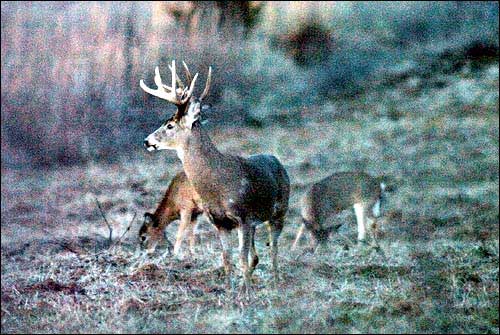
A large buck and two does recently graze in a field northeast of Lawrence, secure in a state where food and hiding places are plentiful. Because deer can be dangerous to drivers and a nuisance to landowners, the Kansas Department of Wildlife and Parks and some Kansas City suburbs have taken measures to help control the increasing population.
“There’s not much you can really do about them,” he said. “I heard of one guy near Clinton who put a guard dog out once. It would never go out at night again.”
Wildlife and Parks officials are hoping their relatively new management plans will help cut deer numbers. During the last deer season from mid-September 2003 through January 2004, hunters took 4,700 deer in Management Unit 19, Wildlife and Parks records show.
Deer hunting statistics for the current season won’t be available for a couple months. Because the management unit didn’t exist prior to the 2003-2004 deer season, it is difficult to know its effectiveness, said Lloyd Fox, Wildlife and Parks’ big game program director.
Fox noted that while the state’s deer hunting regulations encouraged the taking of more deer than in past years, they don’t stop landowners from preventing public hunting on their property. Some landowners are simply against hunting, while others want a higher deer population because they are leasing their land to hunters, Fox said. Then there are some people who just like deer and don’t want to see them shot, he said.
State Government
‘If it ain’t broke, don’t fix it’: Retired Judge Sally Pokorny tells residents why she opposes electing Supreme Court justices
KU professors would be limited in how they could present the idea of systemic racism in future classes
State legislators push back against federal energy regulators ending competitive bids
TOPEKA — Two Kansas legislators asked federal energy regulators to ensure competitive bidding occurs on ...
Senate confirms 1st of 3 Kansas nominees to U.S. District Court
Corporate income tax collections falling sharply in Kansas; Republican, Democratic leaders disagree on what it means
TOPEKA — Corporate income tax collections in Kansas have almost halved since last year, while other sources trend ...
Candidate’s campaign manager created website with documents used to attack rival
TOPEKA — Kansas U.S. Senate candidate Patrick Schmidt’s campaign manager left his digital footprint on ...