

Gay marriage ban sparks slew of legal questions
For gay Kansas couples, watching the constitutional amendment banning same-sex marriage advance from the pulpits of fundamentalist churches to a statewide election has been stunning and hurtful.
“On a good day, I can remind myself that this nation started out with only white men able to own property,” said Linda Gwaltney, of Lawrence. “I can look and see how far we have come.
“On a bad day, I’m really amazed by the fear and hatred that would make people want to take away from this democracy,” she said.
But now that the proposition will be on the April 5 ballot, gay people like Gwaltney and her partner of nine years, Paula Schumacher, have questions.
Will gays be barred from visiting their partners in a hospital emergency room? What would happen if a lesbian couple is raising the child of one of the partners from a previous marriage, and the biological mother becomes terminally ill and wants the child raised by her longtime partner?
And would the amendment affect other relationships outside of marriage?
Constitutional lawyers disagree about the answers to those questions — and that could lead to drawn-out litigation if voters approve the amendment.
“It invites government by the judiciary,” Bill Rich, a law professor at Washburn University, told lawmakers during a hearing on the measure. He said the amendment was a violation of the U.S. Constitution.
But amendment supporter Kris Kobach, who teaches constitutional law at the University of Missouri-Kansas City, said many of the arguments against the measure were “red herrings.”
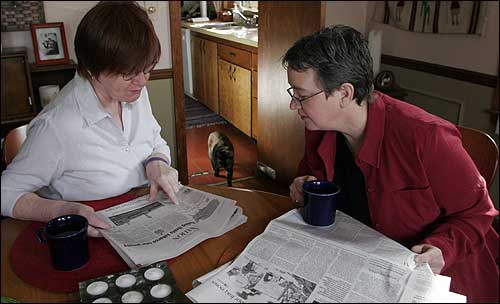
Lawrence residents Linda Gwaltney, left, and her partner, Paula Schumacher, are disappointed in attempts to ban gay marriage and civil unions in the state constitution and have even considered moving to Canada, where gay couples have the same rights as heterosexual ones.
“The Kansas amendment would not put homosexuals in a different position than they already are,” said Kobach, a conservative Republican who recently ran an unsuccessful campaign against U.S. Rep. Dennis Moore, D-Kan.
Man and woman
The proposed amendment has two parts.
The first part says marriage is defined as a civil contract between a man and a woman.
The equal protection clause of the United States Constitution says that states can’t pass laws that treat people unequally unless there is justifiable reason.
| Topeka — Just because there’s no candidate in the April 5 constitutional amendment election doesn’t mean campaign finance laws don’t apply.Carol Williams, director of the Kansas Governmental Ethics Commission, said anyone raising money or spending money to support or oppose the amendment banning same-sex marriage has to file a campaign finance report.Reports are due March 21 and April 20. |
“If the only reason for the law is to target a politically unpopular group, that’s not a legitimate basis,” said Richard Levy, a Kansas University constitutional law professor.
“Proponents of the amendment will say the purpose of the law is to protect marriage and that that’s a legitimate governmental purpose,” he said.
Kobach said the proposed amendment would pass constitutional muster, because recent U.S. Supreme Court decisions on equal protection cases have assured states that the court does not want to jeopardize the traditional marriage relationship.
Part B questions
But the second part of the amendment is the one that has caused the most outcry.
Section B states: “No relationship, other than marriage, shall be recognized by the state as entitling the parties to the rights or incidents of marriage.”

 Gay marriage ban in public’s hands (02-03-05)
What if a single parent assigned guardianship of his or her son to a sibling? Would the provision also prohibit a private company from extending insurance benefits to the partners of gay employees?
These kinds of issues are being litigated in other states with similar bans, including Nebraska.
Rich said the provision was so vague that it would “only become meaningful when a panel of judges tells us what it means.”
But Kobach said no court would construe the provision to affect other relationships.
And he said the state would have no authority to prevent private employee contracts where benefits could be extended to workers’ partners. Gays and lesbians, he added, can protect their rights of inheritance and powers of attorney through private contracts and wills.
‘Sub-citizen’
Kobach, however, said if the constitutional amendment were adopted it could be susceptible to a legal challenge by the full faith and credit clause of the U.S. Constitution, which says states must honor actions from other states.
If a gay couple were married in Massachusetts, where gay marriage is legal, and came to live in Kansas, would they be entitled to the rights of marriage here?
“There isn’t any precedent to say what the Supreme Court would do in this case,” Kobach said. He said that’s why there needs to be an amendment to the federal constitution to ensure that states don’t have to recognize gay marriages.
Geri Summers, the executive director of the Douglas County AIDS Project, said she hoped it didn’t come to that.
Summers and her partner of 20 years share a life together that in most aspects would be considered a marriage. They’ve bought a house together and have set up their finances together.
If the amendment passes, as most expect, Summers said it would be a great disappointment.
“This comes down to core issues,” Summers said. “What this is saying is that you see me as a sub-citizen.”
Gwaltney agreed.
“I’m a patriot,” she said. “I really believe in democracy, and to put these things in the constitution, I find very offensive.”
State Government
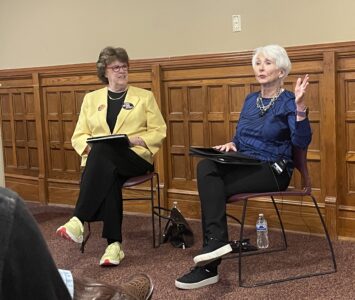
‘If it ain’t broke, don’t fix it’: Retired Judge Sally Pokorny tells residents why she opposes electing Supreme Court justices
KU professors would be limited in how they could present the idea of systemic racism in future classes
State legislators push back against federal energy regulators ending competitive bids
TOPEKA — Two Kansas legislators asked federal energy regulators to ensure competitive bidding occurs on ...
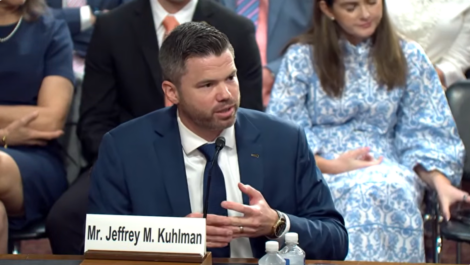
Senate confirms 1st of 3 Kansas nominees to U.S. District Court
Corporate income tax collections falling sharply in Kansas; Republican, Democratic leaders disagree on what it means
TOPEKA — Corporate income tax collections in Kansas have almost halved since last year, while other sources trend ...
Candidate’s campaign manager created website with documents used to attack rival
TOPEKA — Kansas U.S. Senate candidate Patrick Schmidt’s campaign manager left his digital footprint on ...