

Ragtime composer’s career is preserved in Missouri
Compositions illustrate the musical form's beginnings
Columbia, Mo. ? R. Michael Montgomery began his collection of “Blind” Boone memorabilia in 1965 after spotting an ad in a collectors newspaper for record catalogs.
He contacted Maxine Schoyer, whose father, Wayne Allen, was Boone’s manager late in the ragtime artist’s life.
Allen, who had a music store in Columbia, died in the 1950s. His daughter had saved documents relating to Boone, including a signed record contract, said Montgomery, of Southfield, Mich.
“I said, ‘I want to buy from you anything pertaining to ‘Blind’ Boone and the recording business,'” Montgomery recalled.
Montgomery’s collection is now back in Columbia after the Convention and Visitors Bureau bought it last month.
Among the items in the collection are three pieces of sheet music: Boone’s “Southern Rag Medley No. 1,” “Southern Rag Medley No. 2,” and the waltz “Love Feast.” The items also include a signed music contract of Boone’s, letters documenting Boone’s career and “lost” recordings that Boone made for Voycalstyle in Cincinnati.
Boone’s history
John William “Blind” Boone was born May 17, 1864, in Miami, Mo., about 75 miles northwest of Columbia. He was born to a runaway slave named Rachel, and some historians speculate his father was a Union officer.
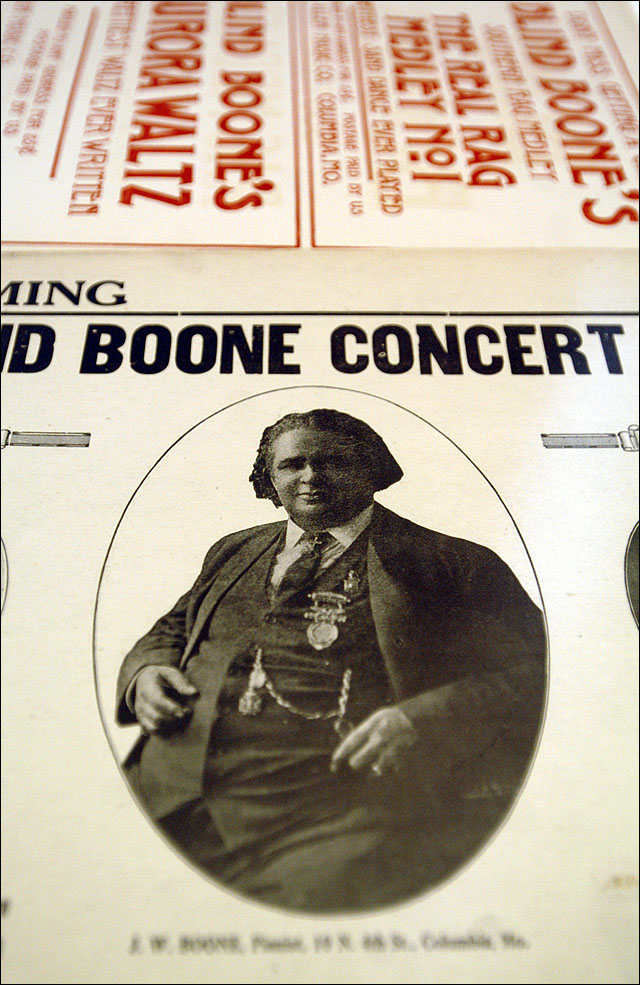
Sheet music written by John William Blind Boone and other publications about him were recently acquired by the city of Columbia, Mo., and are now stored in the Western Historical Manuscript Collection at Ellis Library on the University of Missouri campus in Columbia.
As an infant, Boone suffered from a disease that doctors called “brain fever,” possibly meningitis or encephalitis, said Lucille Salerno, president emerita of the John William Boone Heritage Foundation. To save his life, doctors removed his eyes in a drastic surgical procedure, according to a Boone history compiled by Salerno.
“Boone said later in his life that he would not have been so successful had he not been blind, because it was just a world of sound,” Salerno said.
Boone is known for his musical gift. Montgomery said the musician could hear tunes on the piano and play back approximations. Boone could pound the piano keys to imitate the sound of a rainstorm or thunder, or tickle them to mimic the sound of a Dutch music box.
‘It doesn’t belong on eBay’
Montgomery, a piano player and collector of piano rolls, sheet music, records and other musical documentation, said every collector reaches a point when he’s finished. He sold the Boone collection to the city because he wanted to ensure the documents ended up in the right place.
“It doesn’t belong on eBay; it belongs in Columbia, and that’s where it is now,” he said.
Montgomery is especially interested in ragtime sheet music and sheet music of importance, he said. He began collecting because of his interest in music. His favorite Boone piece is “Gavotte Chromatique.”
In Boone’s concert performances, he mainly focused on the compositions of Chopin, Brahms and Liszt. His compositions were a side activity, Salerno said.
“To lighten the musical experience, Boone would announce, ‘I’m going to put the cookies on a lower shelf so that everyone can get them,”‘ Salerno said. Then he would break into ragtime.
Historical importance
Salerno said Boone’s ragtime compositions are important historically because they illustrate the genesis of ragtime. Boone is known as a folk ragtime artist, one who composed an early form of ragtime that repackaged melodies in the form of syncopation. This was the precursor to Scott Joplin’s classic ragtime, in which he applied a formal construction to ragtime.
“I believe that Boone has been neglected because he spent his career more in performing than in composing, so there is no large store of music in print as there was with Scott Joplin,” Jack Batterson, author of “Blind Boone: Missouri’s Ragtime Pioneer,” said. “Also, his blindness made composition more difficult and no doubt limited what he could do in his whole career.”
“It will be very helpful to have these documents on display because visitors to the museum will have a chance to see primary material about Boone,” Batterson said.
One find the city bought is an original recording contract of Boone’s from 1912 complete with his signature – an ‘X.’ Lorah Steiner, executive director of the Convention and Visitors Bureau, said that piece alone could potentially have cost as much as the entire collection. The price of such a historical document, Steiner said, depends on its rarity.
Montgomery sold the collection for $5,000, or what he called “fair market value.” Steiner said the Convention and Visitors Bureau Advisory Board unanimously approved the purchase.
Steiner said Montgomery’s documents are thought to be the largest privately held collection of documents regarding Boone, and city officials felt it was important to possess them.
“We were thrilled, and that’s probably the understatement of the millennium,” Steiner said.
Restoration of home
The City Council authorized the purchase of letters, sheet music and other memorabilia, and the documents might one day be displayed in the city-owned Blind Boone home in Columbia, which is being restored as a museum that will serve as “a testament to (Boone’s) life, and to Columbia’s African-American heritage.”
The outside of the Boone home will be fully restored this year, Salerno said. The city and the Boone foundation are raising money to convert the interior.
The University of Missouri’s Western Historical Manuscript Collection at Ellis Library is storing the documents in acid-free paper for now. The city can ask for them at any time.
State Government
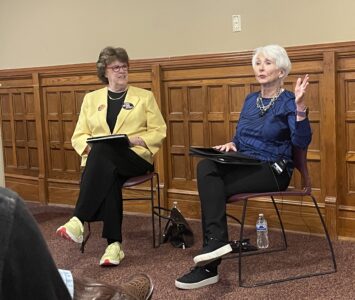
‘If it ain’t broke, don’t fix it’: Retired Judge Sally Pokorny tells residents why she opposes electing Supreme Court justices

KU professors would be limited in how they could present the idea of systemic racism in future classes
State legislators push back against federal energy regulators ending competitive bids
TOPEKA — Two Kansas legislators asked federal energy regulators to ensure competitive bidding occurs on ...
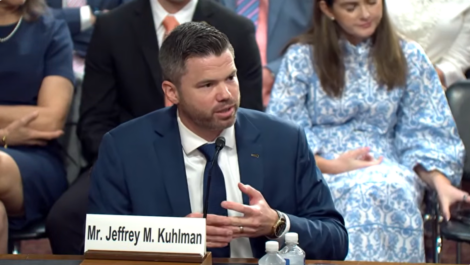
Senate confirms 1st of 3 Kansas nominees to U.S. District Court
Corporate income tax collections falling sharply in Kansas; Republican, Democratic leaders disagree on what it means
TOPEKA — Corporate income tax collections in Kansas have almost halved since last year, while other sources trend ...
Candidate’s campaign manager created website with documents used to attack rival
TOPEKA — Kansas U.S. Senate candidate Patrick Schmidt’s campaign manager left his digital footprint on ...